


Non-professional caregiver burden is associated with the severity of patients' cognitive impairment
- PMID: 30521532
- PMCID: PMC6283568
- DOI: 10.1371/journal.pone.0204110
Non-professional caregiver burden is associated with the severity of patients' cognitive impairment
Abstract
Background/objectives: To analyse the relationship between caregiver burden and severity of patients' cognitive impairment.
Design: Data were drawn from the cross-sectional 2015/2016 Adelphi Real World Dementia Disease-Specific Programme.
Setting: This research was multi-national and studied physicians and their consulting patients with cognitive impairment.
Participants: 1,201 caregivers completed self-assessment forms.
Measurements: Validated instruments of caregiver wellbeing and burden (EQ-5D-3L questionnaire, EQ-VAS, Zarit Burden Interview, and Work Productivity and Activity Impairment questionnaire) and number of caregiver hours were analysed by severity of patients' cognitive impairment, categorised according to the Mini-Mental State Examination. Data were analysed using Spearman's rank correlation coefficients and ordinary least squares regression models, to compare outcomes between caregivers of patients with prodromal, mild, moderate, and severe dementia.
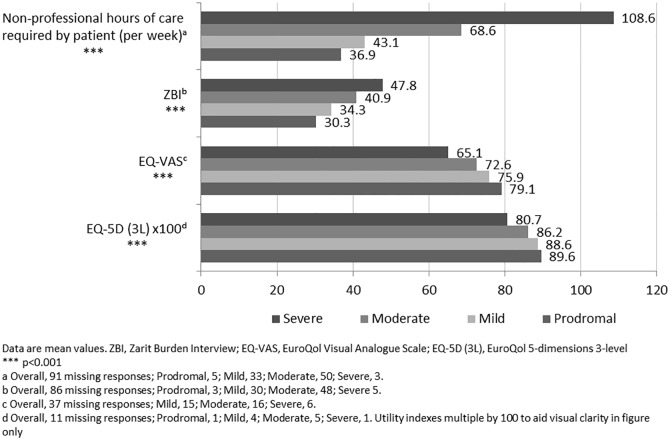
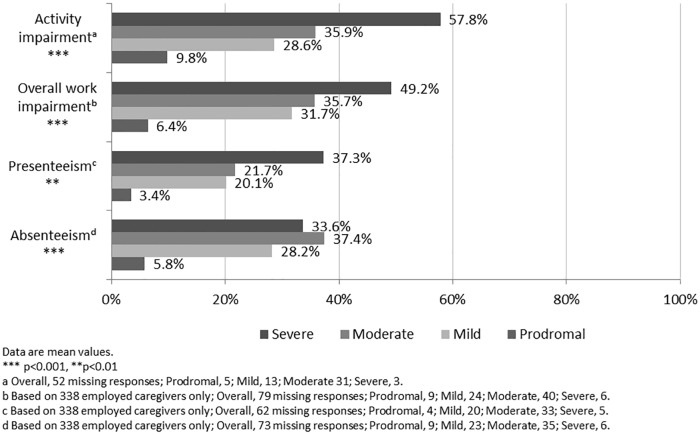
Results: The majority of caregivers were female (69.1%), lived with the patient they cared for (75.8%), and only approximately one third (28.3%) were in part- or full-time employment. There were statistically significant (p<0.001) increases in caregiver time (36.9 versus 108.6 hours per week for prodromal versus severe dementia, respectively) and measures of caregiver burden and health status (EQ-5D-3L, EQ-VAS, and Zarit Burden Interview) and increases in measures of work productivity and activity impairment with increasing severity of patients' disease.
Conclusion: This study of real-world data confirmed an association between increased caregiver burden and severity of patients' cognitive impairment by analysis of a wide range of validated measures of caregiver burden. These findings suggest that maintaining patients in the earliest stages of their disease for as long as possible may potentially help to protect caregiver wellbeing, although further research is required to confirm this hypothesis.
Conflict of interest statement
I have read the journal’s policy and the authors of this manuscript have the following competing interests. Christopher M. Black, Rezaul K. Khandker, Xiaohan Hu, Baishali M. Ambegaonkar, are all current or previous employees of Merck & Co who funded the research. Robert Wood and Eddie Jones are employees of Adelphi Real World which was paid by Merck for conducting the research. Craig W. Ritchie, received consultancy fees from Merck. This does not alter our adherence to PLOS ONE policies on sharing data and materials.
Figures
References
-
- Prince M, Bryce R, Albanese E, Wimo A, Ribeiro W, Ferri CP. The global prevalence of dementia: a systematic review and metaanalysis. Alzheimers Dement. 2013;9(1):63–75. 10.1016/j.jalz.2012.11.007 - DOI - PubMed
-
- Peterson RC. Mild cognitive impairment as a diagnostic entity. J Intern Med. 2004;256(3):183–94. 10.1111/j.1365-2796.2004.01388.x - DOI - PubMed
-
- Arevalo-Rodriguez I, Smailagic N, Roqué I Figuls M, Ciapponi A, Sanchez-Perez E, Giannakou A, et al. Mini-Mental State Examination (MMSE) for the detection of Alzheimer’s disease and other dementias in people with mild cognitive impairment (MCI). Cochrane Database Syst Rev. 2015;Issue 3: CD010783. - PMC - PubMed
Publication types
MeSH terms
LinkOut - more resources
Full Text Sources
Medical
