


Tobacco and cannabis co-use and interrelatedness among adults
- PMID: 30522075
- PMCID: PMC6342479
- DOI: 10.1016/j.addbeh.2018.11.036
Tobacco and cannabis co-use and interrelatedness among adults
Abstract
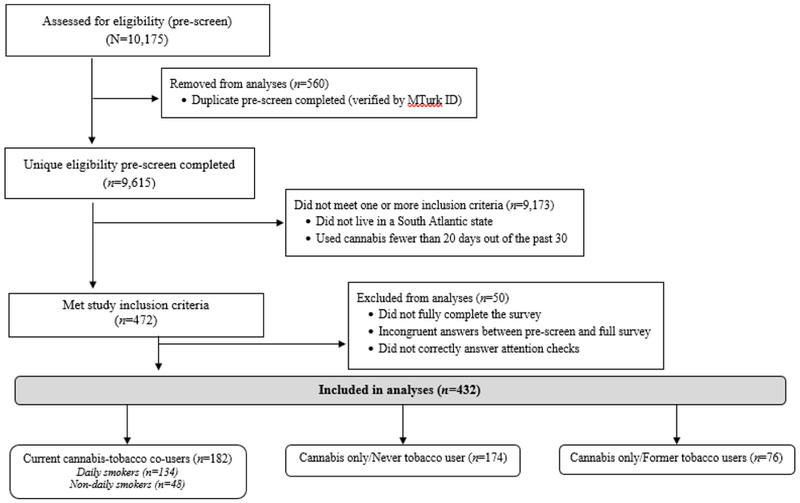
Cannabis and tobacco co-use is prevalent, but consensus regarding the reasons for co-use among adults and the degree of interrelatedness between these substances is lacking. Reasons for co-use have been explored with younger users, but little data exists for more experienced users with entrenched patterns of co-use. The goal of this study was to examine characteristics and patterns of cannabis-tobacco co-use among adults in the Southeastern United States (US), where there is a legal landscape of generally restrictive cannabis legislation coupled with more permissive tobacco control compared to other US regions. Participants (N = 432) were regular cannabis users recruited through Amazon Mechanical Turk. Measures included demographics, patterns of cannabis and tobacco use, and reasons for co-use. Within this sample, 42% were current users of tobacco (n = 182). Cannabis-tobacco co-users were older and had more years of cannabis use than cannabis-only users. Among the co-using sub-sample, there was little consistency in the reasons for co-use, suggesting individual differences in the use of both substances. High levels of cannabis-tobacco interrelatedness (i.e., temporally concurrent use) were associated with smoking more cigarettes (tobacco) per day and greater nicotine dependence scores when compared to users with low levels of interrelatedness. Though these results are limited by a small sample size and generalizability issues, there were individual differences in cannabis-tobacco relatedness, which may be of importance when considering treatment strategies for cannabis, tobacco, or both. With additional research, personalized strategies adapted to cannabis-tobacco relatedness profiles among co-users may be warranted as a treatment strategy.
Keywords: Cannabis; Co-use; Marijuana; Nicotine; Polysubstance use; Tobacco.
Copyright © 2018 Elsevier Ltd. All rights reserved.
Conflict of interest statement
Conflicts of Interest
None to declare.
References
Publication types
MeSH terms
Grants and funding
LinkOut - more resources
Full Text Sources
Medical
