. 2018 Dec 6;17(1):276.
doi: 10.1186/s12944-018-0910-6.

Cordycepin reduces weight through regulating gut microbiota in high-fat diet-induced obese rats

Affiliations

Cordycepin reduces weight through regulating gut microbiota in high-fat diet-induced obese rats

Yanan An et al. Lipids Health Dis. .

Abstract

Background: An increasing number of studies have shown that obesity is the key etiological agent of cardiovascular diseases, nonalcoholic fatty liver disease, type 2 diabetes and several kinds of cancer and that gut microbiota change was one of the reasons suffering from obesity. At present, the gut microbiota has gained increased attention as a potential energy metabolism organ. Our recent study reported that cordycepin, a major bioactive component separated from Cordyceps militaris, prevented body weight gain in mice fed a high-fat diet directly acting to adipocytes, however, the effect of cordycepin regulating gut microbiota keeps unknown.

Methods: In this research, we synthesized cordycepin (3-deoxyadenosine) by chemical methods and verified that cordycepin reduces body weight gain and fat accumulation around the epididymis and the kidneys of rats fed a high-fat diet. Furthermore, we used high-throughput sequencing on a MiSeq Illumina platform to test the species of intestinal bacteria in high-fat-diet-induced obese rats.

Results: We found that cordycepin modifies the relative abundance of intestinal bacteria in high-fat-diet-induced obese rats. However, cordycepin did not alter the variety of bacteria in the intestine. Cordycepin treatment dramatically reversed the relative abundance of two dominant bacterial phyla (Bacteroidetes and Firmicutes) in the high-fat-diet-induced obese rats, resulting in abundance similar to that of the chow diet group.

Conclusion: Our study suggests that cordycepin can reduce body weight and microbiome done by cordycepin seems be a result among its mechanisms of obesity reduction.

Keywords: Body weight; Cordycepin; Fat; Gut microbiota; Obesity.


Conflict of interest statement

Ethics approval and consent to participate

Not applicable.

Consent for publication

All authors read and approve the final manuscript.

Competing interests

The authors declare that they have no competing interests.

Publisher’s Note

Springer Nature remains neutral with regard to jurisdictional claims in published maps and institutional affiliations.

Figures
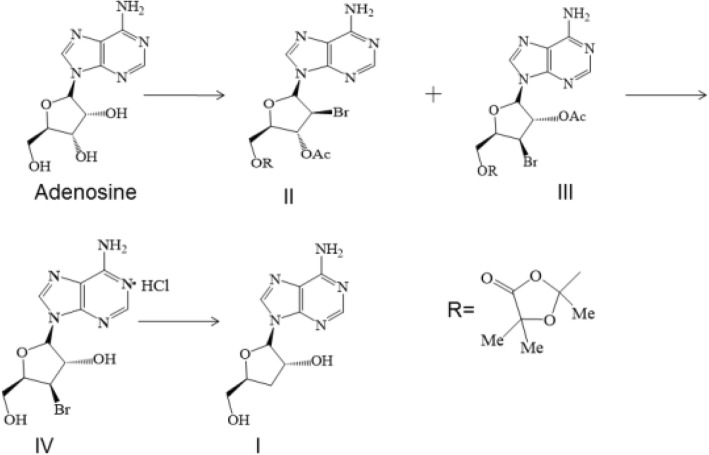
Fig. 1
Fig. 1
Synthetic route and chemical structure of cordycepin. (I) Cordycepin. (II, III, IV) intermediate products
Fig. 2
Fig. 2
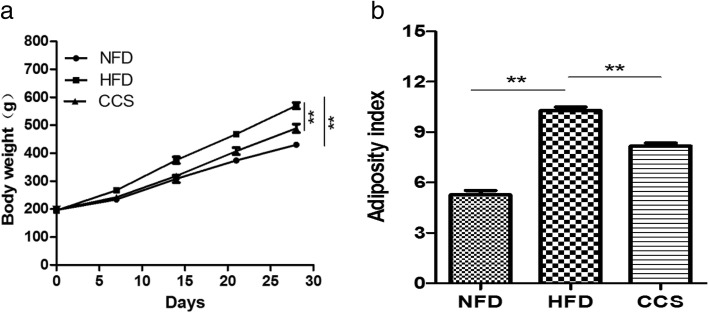
Anti-obesity effects of cordycepin in high-fat-diet-induced obese rats. (a) Body weight. (b) Adiposity index, calculated according to the following formula: 100 × (epididymal fat weight + perirenal fat weight)/body weight. Differences were assessed by one-way ANOVA, (*P < 0.05, **P < 0.01, ***P < 0.001). NFD means the rats were fed a normal diet; HFD meansthe rats were fed a high-fat diet; CCS means the rats were fed a high-fat diet and received cordycepin (50 mg/kg) for 4 weeks continuously
Fig. 3
Fig. 3
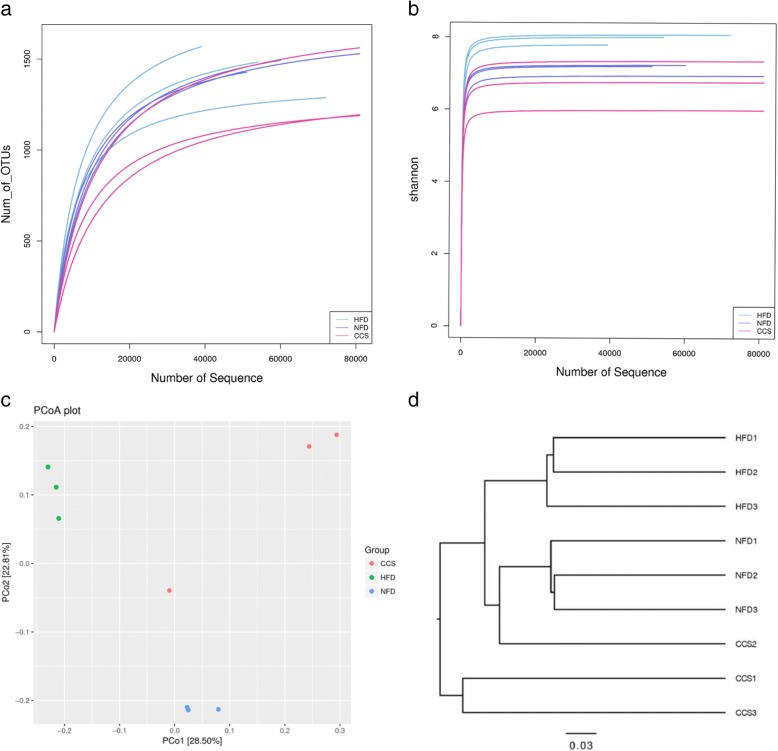
Diversity and richness of the gut microbiota in rats. (a) Displays the rarefaction curves of samples from the NFD group, HFD group and CCS group. (b) Displays the Shannon index of samples from the NFD group, HFD group and CCS group. (c) PCoA plot. Principal component analysis (PCA) scores plot of gut microbiota based on the relative abundance of OTUs. (d) Cluster analysis, unweighted uniFrac-OTU table. NFD means that the rats were fed a normal diet (n = 3), HFD meansthe rats were fed a high-fat diet (n = 3), and CCS meansthe rats were fed a high-fat diet and received cordycepin (50 mg/kg) (n = 3) for 4 weeks continuously
Fig. 4
Fig. 4
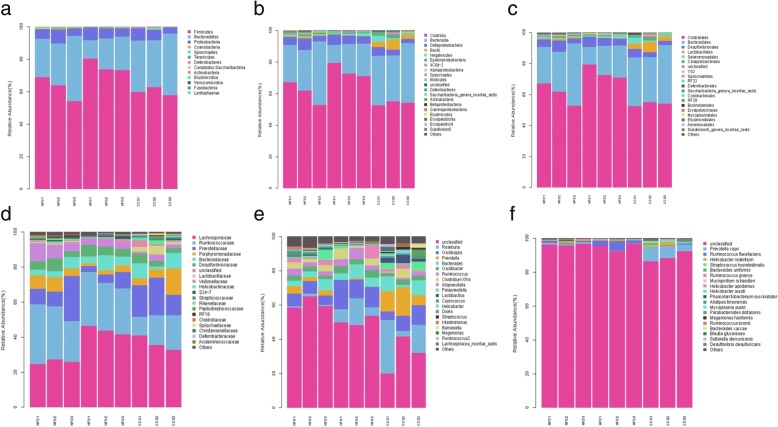
Composition analysis of gut microbiota at different taxonomic levels among all samples. (a) Phylum. (b) Class. (c) Order. (d) Family. (e) Genus. (f) Species. Only the top 20 most abundant OTUs are displayed. NFD means that the rats were fed a normal diet (n = 3), HFD meansthe rats were fed a high-fat diet (n = 3), and CCS means the rats were fed a high-fat diet and received cordycepin (50 mg/kg) (n = 3) for 4 weeks continuously
Fig. 5
Fig. 5
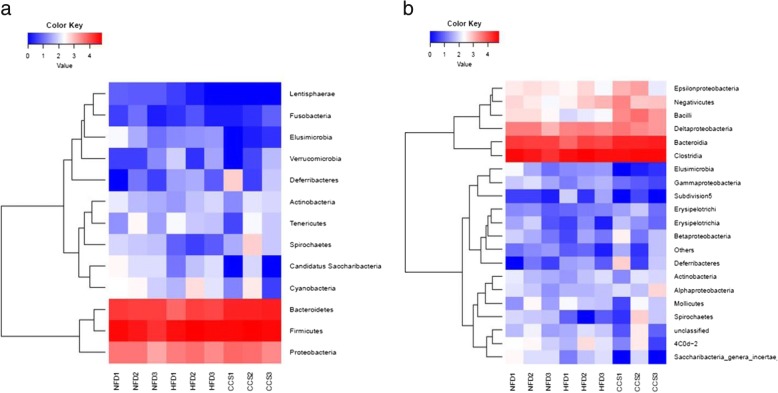
Heatmap analysis of gut microbiota changes from different treatments. (a) Phylum. (b) Class.The color intensity in each sample is normalized to represent its relative ratio in the three groups. A range of colors, from blue to red, indicates the relative values of microbiota (0–4). NFD means that the rats were fed a normal diet (n = 3), HFD meansthe rats were fed a high-fat diet (n = 3), and CCS meansthe rats were fed a high-fat diet andreceived cordycepin (50 mg/kg) (n = 3)for 4 weeks continuously

References

    1. Everard A, Belzer C, Geurts L, Ouwerkerk JP, Druart C, Bindels LB, Guiot Y, Derrien M, Muccioli GG, Delzenne NM, et al. Cross-talk between Akkermansia muciniphila and intestinal epithelium controls diet-induced obesity. Proc Natl Acad Sci U S A. 2013;110:9066–9071. doi: 10.1073/pnas.1219451110. - DOI - PMC - PubMed
    1. Seidell JC, Halberstadt J. The global burden of obesity and the challenges of prevention. Ann Nutr Metab. 2015;66(Suppl 2):7–12. doi: 10.1159/000375143. - DOI - PubMed
    1. Cani PD. Gut microbiota and obesity: lessons from the microbiome. Brief Funct Genomics. 2013;12:381–387. doi: 10.1093/bfgp/elt014. - DOI - PubMed
    1. Villanueva-Millan MJ, Perez-Matute P, Oteo JA. Gut microbiota: a key player in health and disease. A review focused on obesity. J Physiol Biochem. 2015;71:509–525. doi: 10.1007/s13105-015-0390-3. - DOI - PubMed
    1. Seo DB, Jeong HW, Cho D, Lee BJ, Lee JH, Choi JY, Bae IH, Lee SJ. Fermented green tea extract alleviates obesity and related complications and alters gut microbiota composition in diet-induced obese mice. J Med Food. 2015;18:549–556. doi: 10.1089/jmf.2014.3265. - DOI - PubMed

MeSH terms