


Insulin Clearance After Oral and Intravenous Glucose Following Gastric Bypass and Gastric Banding Weight Loss
- PMID: 30523032
- PMCID: PMC6341286
- DOI: 10.2337/dc18-1036
Insulin Clearance After Oral and Intravenous Glucose Following Gastric Bypass and Gastric Banding Weight Loss
Abstract
Objective: Hepatic insulin clearance is a significant regulator of glucose homestasis. We hypothesized that the improvement in insulin clearance rates (ICRs) under fasting conditions and in response to oral and intravenous (IV) glucose would improve similarly after Roux-en-Y gastric bypass (RYGB) and adjustable gastric banding (AGB) as a function of weight loss; the difference in ICR after oral and IV glucose stimulation will be enhanced after RYGB compared with AGB, an effect mediated by glucagon-like peptide 1 (GLP-1).
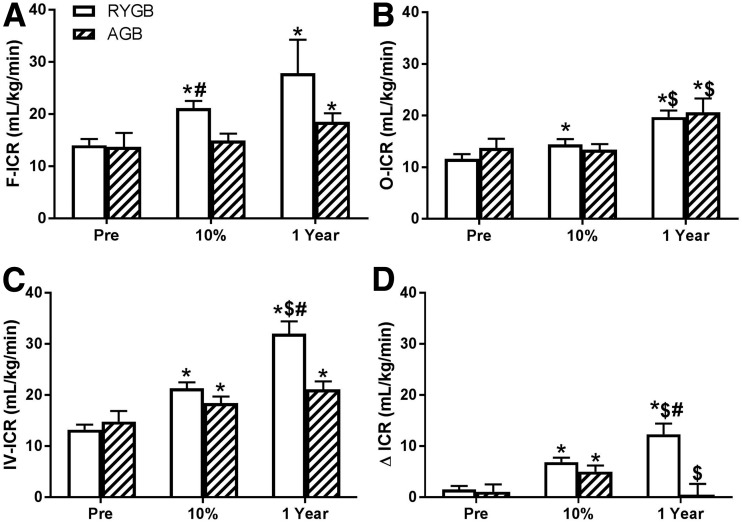
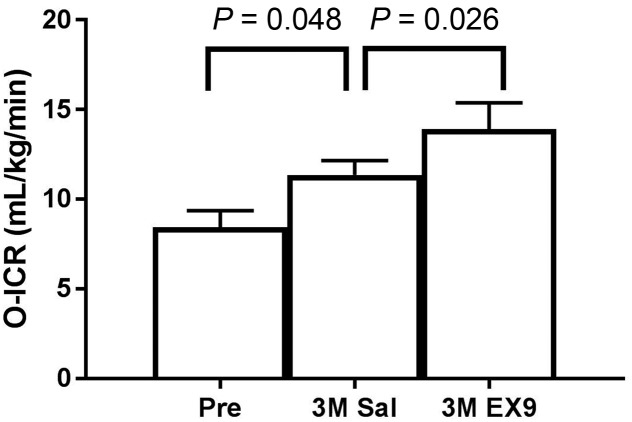
Research design and methods: In study 1, the ICR was calculated under fasting condition (F-ICR), after oral glucose (O-ICR), and after an isoglycemic IV glucose clamp (IV-ICR) in individuals from an established cohort with type 2 diabetes mellitus (T2DM) before, after 10% matched weight loss, and 1 year after either RYGB (n = 22) or AGB (n = 12). In study 2, O-ICR was studied in a separate cohort of individuals with T2DM (n = 22), before and 3 months after RYGB, with and without exendin(9-39) infusion.
Results: In study 1, age, BMI, T2DM duration and control, and ICR did not differ between RYGB and AGB preintervention. Weight loss at 1 year was two times greater after RYGB than after AGB (31.6 ± 5.9% vs. 16.6 ± 9.8%; P < 0.05). RYGB and AGB both significantly increased F-ICR, O-ICR, and IV-ICR at 1 year. ICR was inversely associated with insulinemia. The difference between IV-ICR and O-ICR was significantly greater after RYGB versus AGB. GLP-1 antagonism with exendin(9-39) led to an increase in O-ICR in subjects post-RYGB.
Conclusions: Weight loss increased ICR, an effect more pronounced after RYGB compared with AGB. Our data support a potential role for endogenous GLP-1 in the control of postprandial ICR after RYGB.
Trial registration: ClinicalTrials.gov NCT02287285.
© 2018 by the American Diabetes Association.
Figures
References
-
- Després JP, Lamarche B, Mauriège P, et al. Hyperinsulinemia as an independent risk factor for ischemic heart disease. N Engl J Med 1996;334:952–957 - PubMed
-
- Kim SH, Reaven GM. Insulin clearance: an underappreciated modulator of plasma insulin concentration. J Investig Med 2016;64:1162–1165 - PubMed
-
- Ferrannini E, Wahren J, Faber OK, Felig P, Binder C, DeFronzo RA. Splanchnic and renal metabolism of insulin in human subjects: a dose-response study. Am J Physiol 1983;244:E517–E527 - PubMed
-
- Meistas MT, Margolis S, Kowarski AA. Hyperinsulinemia of obesity is due to decreased clearance of insulin. Am J Physiol 1983;245:E155–E159 - PubMed
Publication types
MeSH terms
Substances
Associated data
Grants and funding
LinkOut - more resources
Full Text Sources
Other Literature Sources
Medical
Research Materials
