


Is antagonistic pleiotropy ubiquitous in aging biology?
- PMID: 30524730
- PMCID: PMC6276058
- DOI: 10.1093/emph/eoy033
Is antagonistic pleiotropy ubiquitous in aging biology?
Abstract
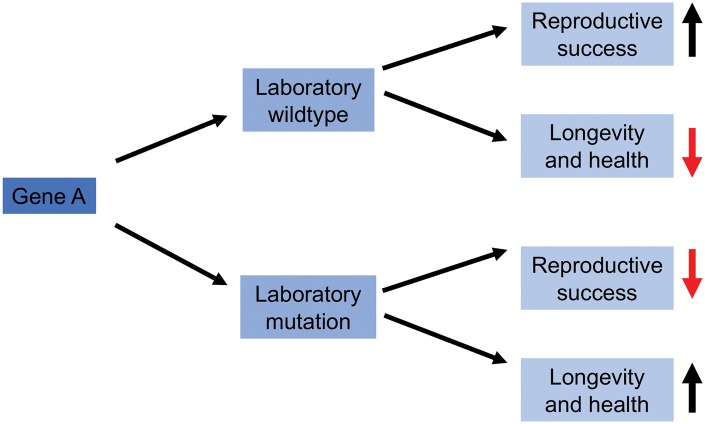
Lay Summary: An evolutionary mechanism of aging was hypothesized 60 years ago to be the genetic trade-off between early life fitness and late life mortality. Genetic evidence supporting this hypothesis was unavailable then, but has accumulated recently. These tradeoffs, known as antagonistic pleiotropy, are common, perhaps ubiquitous. George Williams' 1957 paper developed the antagonistic pleiotropy hypothesis of aging, which had previously been hinted at by Peter Medawar. Antagonistic pleiotropy, as it applies to aging, hypothesizes that animals possess genes that enhance fitness early in life but diminish it in later life and that such genes can be favored by natural selection because selection is stronger early in life even as they cause the aging phenotype to emerge. No genes of the sort hypothesized by Williams were known 60 years ago, but modern molecular biology has now discovered hundreds of genes that, when their activity is enhanced, suppressed, or turned off, lengthen life and enhance health under laboratory conditions. Does this provide strong support for Williams' hypothesis? What are the implications of Williams' hypothesis for the modern goal of medically intervening to enhance and prolong human health? Here we briefly review the current state of knowledge on antagonistic pleiotropy both under wild and laboratory conditions. Overall, whenever antagonistic pleiotropy effects have been seriously investigated, they have been found. However, not all trade-offs are directly between reproduction and longevity as is often assumed. The discovery that antagonistic pleiotropy is common if not ubiquitous implies that a number of molecular mechanisms of aging may be widely shared among organisms and that these mechanisms of aging can be potentially alleviated by targeted interventions.
Keywords: aging; antagonistic pleiotropy; evolution of aging; senescence.
Figures
References
-
- Williams GC. Pleiotropy, natural selection, and the evolution of senescence. Evolution 1957;11:398–411.
-
- Medawar PB. An Unsolved Problem in Biology. London: H.K; Lewis, 1952.
-
- Gaillard JM, Lemaitre JF.. The Williams' legacy: a critical reappraisal of his nine predictions about the evolution of senescence. Evolution 2017;71:2768–85. - PubMed
-
- Kenyon C, Chang J, Gensch E. et al. A C. elegans mutant that lives twice as long as wild type. Nature 1993;366:461–4. - PubMed
Publication types
Grants and funding
LinkOut - more resources
Full Text Sources
Other Literature Sources
