Review
. 2018 Nov 22:6:172.
doi: 10.3389/fbioe.2018.00172. eCollection 2018.

3D Printing-Encompassing the Facets of Dentistry

Affiliations
Review

3D Printing-Encompassing the Facets of Dentistry

Gunpreet Oberoi et al. Front Bioeng Biotechnol. .

Abstract

This narrative review presents an overview on the currently available 3D printing technologies and their utilization in experimental, clinical and educational facets, from the perspective of different specialties of dentistry, including oral and maxillofacial surgery, orthodontics, endodontics, prosthodontics, and periodontics. It covers research and innovation, treatment modalities, education and training, employing the rapidly developing 3D printing process. Research-oriented advancement in 3D printing in dentistry is witnessed by the rising number of publications on this topic. Visualization of treatment outcomes makes it a promising clinical tool. Educational programs utilizing 3D-printed models stimulate training of dental skills in students and trainees. 3D printing has enormous potential to ameliorate oral health care in research, clinical treatment, and education in dentistry.

Keywords: 3D printing; additive manufacturing; bioprinting; dentistry; education; tissue engineering.


Figures
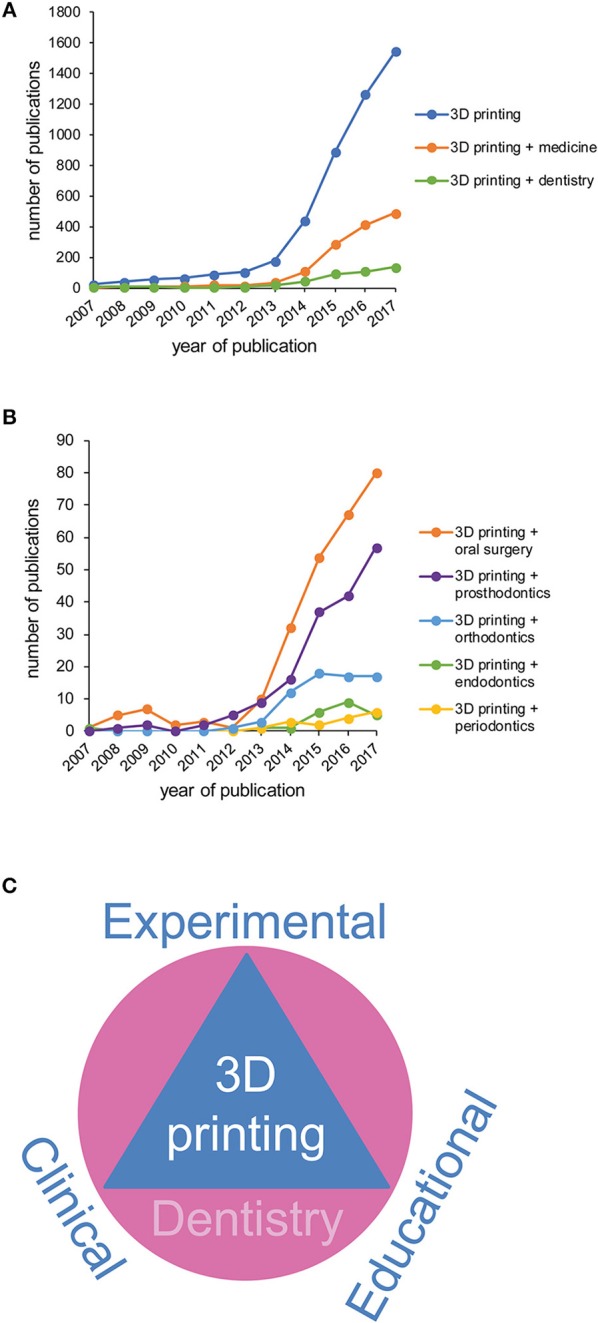
Figure 1
Figure 1
Increasing publication numbers in 3D printing for a variety of dental specialties. (A) Number of publications on 3D printing in general and 3D printing in medicine or dentistry in particular (Pubmed.gov; Search date: 01-25-2018; Search algorithm: “3D printing”; “3D printing” AND medicine; “3D printing” AND dentistry) from 2007-2017. (B) Number of publications on 3D printing in a variety of dental specialties (Pubmed.gov; Search date: 01-25-2018; Search algorithm: “3D printing” AND “oral surgery”; “3D printing” AND “endodontics”; “3D printing” AND “periodontics”; “3D printing” AND “endodontics”; “3D printing” AND “orthodontics”; “3D printing” AND “prosthodontics”) from 2007-2017. (C) Applications for 3D printing in dentistry include experimental, clinical and educational approaches.
Figure 2
Figure 2
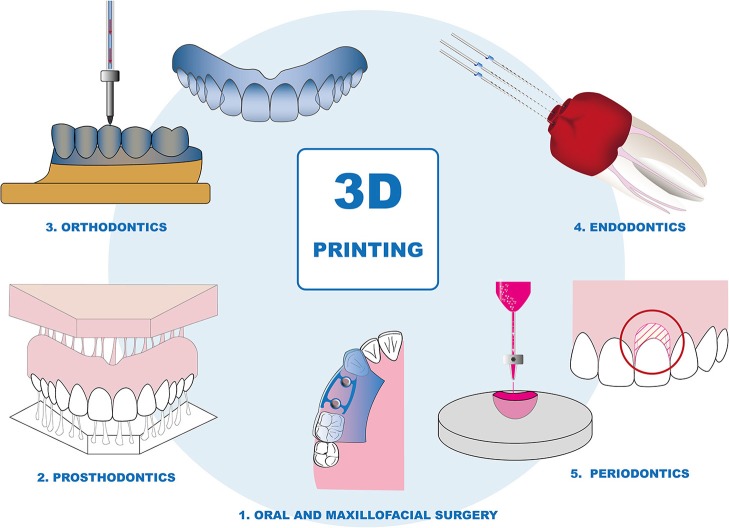
Schematic representation of possible applications of 3D printing in dentistry. Manufacturing anatomical models, guides, and scaffolds for bone defects in oral and maxillofacial surgery; 3D printed dentures and prosthesis in prosthodontics; 3D printed dental models and clear aligners in Orthodontics; Computed tomography based endodontic guides for Root canal treatments; 3D printed scaffolds in Periodontics.
Figure 3
Figure 3
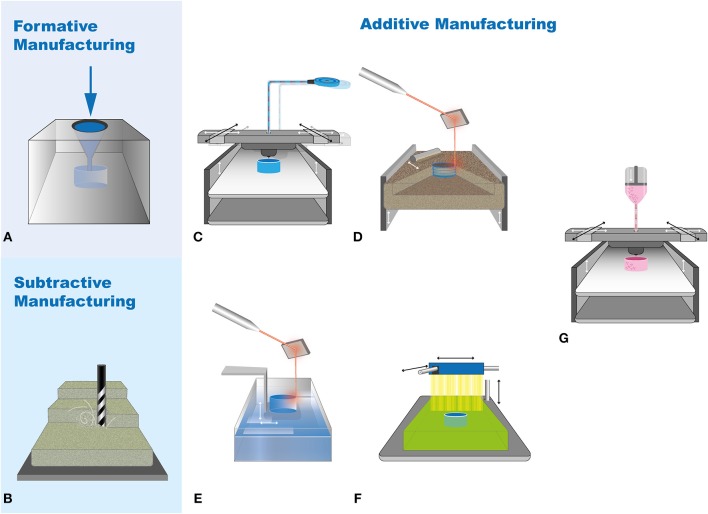
Overview on the different manufacturing approaches. Conventional approaches comprising (A) Formative, (B) Subtractive manufacturing; widely applied additive manufacturing methods including (C) Fused deposition modeling (FDM), (D) Selective laser sintering (SLS), (E) Stereolithography (SLA), (F) Polyjet and (G) Bioprinting. Adopted from (Knowlton et al., ; Ji and Guvendiren, ; Ligon et al., 2017).
Figure 4
Figure 4
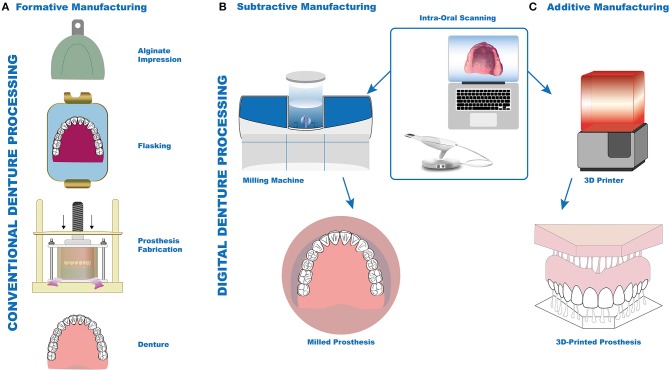
Conventional and digital prosthesis fabrication approaches. Conventional approach for denture fabrication by alginate impression and flasking method (A, Formative manufacturing). Digital approach with intra-oral scanning-based impression; manufacturing of denture either by CAD/CAM (B, subtractive manufacturing) or 3D printer (C, additive manufacturing).

References

    1. Abella F., Ribas F., Roig M., González Sánchez J. A., Durán-Sindreu F. (2018). Outcome of autotransplantation of mature third molars using 3-dimensional-printed guiding templates and donor tooth replicas. J. Endod. 44, 1567–1574. 10.1016/j.joen.2018.07.007 - DOI - PubMed
    1. Al Mortadi N., Eggbeer D., Lewis J., Williams R. J. (2012). CAD/CAM/AM applications in the manufacture of dental appliances. Am. J. Orthod. Dentofacial Orthop. 142, 727–733. 10.1016/j.ajodo.2012.04.023 - DOI - PubMed
    1. Alharbi N., Alharbi S., Cuijpers V. M. J. I., Osman R. B., Wismeijer D. (2017). Three-dimensional evaluation of marginal and internal fit of 3D-printed interim restorations fabricated on different finish line designs. J. Prosthodont. Res. 62, 218–226. 10.1016/j.jpor.2017.09.002 - DOI - PubMed
    1. Almela T., Al-Sahaf S., Brook I. M., Khoshroo K., Rasoulianboroujeni M., Fahimipour F., et al. (2018). 3D printed tissue engineered model for bone invasion of oral cancer. Tissue Cell 52, 71–77. 10.1016/j.tice.2018.03.009 - DOI - PubMed
    1. Anderson J., Wealleans J., Ray J. (2018). Endodontic applications of 3D printing. Int. Endod. J. 51, 1005–1018. 10.1111/iej.12917 - DOI - PubMed

LinkOut - more resources