


Aggressive Behaviors in Alzheimer Disease and Mild Cognitive Impairment: Systematic Review and Meta-Analysis
- PMID: 30527275
- PMCID: PMC6399100
- DOI: 10.1016/j.jagp.2018.10.008
Aggressive Behaviors in Alzheimer Disease and Mild Cognitive Impairment: Systematic Review and Meta-Analysis
Abstract
Objective: We aim to estimate the risk of perpetrating aggression in Alzheimer disease (AD) and mild cognitive impairment (MCI) by conducting a systematic review and meta-analysis of primary studies.
Methods: A systematic search was conducted in six bibliographic databases according to a preregistered protocol. Studies that reported aggressive behaviors in individuals with AD and MCI compared with healthy individuals or those with other dementia etiologies were identified. Risks of aggressive behaviors were assessed using random effects models to calculate pooled odds ratios (ORs). Publication bias was examined.
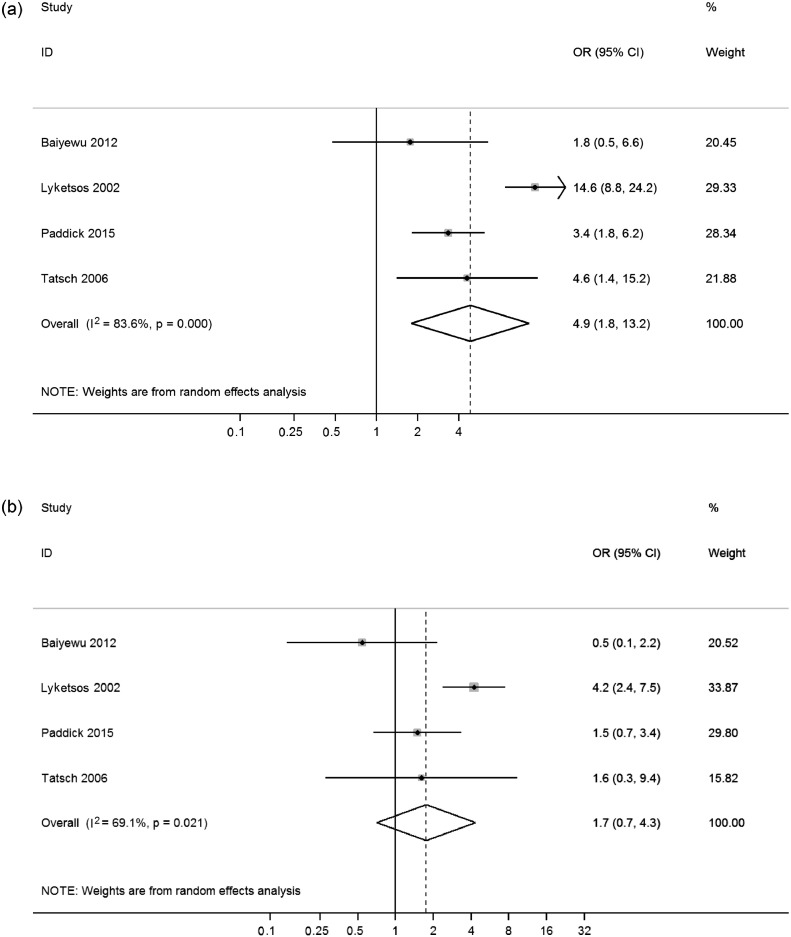
Results: In total, 17 studies involving 6,399 individuals with AD and 2,582 with MCI were identified. Compared with healthy individuals, significantly increased risks of aggressive behaviors were found in AD (OR, 4.9, 95% CI, 1.8-13.2) but not in MCI (OR, 1.8, 95% CI, 0.7-4.3). When comparing AD with MCI, the risk in AD was higher (OR, 2.6, 95% CI, 1.7-4.0). We found no differences in risk of aggressive behaviors between AD and other dementia subtypes or between amnestic and nonamnestic MCI.
Conclusion: Individuals with AD are at higher risk of manifesting aggressive behaviors than healthy individuals or those with MCI. Our findings not only underscore the necessity of treatment of aggressive behaviors in AD but also highlight the importance of preventing the transition from MCI to AD.
Keywords: Alzheimer disease; aggressive behaviors; mild cognitive impairment; systematic review.
Copyright © 2018 The Authors. Published by Elsevier Inc. All rights reserved.
Figures



References
-
- Kuronen M, Kautiainen H, Karppi P. Antipsychotic drug use and associations with neuropsychiatric symptoms in persons with impaired cognition: a cross-sectional study. Nord J Psychiatry. 2016;70:621–625. - PubMed
-
- Lövheim H, Sandman PO, Kallin K. Relationship between antipsychotic drug use and behavioral and psychological symptoms of dementia in old people with cognitive impairment living in geriatric care. Int Psychogeriatr. 2006;18:713–726. - PubMed
-
- Schneider LS, Dagerman KS, Insel P. Risk of death with atypical antipsychotic drug treatment for dementia: meta-analysis of randomized placebo-controlled trials. JAMA. 2005;294:1934–1943. - PubMed
-
- Barnett R, Stirling C, Pandyan AD. A review of the scientific literature related to the adverse impact of physical restraint: gaining a clearer understanding of the physiological factors involved in cases of restraint-related death. Med Sci Law. 2012;52:137–142. - PubMed
Publication types
MeSH terms
Grants and funding
LinkOut - more resources
Full Text Sources
Medical
