. 2019 Feb 1:199:343-350.
doi: 10.1016/j.physbeh.2018.12.007. Epub 2018 Dec 4.

3,4-methylenedioxymethamphetamine (MDMA) impairs the extinction and reconsolidation of fear memory in rats

Affiliations

3,4-methylenedioxymethamphetamine (MDMA) impairs the extinction and reconsolidation of fear memory in rats

Holly S Hake et al. Physiol Behav. .

Abstract

Clinical trials have demonstrated that 3,4-methylenedioxymethamphetamine (MDMA) paired with psychotherapy is more effective at reducing symptoms of post-traumatic stress disorder (PTSD) than psychotherapy or pharmacotherapy, alone or in combination. The processes through which MDMA acts to enhance psychotherapy are not well understood. Given that fear memories contribute to PTSD symptomology, MDMA could augment psychotherapy by targeting fear memories. The current studies investigated the effects of a single administration of MDMA on extinction and reconsolidation of cued and contextual fear memory in adult, male Long-Evans rats. Rats were exposed to contextual or auditory fear conditioning followed by systemic administration of saline or varying doses of MDMA (between 1 and 10 mg/kg) either 30 min before fear extinction training or immediately after brief fear memory retrieval (i.e. during the reconsolidation phase). MDMA administered prior to fear extinction training failed to enhance fear extinction memory, and in fact impaired drug-free cued fear extinction recall without impacting later fear relapse. MDMA administered during the reconsolidation phase, but not outside of the reconsolidation phase, produced a delayed and persistent reduction in conditioned fear. These findings are consistent with a general memory-disrupting effect of MDMA and suggest that MDMA could augment psychotherapy by modifying fear memories during reconsolidation without necessarily enhancing their extinction.

Keywords: Fear conditioning; Fear extinction; Fear memory; Post-traumatic stress disorder; Reconsolidation; Renewal.


Figures

Figure 1.
Figure 1.
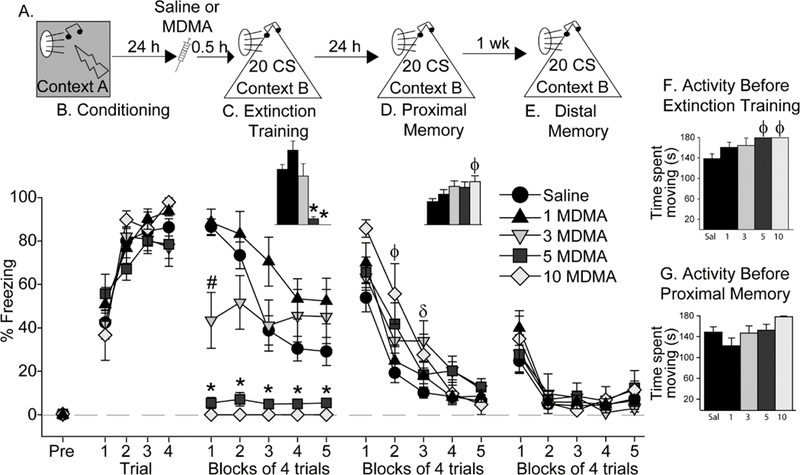
Effect of MDMA on auditory fear extinction. (A) Experimental timeline. Rats received Saline or 1 mg/kg (1 MDMA), 3 mg/kg (3 MDMA), 5 mg/kg (5 MDMA), or 10 mg/kg (10 MDMA) of MDMA 30 minutes prior to auditory fear extinction. (B) Levels of freezing during auditory fear conditioning. (C) Levels of freezing during fear extinction training. Inset shows average freezing over the entire extinction training session. (D) Levels of freezing during proximal memory test. Inset shows average freezing over the entire proximal fear extinction memory test. (E) Levels of freezing during distal memory test. (F) Locomotor activity during the 3-minute exploration period in Context B prior to the first CS during extinction training. (G) Locomotor activity during the 3-minute exploration period in Context B prior to the first conditioned stimulus (CS) during the proximal fear extinction memory test. All data represent means ± SEM. *p<0.05 relative to all other groups except each other; # p<0.05 relative to all other groups; Φ p<0.05 10 mg/kg MDMA versus Saline; δ p<0.05 3 mg/kg MDMA versus Saline.
Figure 2.
Figure 2.
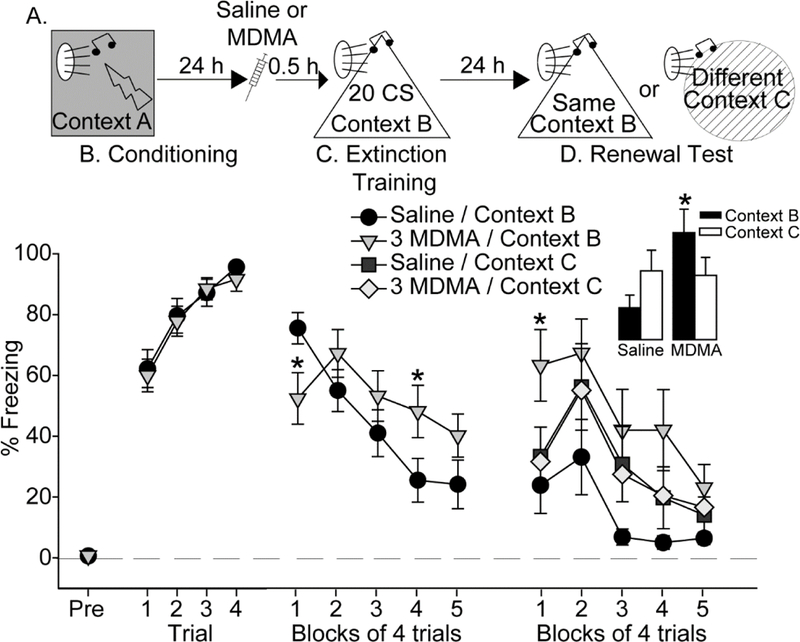
Effect of MDMA on renewal of auditory conditioned fear. (A) Experimental timeline. Rats received Saline or 3 mg/kg MDMA (3 MDMA) 30 minutes prior to auditory fear extinction. (B) Levels of freezing during auditory fear conditioning. (C) Levels of freezing during fear extinction. (D) Levels of freezing during fear renewal. Inset shows average freezing during the entire renewal session. All data represent means ± SEM. *p<0.05 3 mg/kg MDMA / Context B relative to Saline / Context B.
Figure 3.
Figure 3.
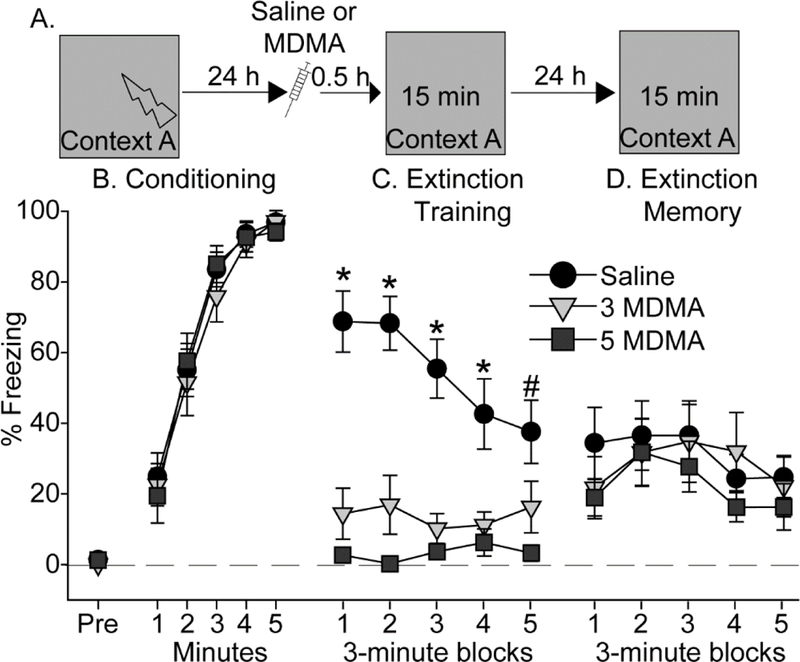
Effect of MDMA on contextual fear extinction. (A) Experimental timeline. Rats received Saline, 3 mg/kg (3 MDMA) or 5 mg/kg (5 MDMA) of MDMA 30 minutes prior to contextual fear extinction. (B) Levels of freezing during contextual fear conditioning. (C) Levels of freezing during contextual fear extinction. (D) Levels of freezing during the contextual fear extinction memory test. All data represent means ± SEM. *p<0.05 relative to all other groups; # p<0.05 Saline relative to 5 mg/kg MDMA.
Figure 4.
Figure 4.
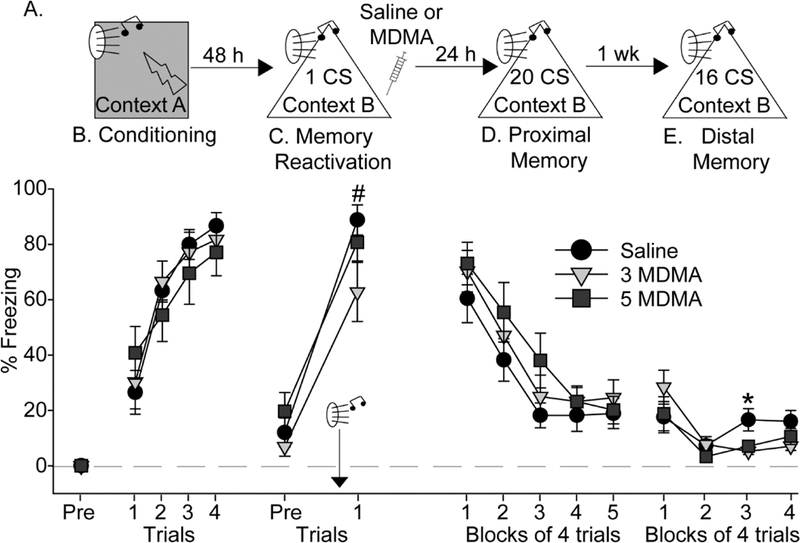
Effect of MDMA on auditory fear memory reconsolidation. (A) Experimental timeline. Rats received Saline, 3 mg/kg (3 MDMA) or 5 mg/kg (5 MDMA) of MDMA 30 seconds after exposure to a single CS. (B) Levels of freezing during auditory fear conditioning. (C) Levels of freezing before (Pre) and after auditory fear memory reactivation with a single conditioned stimulus (CS). (D) Levels of freezing during the proximal auditory conditioned fear memory test. (E) Levels of freezing during the distal auditory conditioned fear memory test. All data represent means ± SEM. #p<0.05 post tone relative to pre tone; *p<0.05 relative to all other groups.
Figure 5.
Figure 5.
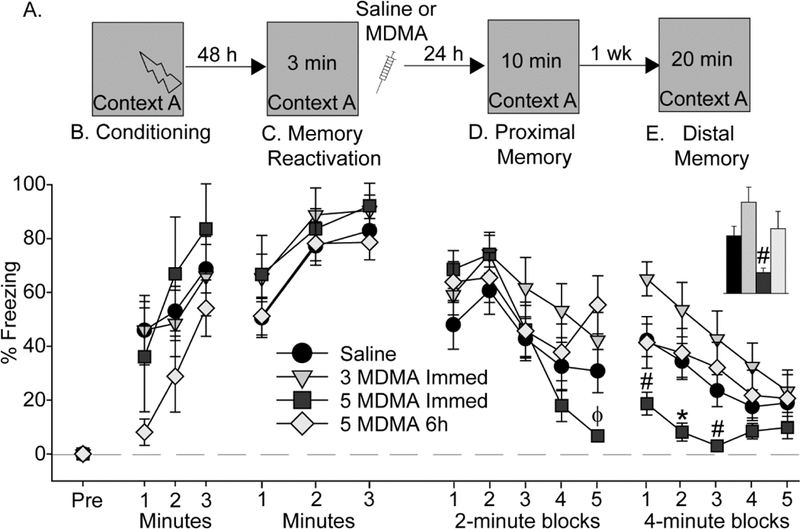
Effect of MDMA on contextual fear memory reconsolidation. (A) Experimental timeline. Rats received Saline, 3 mg/kg (3 MDMA), or 5mg/kg (5 MDMA) MDMA either immediately (Immed) after contextual fear memory reactivation or 6 h later (6h). (B) Levels of freezing during contextual fear conditioning. (C) Levels of freezing during reactivation of contextually conditioned fear memory. (D) Levels of freezing during the proximal fear memory test. (E) Levels of freezing during the distal memory test. Inset shows average freezing over the entire distal contextual fear memory test. All data represent means ± SEM. *p<0.05 relative to all other groups; #p<0.05 relative to 3 MDMA Immed; ϕ p < 0.05 relative to 5 MDMA 6h.

References

    1. Ursano RJ et al. Practice guideline for the treatment ofpatients with acute stress disorder and posttraumaticstress disorder Am J Psychiatry 2004. 161(11 Suppl): p. 3–31 - PubMed
    1. Jonas DE et al. in Psychological and Pharmacological Treatments for Adults With Posttraumatic Stress Disorder (PTSD) 2013: Rockville (MD). - PubMed
    1. Kessler RC et al. Twelve-month and lifetime prevalence and lifetime morbid risk of anxiety and mood disorders in the United States Int J Methods Psychiatr Res 2012. 21(3): p. 169–84 - PMC - PubMed
    1. Mithoefer MC et al. The safety and efficacy of {+/−}3,4- methylenedioxymethamphetamine-assistedpsychotherapy in subjects with chronic, treatment-resistantposttraumatic stress disorder: the first randomized controlled pilot study. J Psychopharmacol 2011. 25(4): p. 439–52 - PMC - PubMed
    1. Mithoefer MC et al. Durability of improvement in post-traumatic stress disorder symptoms and absence of harmful effects or drug dependency after 3,4-methylenedioxymethamphetamine-assisted psychotherapy: a prospective long-term follow-up study J Psychopharmacol 2013. 27(1): p. 28–39 - PMC - PubMed

Publication types

Substances