Review
. 2019 Jan 15:472:86-97.
doi: 10.1016/j.carres.2018.11.014. Epub 2018 Nov 24.

Strategies for chemoenzymatic synthesis of carbohydrates

Affiliations
Review

Strategies for chemoenzymatic synthesis of carbohydrates

Wanqing Li et al. Carbohydr Res. .

Abstract

Carbohydrates are structurally complex but functionally important biomolecules. Therefore, they have been challenging but attractive synthetic targets. While substantial progress has been made on advancing chemical glycosylation methods, incorporating enzymes into carbohydrate synthetic schemes has become increasingly practical as more carbohydrate biosynthetic and metabolic enzymes as well as their mutants with synthetic application are identified and expressed for preparative and large-scale synthesis. Chemoenzymatic strategies that integrate the flexibility of chemical derivatization with enzyme-catalyzed reactions have been extremely powerful. Briefly summarized here are our experiences on developing one-pot multienzyme (OPME) systems and representative chemoenzymatic strategies from others using glycosyltransferase-catalyzed reactions for synthesizing diverse structures of oligosaccharides, polysaccharides, and glycoconjugates. These strategies allow the synthesis of complex carbohydrates including those containing naturally occurring carbohydrate postglycosylational modifications (PGMs) and non-natural functional groups. By combining these srategies with facile purification schemes, synthetic access to the diverse space of carbohydrate structures can be automated and will not be limited to specialists.

Keywords: Carbohydrate synthesis; Chemoenzymatic synthesis; Enzyme engineering; Glycolipid; Glycosyltransferase; Regioselective.


Figures

Figure 1.
Figure 1.
Schematic illustration of one-pot multienzyme (OPME) chemoenzymatic reactions for the synthesis of carbohydrates with structural modifications.
Figure 2.
Figure 2.
OPME sialylation systems for synthesis of sialosides. (Adapted from H. Yu, X. Chen, Org Biomol Chem, 14 (2016) 2809-2818.)
Figure 3.
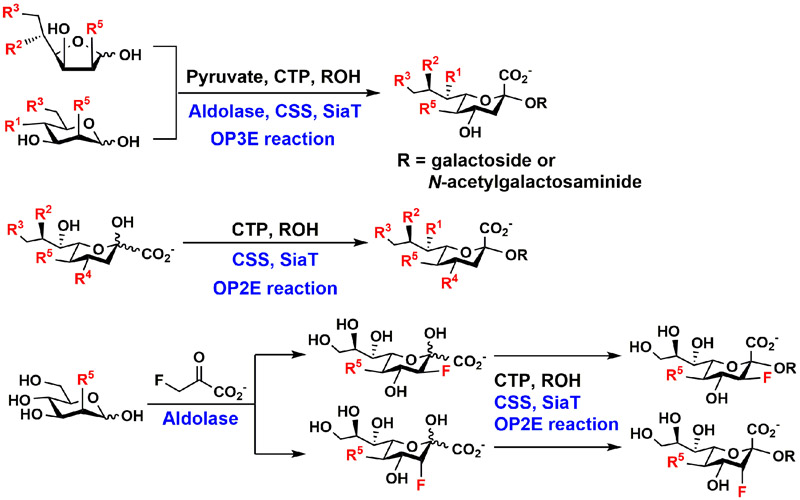
Figure 3.
OPME chemoenzymatic sialylation systems for synthesizing sialosides with modified sialic acid residues.
Figure 4.
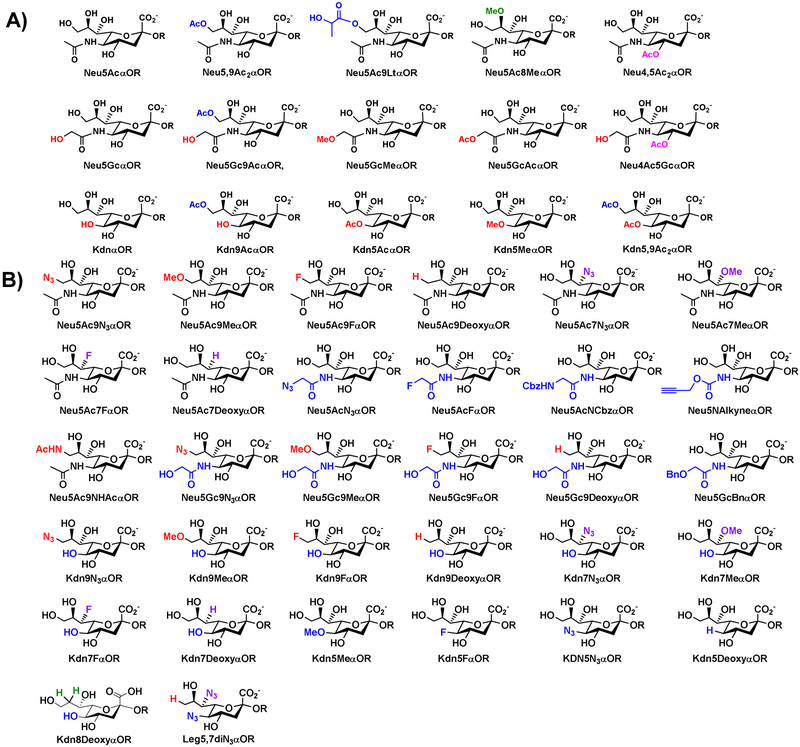
Figure 4.
Sialosides containing naturally occurring sialic acid forms (A) or non-natural modifications (B) that have been synthesized by OPME α2–3/6-sialylation systems.
Figure 5.
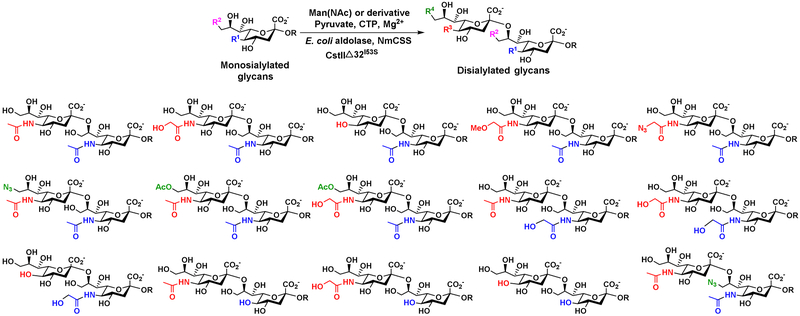
Figure 5.
Sialosides containing naturally occurring sialic acid forms or non-natural modifications that have been synthesized by OPME α2–3/6- and α2–8-sialylation systems.
Figure 6.
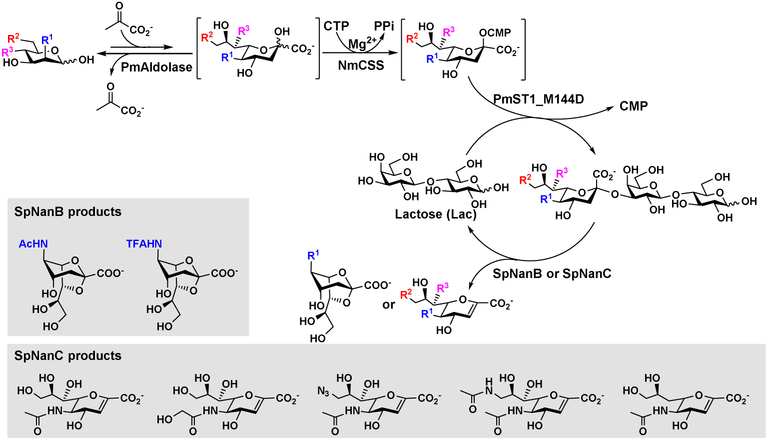
Figure 6.
OPME systems for the synthesis of sialidase inhibitors or sialidase inhibitor precursors 2,3-dehydro-2-deoxy-sialic acids (Sia2ens) and 2,7-anhydro-sialic acids (2,7-anhydro-Sias).
Figure 7.
Figure 7.
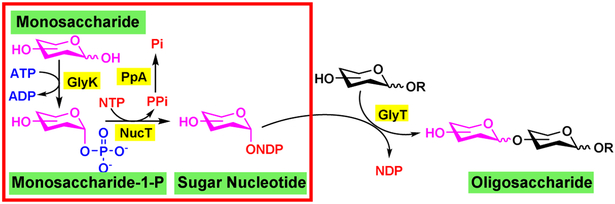
OPME systems for synthesizing oligosaccharides using glycosyltransferases that require nucleoside diphosphate-sugars as donor substrates. Enzyme abbreviations: GlyK – glycokinase; NucT – nucleotidyltransferase; PpA – inorganic pyrophosphatase; GlyT – glycosyltransferase. (Adapted from H. Yu, X. Chen, Org Biomol Chem, 14 (2016) 2809-2818.)[14]
Figure 8.
Figure 8.
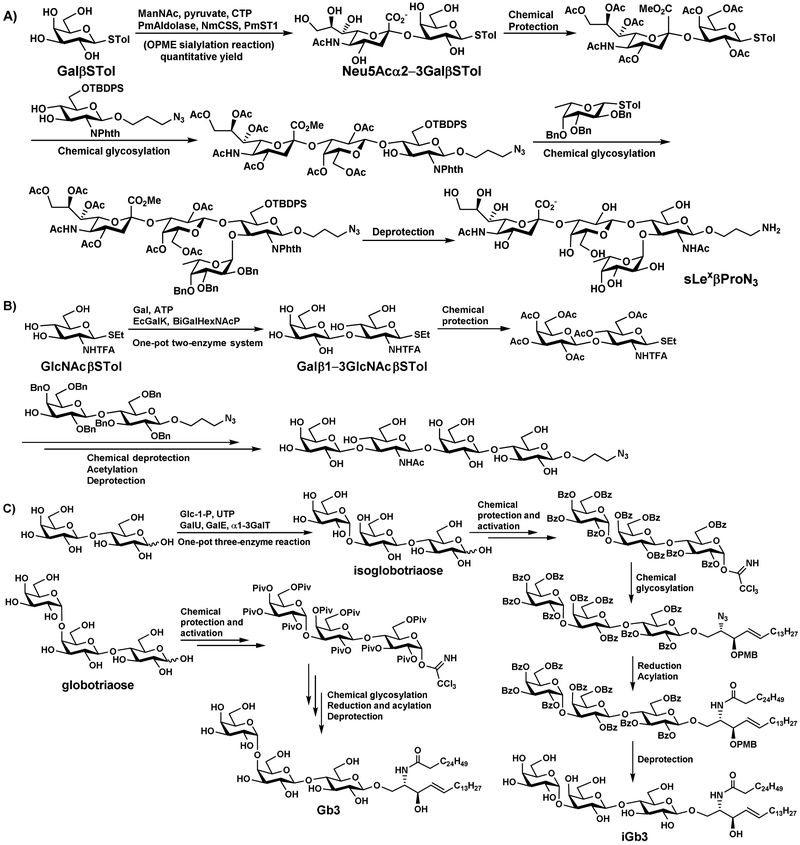
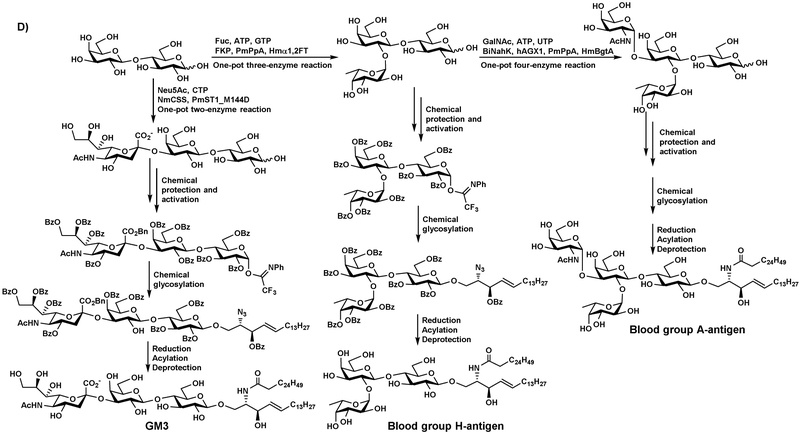
Chemoenzymatic synthesis of sLexβProN3 (A), LNTβProN3 (B), iGb3 and Gb3 (C), as well as GM3, blood group H- and A-antigens (D) by chemical glycosylation using building blocks synthesized by OPME reactions.
Figure 8.
Figure 8.
Chemoenzymatic synthesis of sLexβProN3 (A), LNTβProN3 (B), iGb3 and Gb3 (C), as well as GM3, blood group H- and A-antigens (D) by chemical glycosylation using building blocks synthesized by OPME reactions.
Figure 9.
Figure 9.
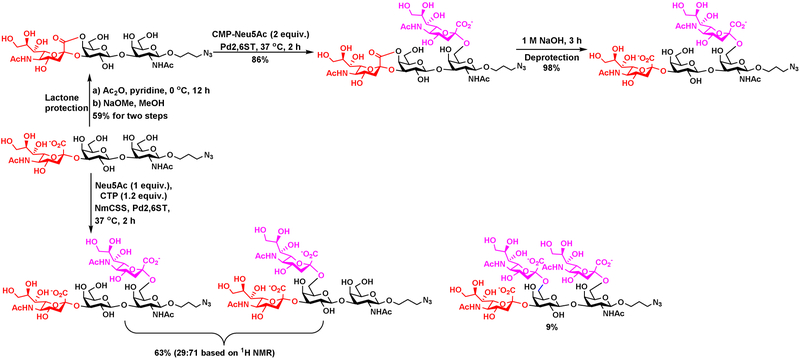
Use of lactone protection as a strategy to provide regioselectivity for chemoenzymatic synthesis of ganglioside disialyl tetrasaccharide. In the absence of lactone protection, mixture of disialyl tetrasaccharides and trisialyl pentasaccharide were formed in Photobacterium damselae α2–6-sialyltransferase (Pd2,6ST)-catalyzed reaction.
Figure 10.
Figure 10.
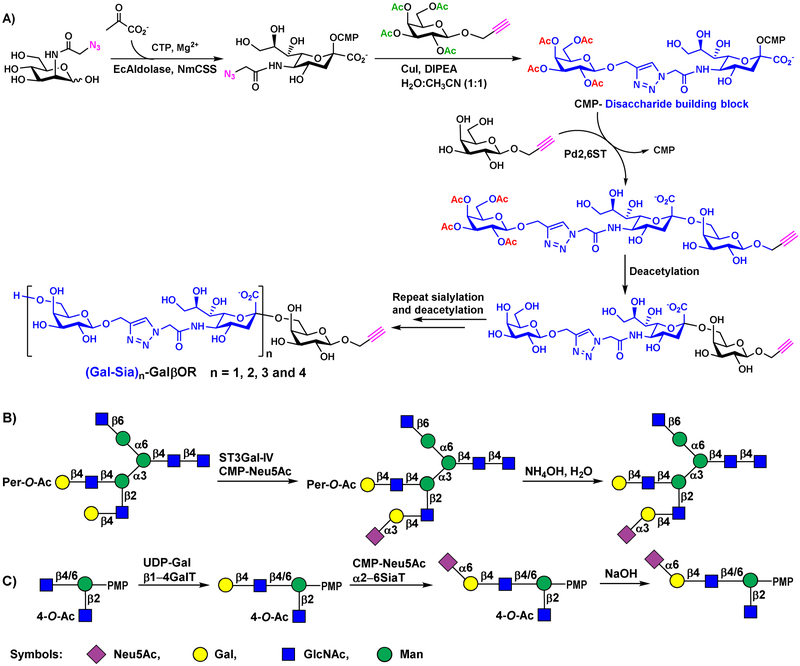
A) Chemoenzymatic synthesis of disaccharide building block and controlled chemoenzymatic synthesis of size-defined polysaccharides by Pd2,6ST-catalyzed block transfer of disaccharide building blocks. B) Chemoenzymatic synthetic route of asymmetrically multi-antennary glycans using selected O-acetylated acceptor. C) Chemoenzymatic synthesis of modules with selected O-acetylation for N-glycan assembly.
Figure 11.
Figure 11.
An example by the Boons group of using a glycosyltransferase (ST6Gal-I) and a glycosidase (Arthrobacter ureafaciens sialidase) pair as a protection and deprotection strategy for regioselective glycosylation (fucosylation) by glycosyltransferase (FUT3)-catalyzed reaction.
Figure 12.
Figure 12.
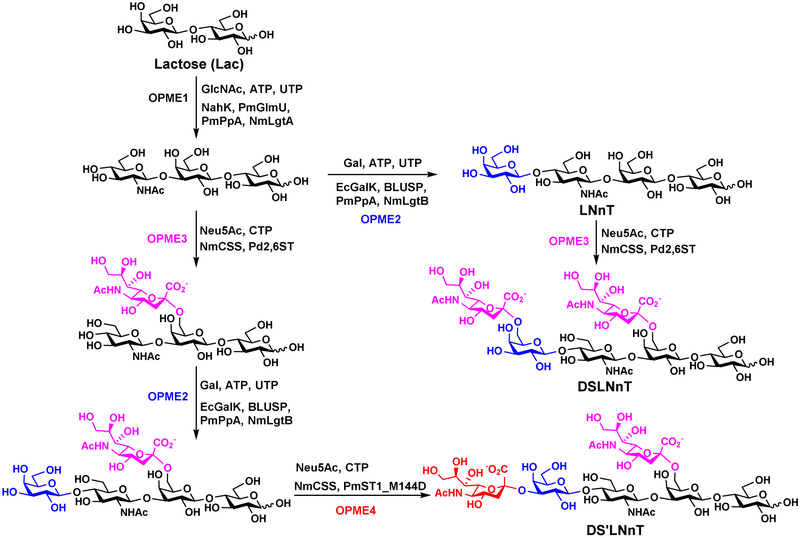
Synthesis of disialylated hexasaccharides DSLNnT and DS’LNnT by sequential OPME reactions with altered sequence of OPME2 and OPME3.
Figure 13.
Figure 13.
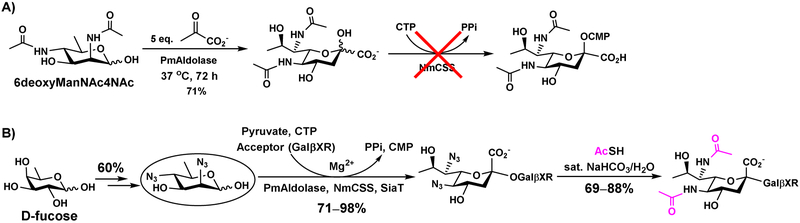
Application of a chemoenzymatic synthon strategy in the synthesis of Leg5,7Ac2-containing oligosaccharides. A) Leg2,7Ac2 produced from 2,4-diacetamido-2,4,6-trideoxy-D-mannose (6deoxyManNAc4NAc) by PmAldolase-catalyzed reaction cannot be used by NmCSS as the substrate. B) Production of Leg2,7Ac2-containing oligosaccharides by OPME synthesis of Leg2,7diN3-containing glycosides followed by chemical derivatization.
Figure 14.
Figure 14.
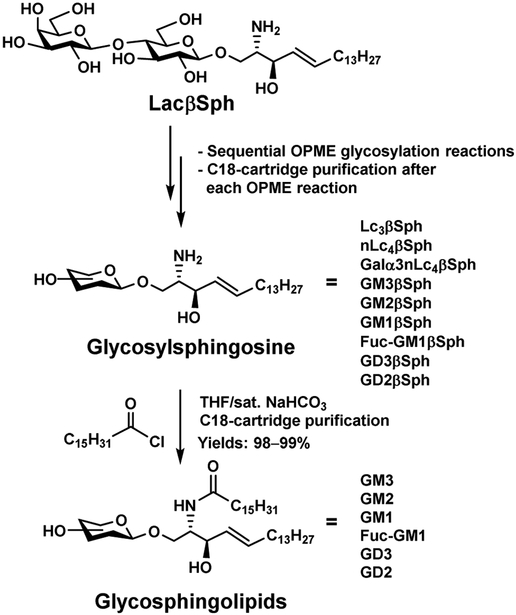
Efficient chemoenzymatic strategies for synthesizing complex glycosphingolipids by enzymatic extension of lactosyl sphingosine using OPME reactions followed by acylation reaction.

References

    1. Varki A, Kornfeld S, in: Varki A, Cummings RD, Esko JD, Stanley P, Hart GW, Aebi M, Darvill AG, Kinoshita T, Packer NH, Prestegard JH, Schnaar RL, Seeberger PH (Eds.) Essentials of Glycobiology, Cold Spring Harbor (NY: ), 2015, pp. 1–18. - PubMed
    1. Reitsma S, Slaaf DW, Vink H, van Zandvoort MA, oude Egbrink MG, The endothelial glycocalyx: composition, functions, and visualization, Pflugers Arch. 454 (2007) 345–359. - PMC - PubMed
    1. Varki A, Biological roles of oligosaccharides: all of the theories are correct, Glycobiology 3 (1993) 97–130. - PMC - PubMed
    1. Hanson S, Best M, Bryan MC, Wong C-H, Chemoenzymatic synthesis of oligosaccharides and glycoproteins, Trends Biochem. Sci 29 (2004) 656–663. - PubMed
    1. Gloster TM, Development of inhibitors as research tools for carbohydrate-processing enzymes, Biochem. Soc. Trans 40 (2012) 913–928. - PubMed