


Identifying cut-off scores for job demands and job control in nursing professionals: a cross-sectional survey in Germany
- PMID: 30530574
- PMCID: PMC6303688
- DOI: 10.1136/bmjopen-2017-021366
Identifying cut-off scores for job demands and job control in nursing professionals: a cross-sectional survey in Germany
Abstract
Objectives: Nurses are generally found to be vulnerable to burnout, but nurses working in cancer care are even more so, since this profession is characterised by continuous confrontation with suffering and death. This study was designed to identify cut-off scores for job strain, that is, low job control and high job demands, for a sample of nurses working in breast cancer care. The main goal was to find cut-off scores, which predict the risk of nurses of developing a mental disorder from high job strain.
Design: The design was a cross-sectional survey study.
Setting: The study is based on an employee survey in breast cancer centres in Germany.
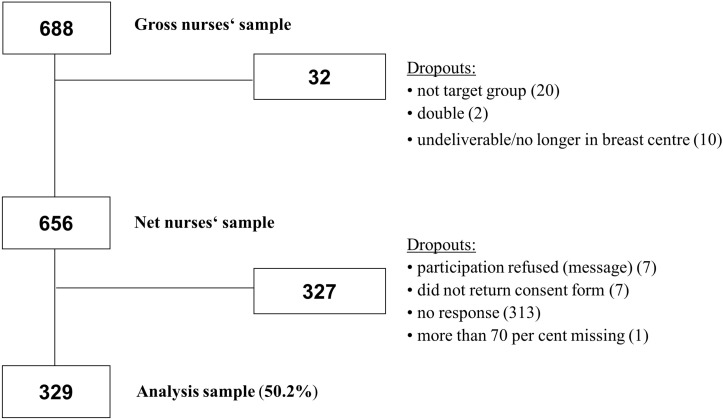
Participants: 688 nurses received a questionnaire; 329 nurses from 33 hospitals participated in the survey (return rate: 50.2%).
Primary and secondary outcome measures: Dependent variable: psychological well-being, measured by the WHO-5 Well-being Index; independent variables: job control and job demands, measured by the Job Content Questionnaire (JCQ).
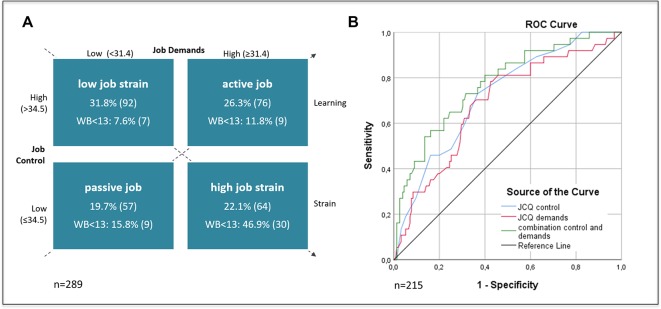
Results: Multivariable analysis indicates that low job control and high job demands are prognostic factors for low well-being. In a receiver operating curve (ROC) analysis, the cut-off scores, which demonstrated a maximum Youden index, were 34.5 for job control and 31.4 for job demands. The combination of both scales from a logistic regression analysis resulted in an area under the curve of 0.778. Sensitivity and specificity are 70.3% and 74.2%, respectively. The total of correct classification was 63.3%.
Conclusion: The determined cut-off scores indicate that there is a risk of becoming psychologically ill from a high workload when an individual reaches a score of ≤34.5 for job control and ≥31.4 for job demands. The described method of establishing risk-based cut-off scores is promising for nursing practice and for the field of occupational health. Transferability and generalisability of the cut-off scores should be further analysed.
Keywords: Job-demand-control-model; cancer care; cut-off scores; nursing professionals; who-5 well-being index; work-related psychosocial risks.
© Author(s) (or their employer(s)) 2018. Re-use permitted under CC BY-NC. No commercial re-use. See rights and permissions. Published by BMJ.
Conflict of interest statement
Competing interests: None declared.
Figures
Similar articles
-
Factors predicting Registered Nurses' intentions to leave their organization and profession: A job demands-resources framework.J Adv Nurs. 2018 Apr;74(4):864-875. doi: 10.1111/jan.13497. Epub 2017 Dec 5. J Adv Nurs. 2018. PMID: 29117451
-
Predictors of job satisfaction and burnout among tuberculosis management nurses and physicians.Epidemiol Health. 2016 Mar 9;38:e2016008. doi: 10.4178/epih.e2016008. eCollection 2016. Epidemiol Health. 2016. PMID: 26971698 Free PMC article.
-
Job demands-resources, burnout and intention to leave the nursing profession: a questionnaire survey.Int J Nurs Stud. 2010 Jun;47(6):709-22. doi: 10.1016/j.ijnurstu.2009.11.007. Int J Nurs Stud. 2010. PMID: 20138278
-
Personal and work-related factors associated with nurse resilience: A systematic review.Int J Nurs Stud. 2019 May;93:129-140. doi: 10.1016/j.ijnurstu.2019.02.014. Epub 2019 Mar 5. Int J Nurs Stud. 2019. PMID: 30925279
-
[Workload and mental health of nursing staff in Germany during the COVID-19 pandemic-a scoping review].Bundesgesundheitsblatt Gesundheitsforschung Gesundheitsschutz. 2025 Feb;68(2):130-140. doi: 10.1007/s00103-024-03984-5. Epub 2024 Dec 3. Bundesgesundheitsblatt Gesundheitsforschung Gesundheitsschutz. 2025. PMID: 39625583 Free PMC article. German.
Cited by
-
How to Use Questionnaire Results in Psychosocial Risk Assessment: Calculating Risks for Health Impairment in Psychosocial Work Risk Assessment.Int J Environ Res Public Health. 2021 Jul 2;18(13):7107. doi: 10.3390/ijerph18137107. Int J Environ Res Public Health. 2021. PMID: 34281047 Free PMC article.
-
Health literacy and psychological wellbeing of employees working from home in Germany-online survey results.Health Promot Int. 2025 Jan 17;40(1):daae202. doi: 10.1093/heapro/daae202. Health Promot Int. 2025. PMID: 39820453 Free PMC article.
-
Measuring social capital of healthcare organizations reported by employees for creating positive workplaces - validation of the SOCAPO-E instrument.BMC Health Serv Res. 2020 Mar 31;20(1):272. doi: 10.1186/s12913-020-05105-9. BMC Health Serv Res. 2020. PMID: 32234055 Free PMC article.
-
Psychosocial factors and Burnout Syndrome among mental health professionals.Rev Lat Am Enfermagem. 2020;28:e3336. doi: 10.1590/1518-8345.4175.3336. Epub 2020 Aug 31. Rev Lat Am Enfermagem. 2020. PMID: 32876293 Free PMC article.
-
Who reported having a high-strain job, low-strain job, active job and passive job? The WIRUS Screening study.PLoS One. 2019 Dec 30;14(12):e0227336. doi: 10.1371/journal.pone.0227336. eCollection 2019. PLoS One. 2019. PMID: 31887201 Free PMC article.
References
-
- Siegrist J. Stress in the workplace. The New Blackwell Companion to Medical Sociology 2016:268 10.1002/9781444314786.ch12 - DOI
-
- Cottini E, Lucifora C. Mental health and working conditions in Europe. ILR Review 2013;66:958–88. 10.1177/001979391306600409 - DOI
-
- Ganster DC, Rosen CC. Work stress and employee health: A multidisciplinary review. Journal of Management 2013;39:1085–122. 10.1177/0149206313475815 - DOI
Publication types
MeSH terms
LinkOut - more resources
Full Text Sources
Medical
