. 2018 Dec 26;115(52):13353-13358.
doi: 10.1073/pnas.1811862115. Epub 2018 Dec 7.

Improving vaccines against Streptococcus pneumoniae using synthetic glycans

Affiliations

Improving vaccines against Streptococcus pneumoniae using synthetic glycans

Paulina Kaplonek et al. Proc Natl Acad Sci U S A. .

Abstract

Streptococcus pneumoniae remains a deadly disease in small children and the elderly even though conjugate and polysaccharide vaccines based on isolated capsular polysaccharides (CPS) are successful. The most common serotypes that cause infection are used in vaccines around the world, but differences in geographic and demographic serotype distribution compromises protection by leading vaccines. The medicinal chemistry approach to glycoconjugate vaccine development has helped to improve the stability and immunogenicity of synthetic vaccine candidates for several serotypes leading to the induction of higher levels of specific protective antibodies. Here, we show that marketed CPS-based glycoconjugate vaccines can be improved by adding synthetic glycoconjugates representing serotypes that are not covered by existing vaccines. Combination (coformulation) of synthetic glycoconjugates with the licensed vaccines Prevnar13 (13-valent) and Synflorix (10-valent) yields improved 15- and 13-valent conjugate vaccines, respectively, in rabbits. A pentavalent semisynthetic glycoconjugate vaccine containing five serotype antigens (sPCV5) elicits antibodies with strong in vitro opsonophagocytic activity. This study illustrates that synthetic oligosaccharides can be used in coformulation with both isolated polysaccharide glycoconjugates to expand protection from existing vaccines and each other to produce precisely defined multivalent conjugated vaccines.

Keywords: Streptococcus pneumoniae; synthetic glycans; vaccine.


Conflict of interest statement

Conflict of interest statement: Glycoconjugates containing the synthetic glycan structures of all five Streptococcus pneumoniae serotypes (type 2, 3, 5, 8, and 14) capsular polysaccharide conjugate elicit opsonic antibodies and is included in patent “Pneumococcal oligosaccharide-protein conjugate composition” no. EP 16 179 133.0 filed by the inventors P.H.S., C.L.P., N.K., M.E., S.G.P., A.D.J.C., M.P.L., B.S., F.-F.X., P.K., and P.H.S. has a significant financial interest in “Vaxxilon,” a spinoff company that is developing vaccines based on synthetic oligosaccharide antigens.

Figures

Fig. 1.
Fig. 1.
CRM197 conjugates of synthetic oligosaccharide antigens resembling the capsular polysaccharides (CPS) of Streptococcus pneumoniae serotypes 2 (ST2), 3 (ST3), 5 (ST5), 8 (ST8), and 14 (ST14).
Fig. 2.
Fig. 2.
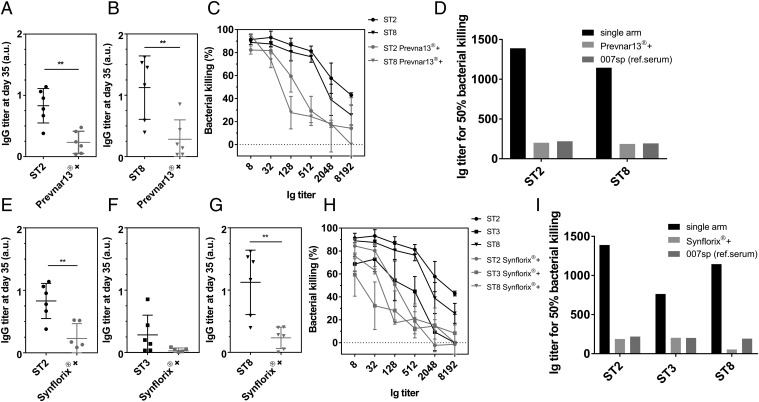
Coformulation of synthetic glycoconjugates of nonvaccine serotypes with licensed polysaccharide-based conjugate vaccines. NZW rabbits (n = 4–6) were vaccinated s.c. with synthetic glycoconjugates ST2, ST3, or ST8 individually or in combination with licensed vaccines (Prevnar13+ST2+ST8 and Synflorix+ST2+ST3+ST8). (A and B) ELISA analysis of ST2 (A) and ST8 (B) polysaccharide-specific antibodies in rabbit sera at the endpoint titer dilution (1:1,000) from animals immunized with ST2 or ST8 individually or in coformulation with Prevnar13. Each dot represents the individual animal response and data were analyzed by an unpaired t test. (C) In vitro OPKA of pooled sera raised against synthetic glycoconjugate ST2 or ST8 individually or in coformulation with Prevnar13. Data presented as mean ± SD of three independent experiments. (EG) ELISA analysis of ST2 (E), ST3 (F), and ST8 (G) polysaccharide-specific antibodies in rabbit sera at the endpoint titer dilution from animals immunized with ST2, ST3, and ST8 individually or in coformulation with Synflorix. Each dot represents the individual animal response and data were analyzed by an unpaired t test. (H) OPKA of pooled sera raised against glycoconjugates ST2, ST3 or ST8 individually or in combination with Synflorix. Data presented as mean ± SD of three independent experiments. (D and I) Comparison of antibody titers of pooled sera responsible for 50% killing of bacteria in the OPKA. IgG titers are expressed as the reciprocal serum dilution mediating 50% bacterial killing, estimated through nonlinear interpolation of the dilution-killing OPKA data. Human reference serum 007sp was used as a control. Each dot represents an individual rabbit immune response; data were analyzed by an ANOVA test, **P < 0.01.
Fig. 3.
Fig. 3.
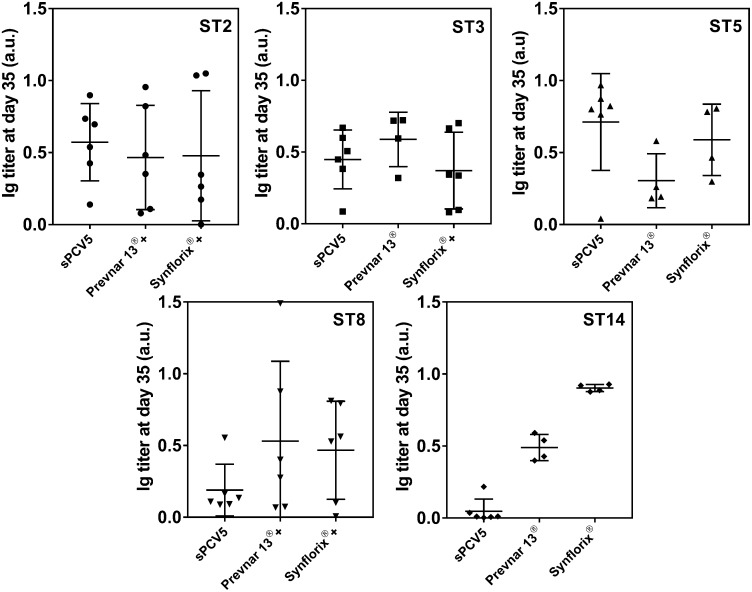
Immune response of pentavalent synthetic glycoconjugate vaccine sPCV5 in rabbits. NZW rabbits (n = 3–6) were vaccinated s.c. with sPCV5, the marketed vaccines Prevnar13 or Synflorix, or the coformulated vaccines Prevnar13+ST2+ST8 or Synflorix+ST2+ST3+ST8. Polysaccharide-specific ST2, ST3, ST5, ST8, and ST14 antibody levels in rabbit sera were evaluated by ELISA at the endpoint titer dilution. Each dot represents an individual rabbit immune response; data were analyzed by an ANOVA test.
Fig. 4.
Fig. 4.
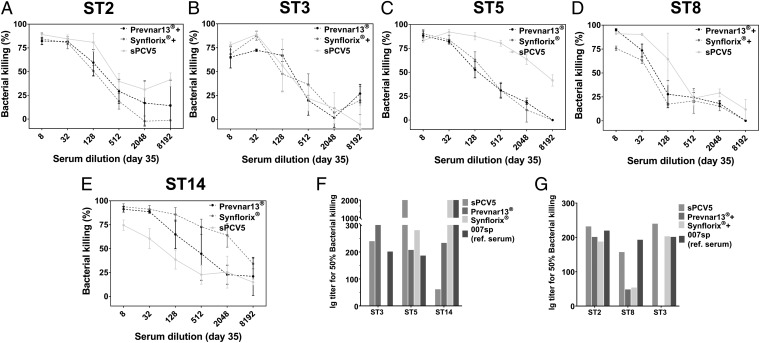
In vitro opsonophagocytic activity of sPCV5 formulation. (AE) Comparison of pooled sera from rabbit immunized with sPCV5, Prevnar13+ST2+ST8, Synflorix+ST2+ST3+ST8 as well as positive controls Prevnar13 and Synflorix for opsonophagocytic killing of S. pneumoniae serotypes (A) ST2, (B) ST3, (C) ST5, (D) ST8, and (E) ST14. Data are means ± SD of colony-forming units reduction relative to negative control wells (samples lacking either antibody or complement) of three independent experiments (F and G). Comparison of antibody titer of pooled serum responsible for 50% killing of bacteria in opsonophagocytic killing assay. IgG titers are expressed as the reciprocal serum dilution mediating 50% bacterial killing, estimated through nonlinear interpolation of the dilution-killing OPKA data. Human reference serum 007sp was used as a control.
Fig. 5.
Fig. 5.
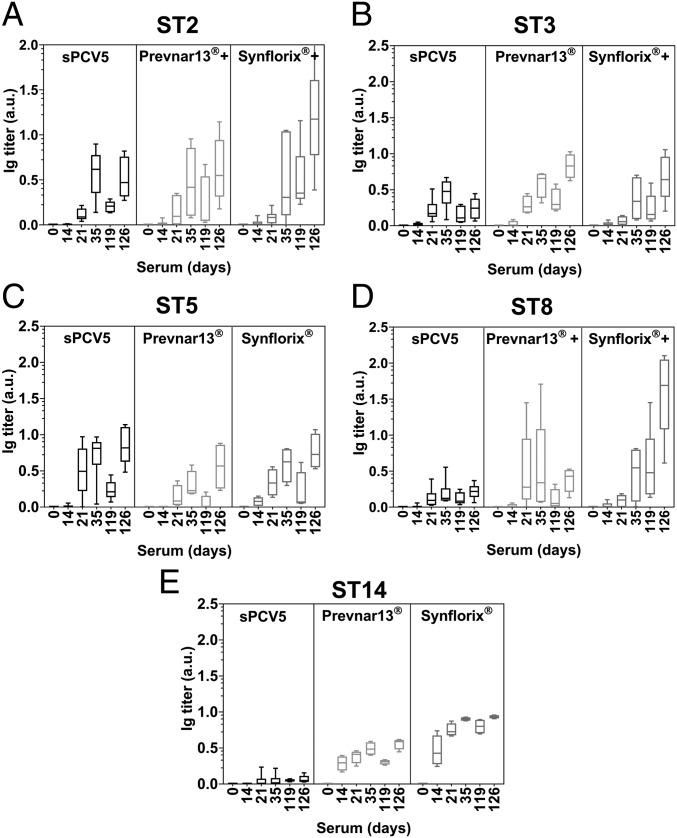
Synthetic glycoconjugate vaccine sPCV5 induces long-term memory response. NZW rabbits (n = 3–6) were immunized four times (days 0, 14, 28, and 119) s.c. with sPCV5, Prevnar13+ST2+ST8, Synflorix+ST2+ST3+ST8 as well as positive controls Prevnar13 and Synflorix. Serum was collected 1 wk after each immunization. Polysaccharide-specific antibody titers were analyzed by ELISA. Plates coated with CPSs corresponding to (A) ST2, (B) ST3, (C) ST5, (D) ST8, and (E) ST14. Data represented as mean ± SD, duplicate determinations.

References

    1. Centers for Disease Control and Prevention 2016 Active Bacterial Core Surveillance Report, Emerging Infections Program Network, Streptococcus pneumoniae, 2016. Available at https://www.cdc.gov/abcs/reports-findings/survreports/spneu16.pdf. Accessed November 30, 2018.
    1. Rodrigues CMC, Groves H. Community-acquired pneumonia in children: The challenges of microbiological diagnosis. J Clin Microbiol. 2018;56:e01318-17. - PMC - PubMed
    1. Klein Klouwenberg P, Bont L. Neonatal and infantile immune responses to encapsulated bacteria and conjugate vaccines. Clin Dev Immunol. 2008;2008:628963. - PMC - PubMed
    1. Dretler AW, Rouphael NG, Stephens DS. Progress toward the global control of Neisseria meningitidis: 21st century vaccines, current guidelines, and challenges for future vaccine development. Hum Vaccin Immunother. 2018;14:1146–1160. - PMC - PubMed
    1. Li Y, Weinberger DM, Thompson CM, Trzciński K, Lipsitch M. Surface charge of Streptococcus pneumoniae predicts serotype distribution. Infect Immun. 2013;81:4519–4524. - PMC - PubMed

Publication types

MeSH terms