Death and readmissions after hospital discharge during the December holiday period: cohort study
- PMID: 30530782
- PMCID: PMC6287120
- DOI: 10.1136/bmj.k4481
Death and readmissions after hospital discharge during the December holiday period: cohort study
Abstract
Objective: To determine whether patients discharged from hospital during the December holiday period have fewer outpatient follow-ups and higher rates of death or readmission than patients discharged at other times.
Design: Population based retrospective cohort study.
Setting: Acute care hospitals in Ontario, Canada, 1 April 2002 to 31 January 2016.
Participants: 217 305 children and adults discharged home after an urgent admission, during the two week December holiday period, compared with 453 641 children and adults discharged during two control periods in late November and January.
Main outcome measures: The primary outcome was death or readmission, defined as a visit to an emergency department or urgent rehospitalisation, within 30 days. Secondary outcomes were death or readmission and outpatient follow-up with a physician within seven and 14 days after discharge. Multivariable logistic regression with generalised estimating equations was used to adjust for characteristics of patients, admissions, and hospital.
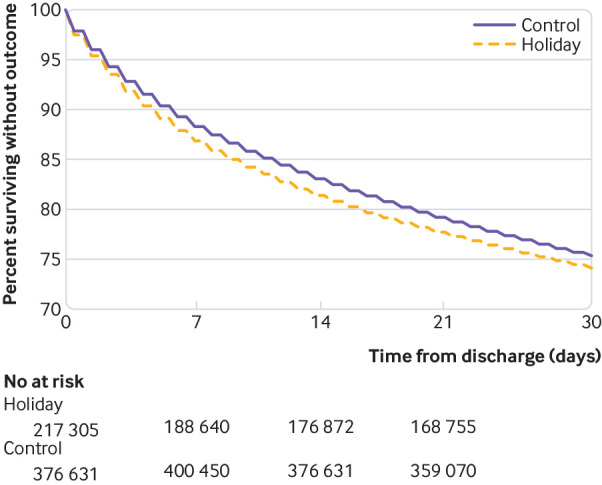
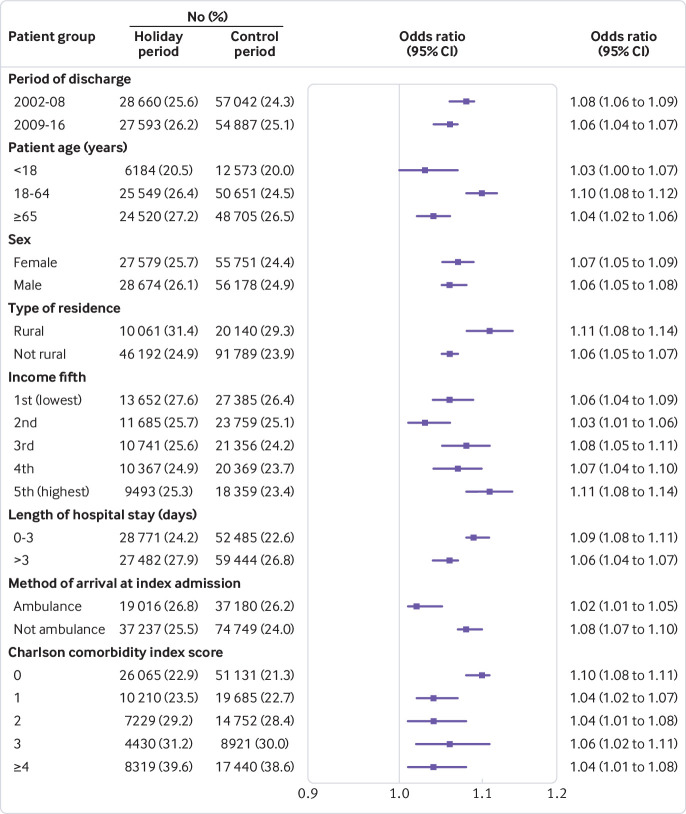
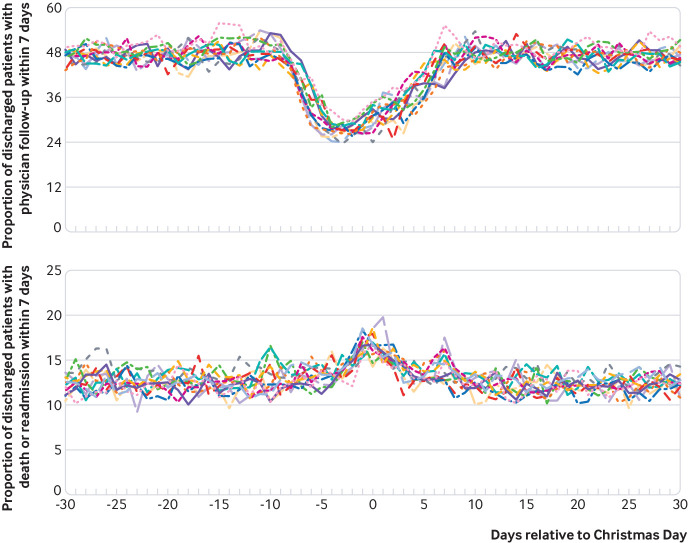
Results: 217 305 (32.4%) patients discharged during the holiday period and 453 641 (67.6%) discharged during control periods had similar baseline characteristics and previous healthcare utilisation. Patients who were discharged during the holiday period were less likely to have follow-up with a physician within seven days (36.3% v 47.8%, adjusted odds ratio 0.61, 95% confidence interval 0.60 to 0.62) and 14 days (59.5% v 68.7%, 0.65, 0.64 to 0.66) after discharge. Patients discharged during the holiday period were also at higher risk of 30 day death or readmission (25.9% v 24.7%, 1.09, 1.07 to 1.10). This relative increase was also seen at seven days (13.2% v 11.7%, 1.16, 1.14 to 1.18) and 14 days (18.6% v 17.0%, 1.14, 1.12 to 1.15). Per 100 000 patients, there were 2999 fewer follow-up appointments within 14 days, 26 excess deaths, 188 excess hospital admissions, and 483 excess emergency department visits attributable to hospital discharge during the holiday period.
Conclusions: Patients discharged from hospital during the December holiday period are less likely to have prompt outpatient follow-up and are at higher risk of death or readmission within 30 days.
Published by the BMJ Publishing Group Limited. For permission to use (where not already granted under a licence) please go to http://group.bmj.com/group/rights-licensing/permissions.
Conflict of interest statement
Competing interests: All authors have completed the ICMJE uniform disclosure form and declare (with the exception of disclosures that follow): no support from any organisation for the submitted work, no financial relationships with any organisations that might have an interest in the submitted work in the previous three years, no other relationships or activities that could appear to have influenced the submitted work.
Figures
References
MeSH terms
LinkOut - more resources
Full Text Sources
Molecular Biology Databases
Miscellaneous