


Therapeutic Plasma Exchange in Children With Thrombocytopenia-Associated Multiple Organ Failure: The Thrombocytopenia-Associated Multiple Organ Failure Network Prospective Experience
- PMID: 30531184
- PMCID: PMC9084562
- DOI: 10.1097/CCM.0000000000003559
Therapeutic Plasma Exchange in Children With Thrombocytopenia-Associated Multiple Organ Failure: The Thrombocytopenia-Associated Multiple Organ Failure Network Prospective Experience
Abstract
Objective: The objective was to compare the resolution of organ dysfunction, 28-day mortality, and biochemical markers in children with thrombocytopenia-associated multiple organ failure who received therapeutic plasma exchange versus no therapeutic plasma exchange.
Design: Observational longitudinal cohort study.
Setting: Nine U.S. PICUs.
Patients: Eighty-one children with sepsis-induced thrombocytopenia-associated multiple organ failure.
Interventions: Therapeutic plasma exchange.
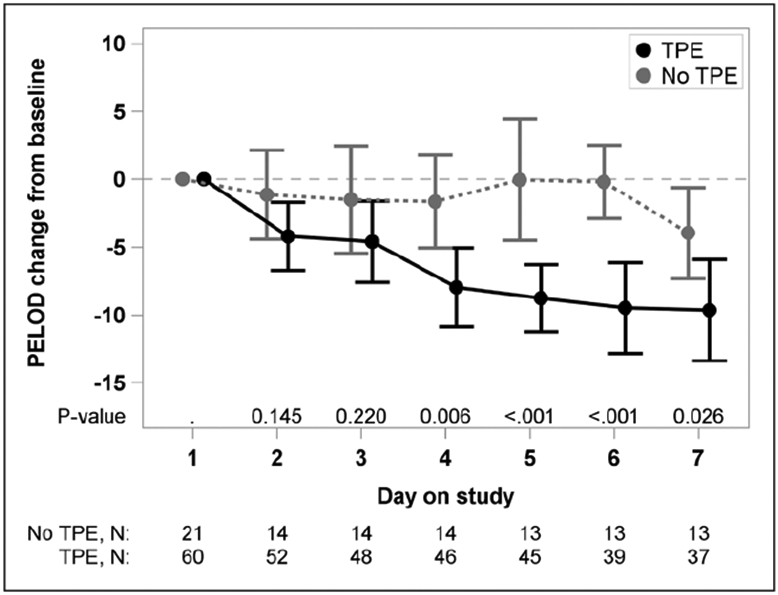
Measurements and main results: Adjusted relative risk for 28-day mortality was modeled using standard multivariate regression with propensity score weighting to reduce covariate confounding. Change from baseline Pediatric Logistic Organ Dysfunction scores between therapeutic plasma exchange and no therapeutic plasma exchange differed in temporal pattern during the first week (p = 0.009). By day 4, mean Pediatric Logistic Organ Dysfunction score declined by 7.9 points (95% CI, -10.8 to -5.1) in the therapeutic plasma exchange-treated group compared with no change with no therapeutic plasma exchange. Use of therapeutic plasma exchange was associated with reduced 28-day mortality by multivariate analysis (adjusted relative risk, 0.45; 95% CI, 0.23-0.90; p = 0.02) and by propensity score weighting (adjusted relative risk, 0.46; 95% CI, 0.22-0.97; p = 0.04).
Conclusions: Therapeutic plasma exchange use in thrombocytopenia-associated multiple organ failure was associated with a decrease in organ dysfunction. After accounting for several risk factors, 28-day all-cause mortality was lower in children treated with therapeutic plasma exchange compared with those receiving no therapeutic plasma exchange. A multicenter randomized clinical trial is necessary to determine a causal relationship.
Figures
Comment in
-
Not Enough Evidence to Use Plasma Exchange for Sepsis or Thrombocytopenia-Associated Multiple Organ Failure in Children.Crit Care Med. 2019 Jun;47(6):e533-e534. doi: 10.1097/CCM.0000000000003695. Crit Care Med. 2019. PMID: 31095031 No abstract available.
References
-
- Hartman ME, Linde-Zwirble WT, Angus DC, et al.: Trends in the epidemiology of pediatric severe sepsis. Pediatr Crit Care Med 2013; 14:686–693 - PubMed
-
- Ruth A, McCracken CE, Fortenberry JD, et al.: Pediatric severe sepsis: Current trends and outcomes from the Pediatric Health Information Systems database. Pediatr Crit Care Med 2014; 15:828–838 - PubMed
-
- Tamburro RF, Jenkins TL: Multiple organ dysfunction syndrome: A challenge for the pediatric critical care community. Pediatr Crit Care Med 2017; 18:S1–S3 - PubMed
-
- Watson RS, Carcillo JA, Linde-Zwirble WT, et al.: The epidemiology of severe sepsis in children in the United States. Am J Respir Crit Care Med 2003; 167:695–701 - PubMed
Publication types
MeSH terms
Grants and funding
LinkOut - more resources
Full Text Sources
