


The Language of First-Trimester Nonviable Pregnancy: Patient-Reported Preferences and Clarity
- PMID: 30531561
- PMCID: PMC10302403
- DOI: 10.1097/AOG.0000000000002997
The Language of First-Trimester Nonviable Pregnancy: Patient-Reported Preferences and Clarity
Abstract
Objective: To document the terminology patients hear during the treatment course for a nonviable pregnancy and to ask patients their perceived clarity and preference of terminology to identify a patient-centered lexicon.
Methods: We performed a preplanned substudy survey of English-speaking participants in New York, Pennsylvania, and California at the time of enrollment in a randomized multisite trial of medical management of first-trimester early pregnancy loss. The six-item survey, administered on paper or an electronic tablet, was developed and piloted for internal and external validity. We used a visual analog scale and quantified tests of associations between participant characteristics and survey responses using risk ratios.
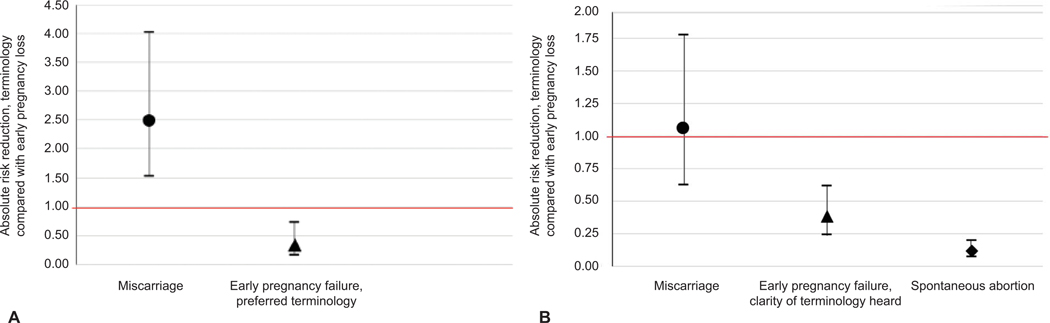
Results: We approached 155 English-speaking participants in the parent study, of whom 145 (93.5%) participated. In the process of receiving their diagnosis from a clinician, participants reported hearing the terms "miscarriage" (n=109 [75.2%]) and "early pregnancy loss" (n=73 [50.3%]) more than "early pregnancy failure" (n=31 [21.3%]) and "spontaneous abortion" (n=21 [14.4%]). The majority selected "miscarriage" (n=79 [54.5%]) followed by "early pregnancy loss" (n=49 [33.8%]) as their preferred term. In multivariable models controlling for study site, ethnicity, race, history of induced abortion, and whether the current pregnancy was planned, women indicated that "spontaneous abortion" and "early pregnancy failure" were significantly less clear than "early pregnancy loss" (53/145, adjusted risk ratio 0.12, 95% CI 0.07-0.19 and 92/145, adjusted risk ratio 0.38, 95% CI 0.24-0.61, respectively, as compared with 118/145 for "early pregnancy loss"). "Miscarriage" scored similarly to "early pregnancy loss" in clarity (119/145, adjusted risk ratio 1.05, 95% CI 0.62-1.77).
Conclusion: The terminology used to communicate "nonviable pregnancy in the first trimester" is highly variable. In this cohort of women, most preferred the term "miscarriage" and classified both "miscarriage" and "early pregnancy loss" as clear labels for a nonviable pregnancy. Health care providers can use these terms to enhance patient-clinician communication.
Clinical trial registration: ClinicalTrials.gov, NCT02012491.
Conflict of interest statement
Financial Disclosure
The authors did not report any potential conflicts of interest.
Each author has indicated that he or she has met the journal’s requirements for authorship.
Figures
References
-
- Jones RK, Kost K. Underreporting of induced and spontaneous abortion in the United States: an analysis of the 2002 National Survey of Family Growth. Stud Fam Plann 2007;38:187–97. - PubMed
-
- Conversations Van P., coping, & connectedness: a qualitative study of women who have experienced involuntary pregnancy loss. Omega (Westport) 2012;65:71–85. - PubMed
-
- Layne LL. Pregnancy and infant loss support: a new, feminist, American, patient movement? Soc Sci Med 2006;62:602–13. - PubMed
Publication types
MeSH terms
Associated data
Grants and funding
LinkOut - more resources
Full Text Sources
Medical
