. 2018 Dec 7;8(1):17723.
doi: 10.1038/s41598-018-35989-x.

Using a three-compartment model improves the estimation of iohexol clearance to assess glomerular filtration rate

Affiliations

Using a three-compartment model improves the estimation of iohexol clearance to assess glomerular filtration rate

Max Taubert et al. Sci Rep. .

Abstract

Plasma clearance of iohexol is a key tool to precisely determine glomerular filtration rate (GFR) in clinical research and clinical practice. Despite evidence that iohexol pharmacokinetics are described best by three-compartment models, two-compartment approaches (Schwartz approach) are customary, which might result in avoidable bias and imprecision. We aimed to provide a population pharmacokinetic (popPK) model of iohexol by re-evaluating data from the Berlin Initiative Study (BIS) to compare respective clearance estimates to the Schwartz approach and to assess the impact of revised clearance estimates on the BIS equations. A popPK model was developed based on iohexol plasma samples (8-10 per subject, iohexol dose 3235 mg) from 570 elderly patients. A three-compartment model appropriately described the pharmacokinetics of iohexol (clearance 57.4 mL/min, CV 33%). Compared to the three-compartment model, clearance values were overestimated by the Schwartz approach (bias 6.5 mL/min), resulting in limited effects on regression coefficients of the BIS equations (e.g., proportionality factor of BIS2 changed from 767 to 720). Predictions based on the BIS2 equation were biased (5.4 mL/min/1.73 m²) and the sensitivity to detect a GFR < 60 mL/min/1.73 m² was low compared to the revised equation (72% versus 89%). Three-compartment models should be employed to assess iohexol pharmacokinetics.


Conflict of interest statement

The authors declare no competing interests.

Figures

Figure 1
Figure 1
Visual predictive checks of the two- and three-compartment population pharmacokinetic models. Visual predictive checks of the two-compartment (left side) and three-compartment (right side) model. Solid (dashed) lines represent medians (5%, 95% percentiles) of observed concentrations; grey areas represent 95% confidence intervals of 5%, 50% and 95% percentiles predicted by the model. For a correctly specified compartmental model, observed medians should lie inside the middle grey boxes. Observed 95% percentiles should lie within the upper and 5% percentiles within the lower grey boxes. For the two-compartment model, model-predictions of early measurements are relevantly lower than the observed data, which is indicated by an asterisk. Thus, the two-compartment model is clearly misspecified with respect to early concentration measurements. For the three-compartment model, only early low concentrations are not predicted well, indicating that misspecifications mostly disappeared.
Figure 2
Figure 2
Residual plots indicating a misspecification of the two-compartment population pharmacokinetic model compared to the three compartment model. Conditional weighted residuals versus time after administration of iohexol from the two-compartment (left side) and three-compartment (right side) model. A clear misspecification is apparent for early concentrations in the two-, but not in the three-compartment model (indicated by asterisk).
Figure 3
Figure 3
Amounts of iohexol in the three compartments over time. Median percentage of iohexol amounts (relative to the administered dose) in the compartments 1, 2 and 3 over time as predicted by the three-compartment population pharmacokinetic model. The amount of iohexol in the third compartment increases quickly, thus yielding a fast, initial decrease of plasma concentrations.
Figure 4
Figure 4
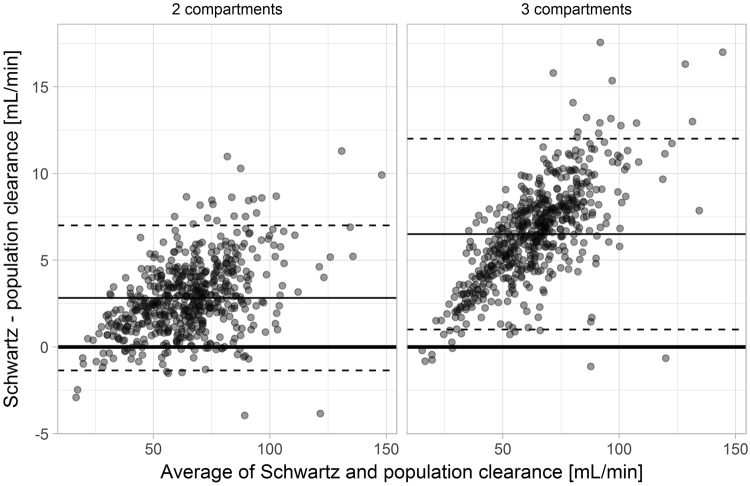
Bland-Altman plots of new and revised clearance estimates. Bland-Altman plot of clearance estimates obtained from the Schwartz approach compared to clearance estimates from a population pharmacokinetic two-compartment (left side) and three-compartment (right side) model. The bias (2.8 ml/min for the 2 compartment and 6.5 ml/min for the 3-compartment model) is represented by the thin solid line, the upper and lower limits of agreement by the dashed lines.
Figure 5
Figure 5
Exemplary plot of the Schwartz approach applied to a simulated three-compartment concentration-time curve. Exemplary plot of simulated concentrations (dots) in a single, virtual subject, and the slow (dashed line) and slow + fast (solid line) components based on the Schwartz approach fitted to concentrations 10, 20, 30, 60, 120, 240 and 300 minutes post-dose. Underprediction is apparent for later concentrations, reflecting the overestimated clearance.
Figure 6
Figure 6
True versus estimated clearances from simulations. Bland-Altman plot of clearance estimates obtained from the Schwartz approach compared to true clearance values from a simulated population pharmacokinetic three-compartment model. The bias (3.1 mL/min) is represented by the solid middle line, the upper and lower limits of agreement by the dashed lines.

References

    1. Delanaye P, et al. Iohexol plasma clearance for measuring glomerular filtration rate in clinical practice and research: a review. Part 2: Why to measure glomerular filtration rate with iohexol? Clin. Kidney J. 2016;9:700–4. doi: 10.1093/ckj/sfw071. - DOI - PMC - PubMed
    1. Schaeffner ES, et al. Two novel equations to estimate kidney function in persons aged 70 years or older. Ann. Intern. Med. 2012;157:471. doi: 10.7326/0003-4819-157-7-201210020-00003. - DOI - PubMed
    1. Schwartz GJ, Furth S, Cole SR, Warady B, Mũoz A. glomerular filtration rate via plasma iohexol disappearance: Pilot study for chronic kidney disease in children. Kidney Int. 2006;69:2070–2077. doi: 10.1038/sj.ki.5000385. - DOI - PubMed
    1. Edelson J, Shaw D, Palace G. Pharmacokinetics of iohexol, a new nonionic radiocontrast agent, in humans. J. Pharm. Sci. 1984;73:993–995. doi: 10.1002/jps.2600730735. - DOI - PubMed
    1. Schaeffner ES, et al. The Berlin initiative study: the methodology of exploring kidney function in the elderly by combining a longitudinal and cross-sectional approach. Eur. J. Epidemiol. 2010;25:203–210. doi: 10.1007/s10654-010-9424-x. - DOI - PubMed

Publication types