. 2020 Jun;25(6):1229-1244.
doi: 10.1038/s41380-018-0316-x. Epub 2018 Dec 10.

Obligatory roles of dopamine D1 receptors in the dentate gyrus in antidepressant actions of a selective serotonin reuptake inhibitor, fluoxetine

Affiliations

Obligatory roles of dopamine D1 receptors in the dentate gyrus in antidepressant actions of a selective serotonin reuptake inhibitor, fluoxetine

Takahide Shuto et al. Mol Psychiatry. 2020 Jun.

Abstract

Depression is a leading cause of disability. Current pharmacological treatment of depression is insufficient, and development of improved treatments especially for treatment-resistant depression is desired. Understanding the neurobiology of antidepressant actions may lead to development of improved therapeutic approaches. Here, we demonstrate that dopamine D1 receptors in the dentate gyrus act as a pivotal mediator of antidepressant actions in mice. Chronic administration of a selective serotonin reuptake inhibitor (SSRI), fluoxetine, increases D1 receptor expression in mature granule cells in the dentate gyrus. The increased D1 receptor signaling, in turn, contributes to the actions of chronic fluoxetine treatment, such as suppression of acute stress-evoked serotonin release, stimulation of adult neurogenesis and behavioral improvement. Importantly, under severely stressed conditions, chronic administration of a D1 receptor agonist in conjunction with fluoxetine restores the efficacy of fluoxetine actions on D1 receptor expression and behavioral responses. Thus, our results suggest that stimulation of D1 receptors in the dentate gyrus is a potential adjunctive approach to improve therapeutic efficacy of SSRI antidepressants.


Conflict of interest statement

The authors declare that they have no conflict of interest.

Figures
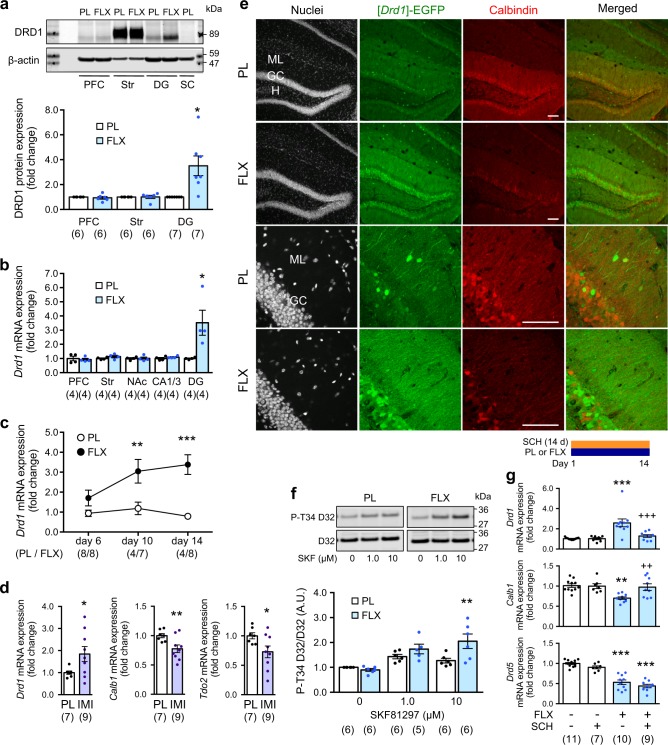
Fig. 1
Fig. 1
Effect of chronic antidepressant treatment on dopamine D1 receptor expression and signaling in the dentate gyrus. a D1 receptor protein (DRD1) expression in the prefrontal cortex (PFC), dorsal striatum (Str), dentate gyrus (DG), and spinal cord (SC) in fluoxetine (FLX; 15 mg/kg/day for 14 days) or placebo (PL) pellet-treated mice. 60 μg (prefrontal cortex, dentate gyrus, and spinal cord) or 6 μg (striatum) of samples were analyzed. Typical immunoblots are shown with quantitation. DRD1 expression is normalized with β-actin. Data represent mean ± SEM. *p< 0.05 vs. the placebo group; paired Student’s t test. b Drd1 mRNA expression in various brain regions in fluoxetine or placebo pellet-treated mice. NAc nucleus accumbens. Data represent mean ± SEM. *p< 0.05 vs. the placebo group; Student’s t test. c Time course of fluoxetine effects on Drd1 mRNA expression in the dentate gyrus. Data represent mean ± SEM. **p< 0.01, ***p< 0.001 vs. the placebo group; two-way ANOVA and Bonferroni post hoc test. d mRNA expression of Drd1, calbindin-D28K (Calb1) and Tdo2 in the dentate gyrus in imipramine (IMI; 10 mg/kg/day for 14 days) or placebo (PL) pellet-treated mice. Data represent mean ± SEM. *p < 0.05, **p < 0.01 vs. the placebo group; Student’s t test. Data in (ad) are normalized and represented as fold changes by fluoxetine or imipramine. e Immunofluorescence signal of a nuclear dye DraQ5, [Drd1]-EGFP and Calbindin-D28K in the dentate gyrus from [Drd1]-EGFP mice treated with the fluoxetine or placebo pellet. ML molecular layer, GC granule cell layer, H hilus. Scale bars, 100 µm. f Effects of a D1 receptor agonist, (±)-SKF81297 (1 and 10 µM), on PKA-mediated DARPP-32 phosphorylation in slices of the dentate gyrus from mice treated with the fluoxetine or placebo pellet. Typical immunoblots for detection of phospho-Thr34 and total DARPP-32 are shown with quantitation. Data represent mean ± SEM. **p< 0.01 vs. the placebo group; two-way ANOVA and Bonferroni post hoc test. g Effect of D1 receptor blockade with a specific antagonist, SCH23390 (SCH; 0.1 mg/kg/day i.p. for 14 days), on fluoxetine-induced changes in the gene expression of Drd1, Calb1 and Drd5 in the dentate gyrus. Data represent mean ± SEM. **p< 0.01, ***p< 0.001 vs. the fluoxetine (−)/SCH23390 (−) group; ++p< 0.01, +++p< 0.001 vs. the fluoxetine (+)/SCH23390 (−) group; one-way ANOVA and Newman−Keuls post hoc test. The number of mice is indicated in parentheses under each experimental condition
Fig. 2
Fig. 2
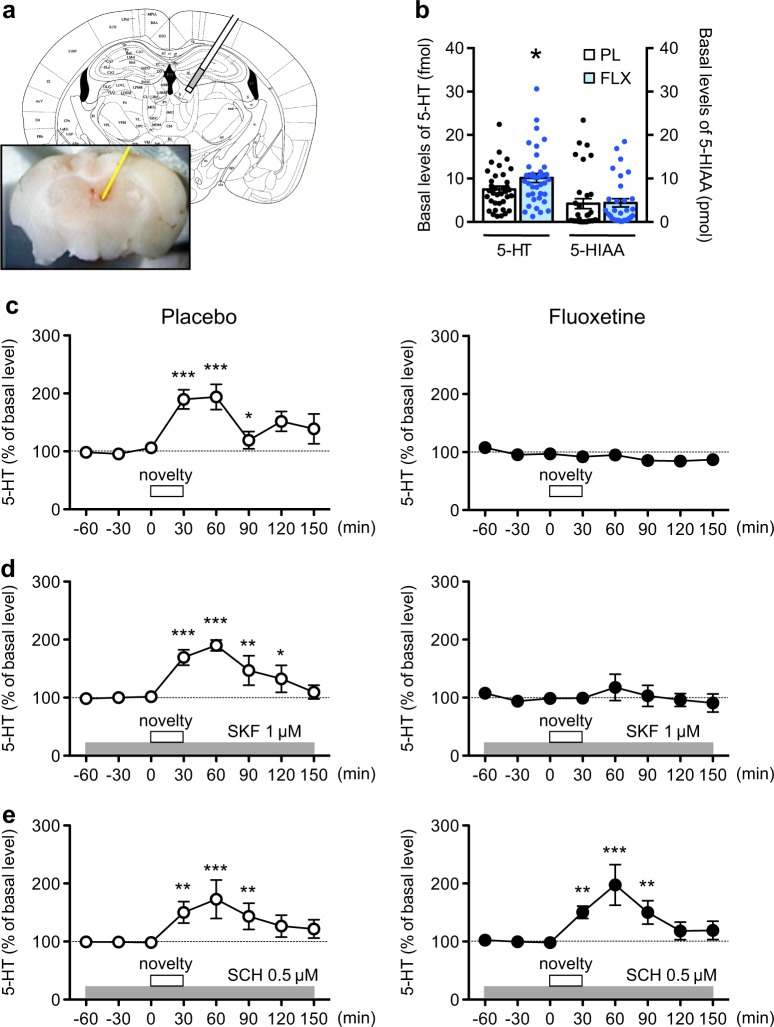
Effects of chronic fluoxetine treatment on 5-HT response to novelty stress. a Representative location of a microdialysis probe placed in the mouse dentate gyrus. The end of the dialysis probe is close to the habenula, but the end of the probe indicated with white color is inactive area. b Basal values of extracellular 5-HT and 5-HIAA contents in dialysates from the dentate gyrus of mice treated with the placebo (PL) or fluoxetine (FLX; 15 mg/kg/day for 14 days) pellet. Data are expressed as mean ± SEM. *p< 0.05 vs. the placebo group; Student’s t test. c Effects of novelty stress on 5-HT levels in dialysates from the dentate gyrus of mice treated with placebo (n = 5) or fluoxetine (n = 5). The open squares indicate the period (30 min) of novelty stress. d Effects of a local infusion of a D1 receptor agonist, R(+)-SKF81297 (1 µM), into the dentate gyrus on the 5-HT response to novelty stress in mice treated with placebo (n = 5) or fluoxetine (n = 5). e Effects of a local infusion of a D1 receptor antagonist, SCH23390 (0.5 µM), on the 5-HT response to novelty stress in mice treated with placebo (n = 5) or fluoxetine (n = 6). The data are expressed as mean ± SEM. *p < 0.05, **p < 0.01, ***p < 0.001 vs. the basal levels of dopamine in the same group
Fig. 3
Fig. 3
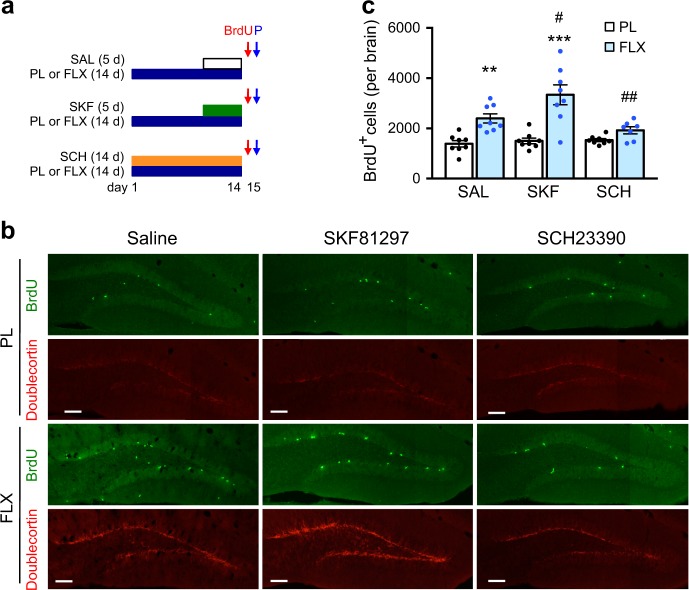
Role of fluoxetine-induced D1 receptors in adult neurogenesis in the dentate gyrus. a Experimental design for treatment of mice with placebo (PL) or fluoxetine (FLX; 15 mg/kg/day for 14 days) pellet and injection of R(+)-SKF81297 (SKF; 1.5 mg/kg/day i.p. for 5 days), SCH23390 (SCH; 0.1 mg/kg/day i.p. for 14 days) or saline (SAL) and for neurogenesis analysis with BrdU injection and perfusion (P). On day 15, mice were perfused 2 h after BrdU injection to evaluate cell proliferation. b, c Immunostaining with BrdU and doublecortin antibodies in the dentate gyrus (b) and quantitation of BrdU-positive cells in the subgranular zone of the dentate gyrus on both sides in placebo or fluoxetine pellet-treated mice (n = 7–8) (c). Scale bars, 100 µm. **p < 0.01 vs. the placebo/saline group; ***p < 0.001 vs. the placebo/SKF81297 group; two-way ANOVA and Bonferroni post hoc test. #p < 0.05 vs. the fluoxetine/saline group; ##p < 0.01 vs. the fluoxetine/SKF81297 group; one-way ANOVA and Newman−Keuls post hoc test
Fig. 4
Fig. 4
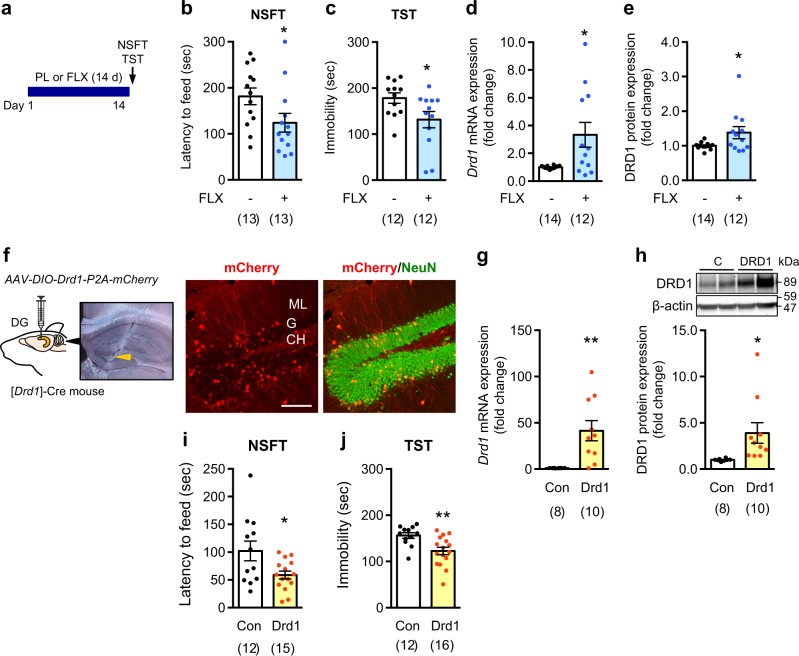
Role of D1 receptors on behavioral effects of chronic fluoxetine treatment. ae Effects of treatment with the placebo (PL) or fluoxetine (FLX; 15 mg/kg/day for 14 days) pellet on the latency to feed in the novelty-suppressed feeding test (NSFT) (b) and the immobility time in the tail suspension test (TST) (c). After the behavioral tests, the expression levels of Drd1 mRNA (d) and protein (e) in the dentate gyrus were evaluated. *p < 0.05 vs. the placebo group; Student’s t test. fj AAV vectors (AAV-DIO-Drd1-P2A-mCherry or AAV-DIO-YFP) were injected into both sides of the dentate gyrus of [Drd1]-Cre mice to overexpress D1 receptors. An image of the dentate gyrus obtained on the same day of needle insertion showed that the edge of injection needle (arrow head) was in the right place. mCherry was mainly expressed in NeuN-positive granule cells of the dentate gyrus after injection of AAV-DIO-Drd1-P2A-mCherry (f). ML molecular layer, GC granule cell layer, H hilus. Scale bars, 100 µm. Overexpression of D1 receptors in the dentate gyrus was confirmed by measurements of mRNA (g) and protein (h) levels. D1 receptor overexpression in the dentate gyrus decreased the latency to feed in the NSFT (i) and the immobility time in the TST (j). Data are expressed as mean ± SEM. *p < 0.05, **p < 0.01 vs. the control (C) group; Student’s t test. The number of mice is indicated in parentheses under each experimental condition
Fig. 5
Fig. 5
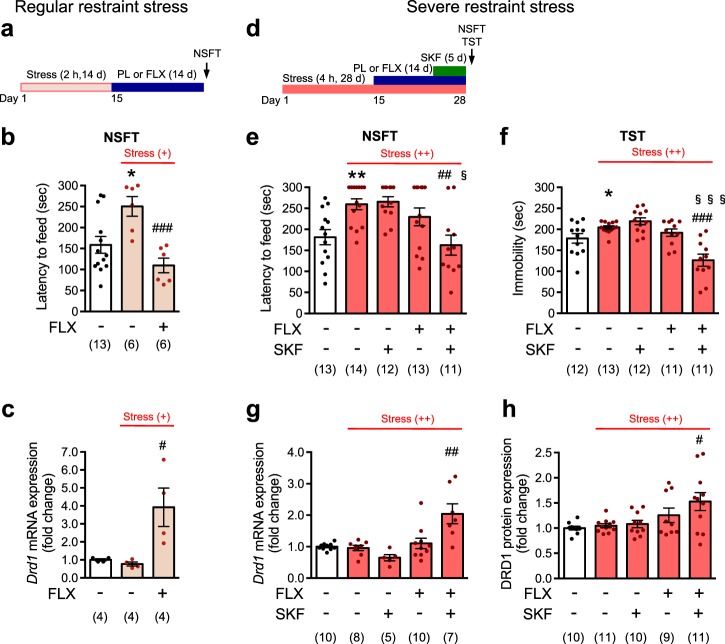
D1 receptor activation enhances antidepressant actions under severe stress conditions. ac Regular restraint stress. a An experimental design for regular restraint stress and fluoxetine (FLX; 15 mg/kg/day for 14 days) administration. b The latency to feed in NSFT was evaluated on day 29 in mice subjected to regular restraint stress. c mRNA levels of Drd1 in the dentate gyrus were evaluated after behavioral analyses. *p < 0.05 vs. the stress (−)-placebo group; #p < 0.05, ###p < 0.001 vs. stress (+)-placebo group; Student’s t test. d−h Severe restraint stress. d An experimental design for severe restraint stress and fluoxetine and R(+)-SKF81297 (SKF; 1.5 mg/kg i.p. for 5 days) administration. The latency to feed in the NSFT (e) and the immobility time in TST (f) were evaluated on day 29 in mice subjected to severe restraint stress. mRNA (g) and protein (h) levels of Drd1 in the dentate gyrus were evaluated after behavioral analyses. Dissected tissues of the dentate gyrus from hippocampal slices were randomly split into mRNA and protein analyses, although all the tissues were used for either mRNA or protein analysis in some mice. *p < 0.05, **p < 0.01 vs. stress (-)-placebo/saline group; Student’s t-test. #p < 0.05, ##p < 0.01, ###p < 0.001 vs. stress ( + + )-placebo/saline group; §p < 0.05, §§§p < 0.001 vs. stress (++)-fluoxetine/saline group; one-way ANOVA and Newman−Keuls post hoc test. The number of mice is indicated in parentheses under each experimental condition

Comment in

References

    1. Holtzheimer PE, Mayberg HS. Stuck in a rut: rethinking depression and its treatment. Trends Neurosci. 2011;34:1–9. - PMC - PubMed
    1. Thompson SM, Kallarackal AJ, Kvarta MD, Van Dyke AM, LeGates TA, Cai X. An excitatory synapse hypothesis of depression. Trends Neurosci. 2015;38:279–94. - PMC - PubMed
    1. Russo SJ, Nestler EJ. The brain reward circuitry in mood disorders. Nat Rev Neurosci. 2013;14:609–25. - PMC - PubMed
    1. Rush AJ, Trivedi MH, Wisniewski SR, Nierenberg AA, Stewart JW, Warden D, et al. Acute and longer-term outcomes in depressed outpatients requiring one or several treatment steps: a STAR*D report. Am J Psychiatry. 2006;163:1905–17. - PubMed
    1. MacQueen G, Frodl T. The hippocampus in major depression: evidence for the convergence of the bench and bedside in psychiatric research? Mol Psychiatry. 2011;16:252–64. - PubMed

Publication types