. 2019 Feb;15(2):115-122.
doi: 10.1038/s41589-018-0181-6. Epub 2018 Dec 10.

Design of fast proteolysis-based signaling and logic circuits in mammalian cells

Affiliations

Design of fast proteolysis-based signaling and logic circuits in mammalian cells

Tina Fink et al. Nat Chem Biol. 2019 Feb.

Abstract

Cellular signal transduction is predominantly based on protein interactions and their post-translational modifications, which enable a fast response to input signals. Owing to difficulties in designing new unique protein-protein interactions, designed cellular logic has focused on transcriptional regulation; however, that process has a substantially slower response, because it requires transcription and translation. Here, we present de novo design of modular, scalable signaling pathways based on proteolysis and designed coiled coils (CC) and implemented in mammalian cells. A set of split proteases with highly specific orthogonal cleavage motifs was constructed and combined with strategically positioned cleavage sites and designed orthogonal CC dimerizing domains with tunable affinity for competitive displacement after proteolytic cleavage. This framework enabled the implementation of Boolean logic functions and signaling cascades in mammalian cells. The designed split-protease-cleavable orthogonal-CC-based (SPOC) logic circuits enable response to chemical or biological signals within minutes rather than hours and should be useful for diverse medical and nonmedical applications.


Conflict of interest statement

Competing financial interests: The authors declare no competing interests.

Figures

Figure 1
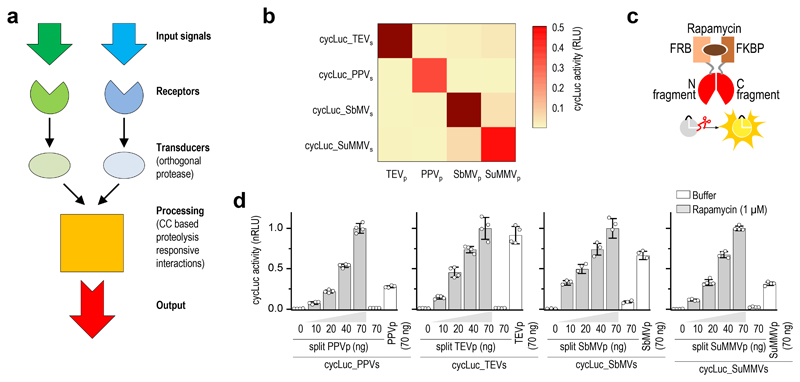
Figure 1. Design of the proteolysis-based signaling pathways and orthogonal proteases.
(a) Scheme of components of the proteolysis-based signaling pathways. (b) Heat map showing orthogonality of the four potyviral protease homologues tested in HEK293T cells, detected by the cycLuc reporter with a matching protease cleavage site. (c,d) Chemically inducible reconstitution of the split proteases 24h after induction with rapamycin (three-dimensional homology models of orthogonal split proteases are shown in Supplementary Fig. 1e). Values in (d) are the mean of four cell cultures ± (s.d.) and are representative of two independent experiments. Transfection plasmid mixtures are listed in Supplementary Table 1.
Figure 2
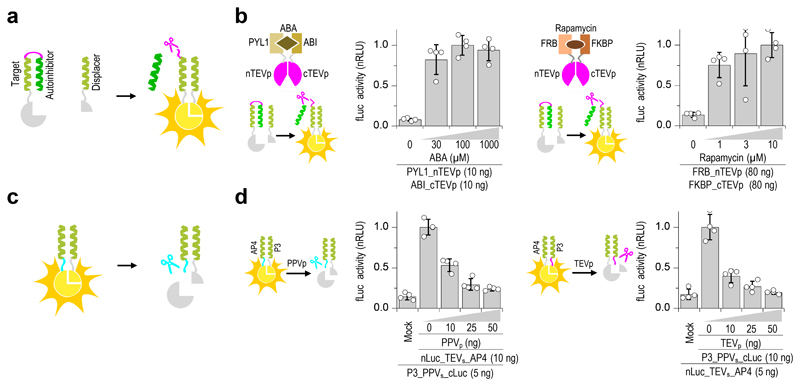
Figure 2. Design of proteolytic cleavage-responsive coiled-coil (CC) interaction modules.
(a) Design of the proteolytic cleavage-responsive CC rearrangement reconstituting the functional split protein. Upon linker cleavage, an autoinhibitory coil is replaced by a displacer segment with higher binding affinity to reconstitute the split effector/reporter. (b) Abscisic acid (ABA) and rapamycin inducible activation was demonstrated in HEK293T cells measured 30 min after induction with indicated concentration of ABA or rapamycin. (c) Design of a proteolytic cleavage-inactivated module (logical negation). A protease cleavage site is introduced between the CC-forming segments and split effector/reporter domain. After cleavage of the linker, split luciferase dissociates. (d) Decrease in luciferase activity upon co-transfection of logical negation functions with plasmids coding for specific proteases. Values in (b), and (d) are the mean of four cell cultures ± (s.d.) and representative of two independent experiments. Transfection plasmid mixtures are listed in Supplementary Table 1.
Figure 3
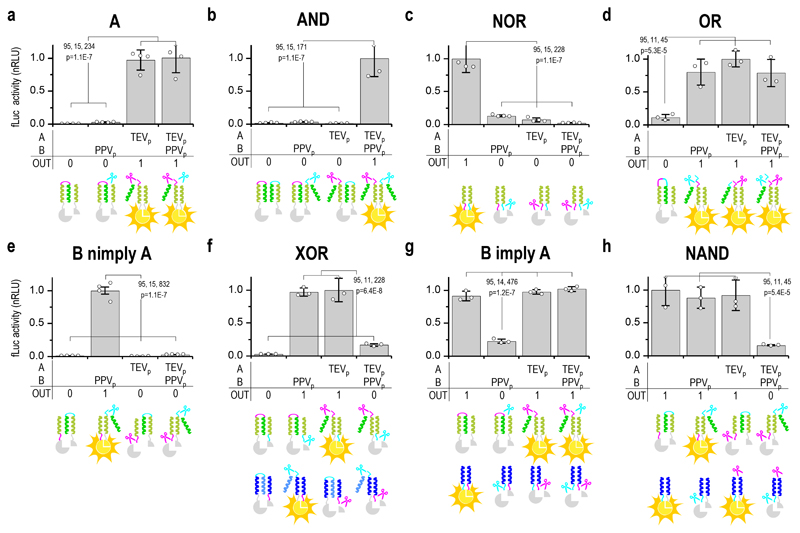
Figure 3. Design of Boolean logic functions implemented by split protease-cleavable orthogonal coiled-coil (CC)-based logic (SPOC logic).
Experimental analysis of SPOC logic function designs in HEK293T cells with introduced genetic circuits. The design and expected response to all input combinations is schematically shown below the graphs with experimental luciferase based results. Input signals are combinations of two orthogonal proteases TEVp and PPVp, and the output signal is split luciferase activity. The remaining Boolean SPOC logic circuits (B, NOT B, NOT A, A nimply B, A imply B, XNOR, NAND) are shown in Supplementary Fig. 9. Transfection plasmid mixtures are listed in Supplementary Table 2. Values are the mean of three (d-h) and four (a-c,e) cell cultures ± (s.d.) and are representative of two independent experiments. Significance was tested by 1-way ANOVA with Tukey’s comparison (values CI, df, F and p are indicated on graphs).
Figure 4
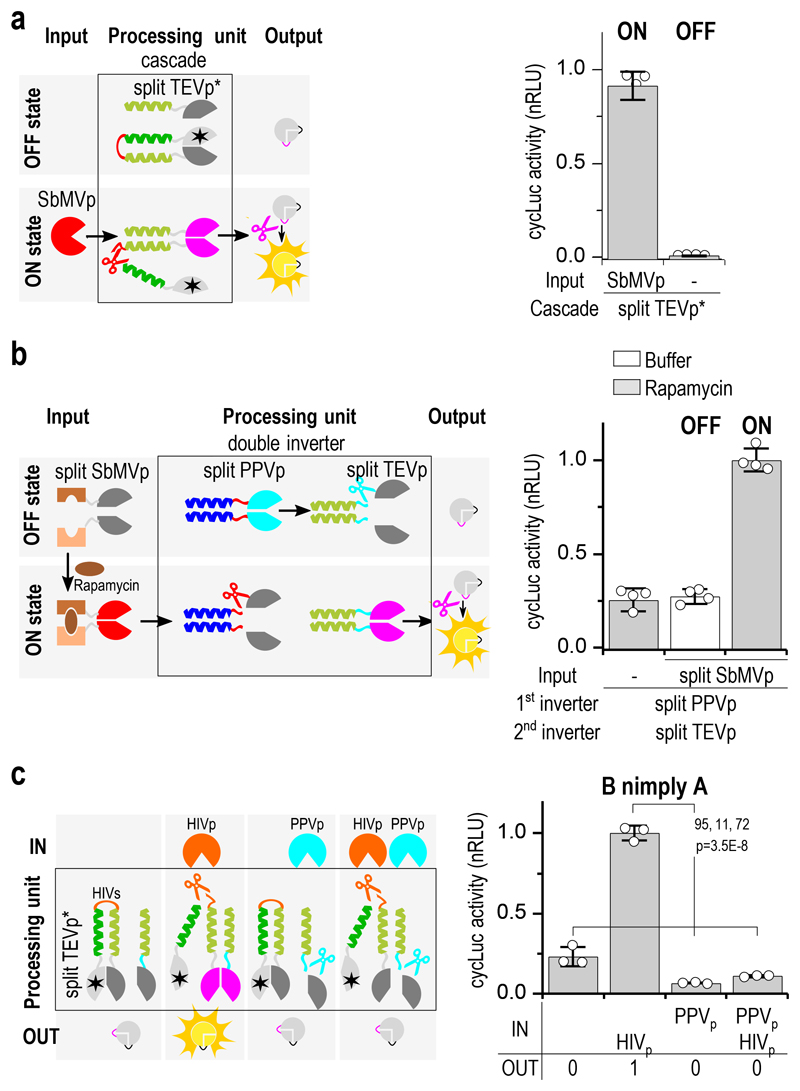
Figure 4. Multilayer design of proteolysis-based signaling pathways.
(a) Two-layer protease-cascade function with a catalytically inactive split tobacco etch virus protease (TEVp*) domain fused to the autoinhibitory CC shows decreased leakage and higher fold activation (see also Supplementary Fig. 11). (b) Double inverter consisting of a split TEVp regulated by split plum pox virus protease (PPVp), where PPVp is regulated by the rapamycin-induced split soybean mosaic virus protease (SbMVp). (c) B nimply A logic function combining human immunodeficiency virus-1 (HIV-1p) and PPVp as input signals. “SQVSQNYPIVQNLQ” recognition sequence for HIV-1 protease was used. Transfection plasmid mixtures are listed in Supplementary Table 1, 4. Values are the mean of three (c) and four (a,b) cell cultures ± (s.d.) and are representative of at least two independent experiments, significance tested by 1-way ANOVA with Tukey’s comparison between the indicated ON and OFF states (CI=95%, df=11, F=72 (c)).
Figure 5
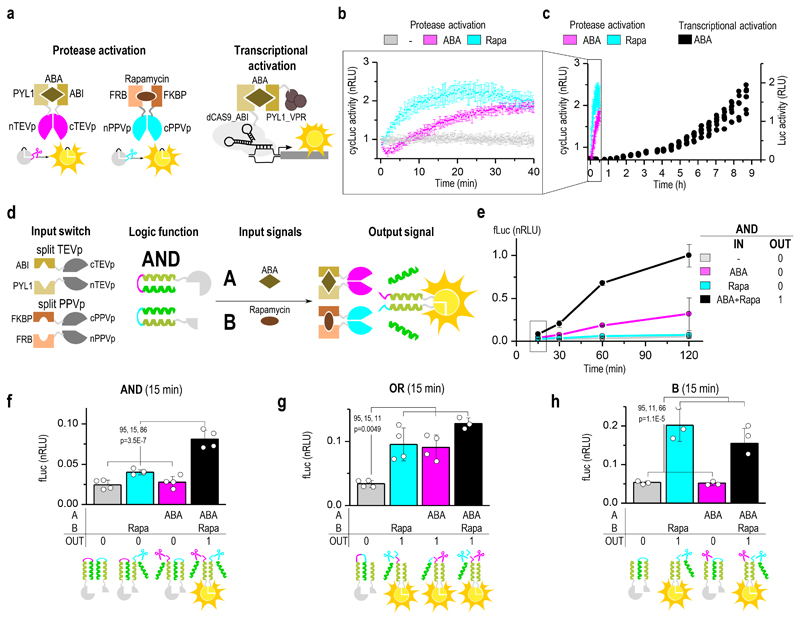
Figure 5. Fast kinetics of the proteolysis-mediated signaling pathway.
(a) Scheme of the reconstitution of the split tobacco etch virus protease (TEVp) by abscisic acid (ABA) and split plum pox virus protease (PPVp) by rapamycin measured using cyclic luciferase reporter in HEK293 cells. A CRISPR/dCas9-based activator was used as comparison for the kinetics of the transcriptional control of luciferase activation. (b) Continuous online monitoring of chemically induced luciferase activity in HEK293T cells and comparison with the kinetics of transcriptional activation (c). (d) Schematic presentation of building blocks for inducible split protease-cleavable orthogonal CC-based logic (SPOC logic) functions. (e) Kinetics of chemically regulated AND function where both segments of the split luciferase are activated by proteolytic cleavage. Significant response was detected in less than 15 minutes after the addition of chemical inducers. (f-h) SPOC logic functions AND, OR, and B regulated by rapamycin and ABA 15 minutes after induction. Transfection mixtures are listed in Supplementary Table 5, 6. Values are the mean of three (f) and four (b, c, e-g) cell cultures ± (s.d.) and are representative of two independent experiments, significance tested by 1-way ANOVA with Tukey’s comparison between the indicated ON and OFF states (values CI, df, F and p are indicated on graphs (f-h)).

Comment in

  • Protein circuits reprogram cells.
    Wu Y, Wang Y. Wu Y, et al. Nat Chem Biol. 2019 Feb;15(2):96-97. doi: 10.1038/s41589-018-0210-5. Nat Chem Biol. 2019. PMID: 30617291 Free PMC article.

References

    1. Cohen GB, Ren R, Baltimore D. Modular binding domains in signal transduction proteins. Cell. 1995;80:237–248. - PubMed
    1. Nandagopal N, Elowitz MB. Synthetic biology: integrated gene circuits. Science. 2011;333:1244–8. - PMC - PubMed
    1. Good MC, Zalatan JG, Lim WA. Scaffold proteins: Hubs for controlling the flow of cellular information. Science (80-. ) 2011;332:680–686. - PMC - PubMed
    1. Gordley RM, et al. Engineering dynamical control of cell fate switching using synthetic phospho-regulons. Proc Natl Acad Sci. 2016;113:13528–13533. - PMC - PubMed
    1. Dueber JE, Yeh BJ, Chak K, Lim WA. Reprogramming control of an allosteric signaling switch through modular recombination. Science. 2003;301:1904–8. - PubMed

Publication types