. 2018 Dec 10;9(1):5275.
doi: 10.1038/s41467-018-07673-1.

Molecular Russian dolls

Affiliations

Molecular Russian dolls

Kang Cai et al. Nat Commun. .

Abstract

The host-guest recognition between two macrocycles to form hierarchical non-intertwined ring-in-ring assemblies remains an interesting and challenging target in noncovalent synthesis. Herein, we report the design and characterization of a box-in-box assembly on the basis of host-guest radical-pairing interactions between two rigid diradical dicationic cyclophanes. One striking feature of the box-in-box complex is its ability to host various 1,4-disubstituted benzene derivatives inside as a third component in the cavity of the smaller of the two diradical dicationic cyclophanes to produce hierarchical Russian doll like assemblies. These results highlight the utility of matching the dimensions of two different cyclophanes as an efficient approach for developing new hybrid supramolecular assemblies with radical-paired ring-in-ring complexes and smaller neutral guest molecules.


Conflict of interest statement

The authors declare no competing interests.

Figures
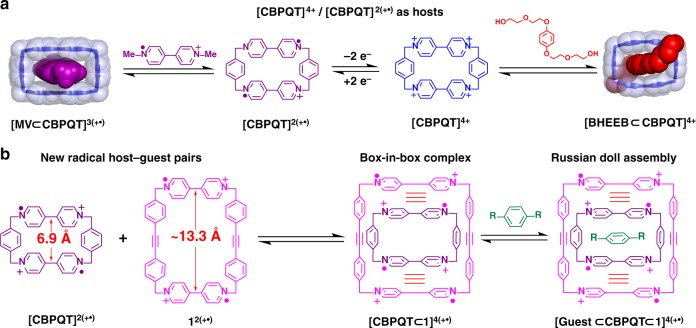
Fig. 1
Fig. 1
Design and structures. a Examples of CBPQT4+ and CBPQT2(+•) as hosts. b Proposed superstructures of the tetraradical tetracationic box-in-box complex and Russian doll assemblies
Fig. 2
Fig. 2
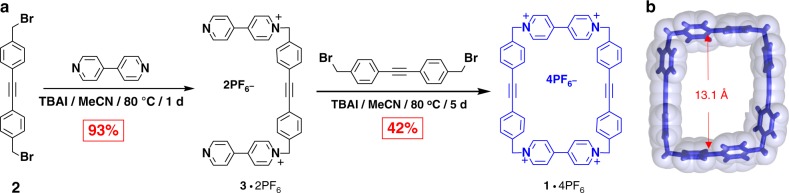
Synthesis and crystal structure. a Synthesis of 4PF6 and b solid-state structure of 14+
Fig. 3
Fig. 3
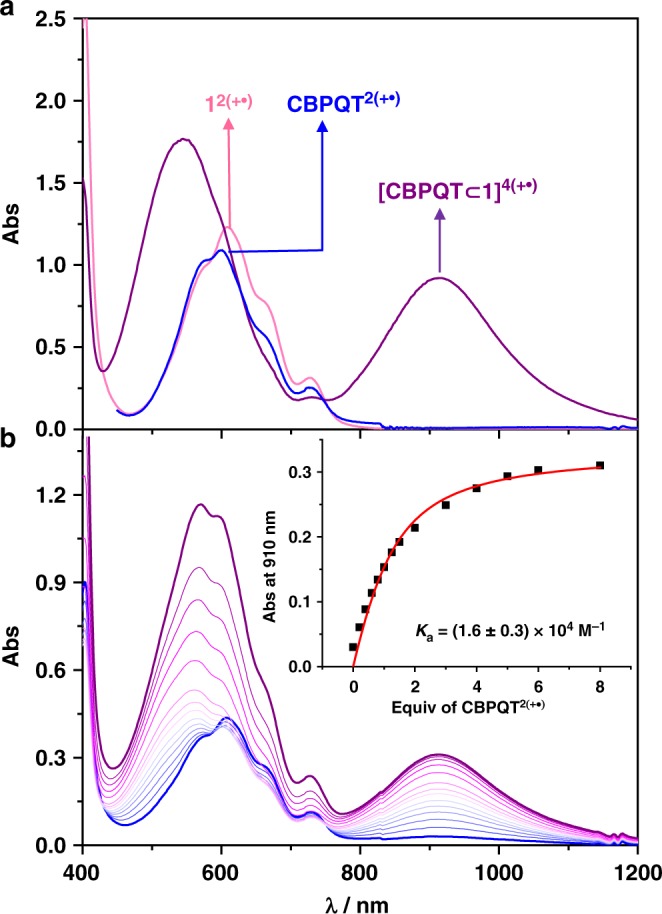
UV–Vis–NIR characterization of [CBPQT ⊂ 1]4(+•). a UV–Vis–NIR spectra (0.50 mM in MeCN, 1 mm path cuvette) of CBPQT2(+•) (blue), 12(+•) (red), and a 1:1 molar ratio of CBPQT2(+•) and 12(+•) (purple); b Vis/NIR Spectra (MeCN, 2 mm cuvette) on titrating CBPQT2(+•) into 12(•+) (0.10 mM). Initial and final spectra are highlighted in blue and purple, respectively. The inset shows the change in absorption at 910 nm on titration of 12(+•) with CBPQT2(+•). Curve fitting is highlighted in red
Fig. 4
Fig. 4
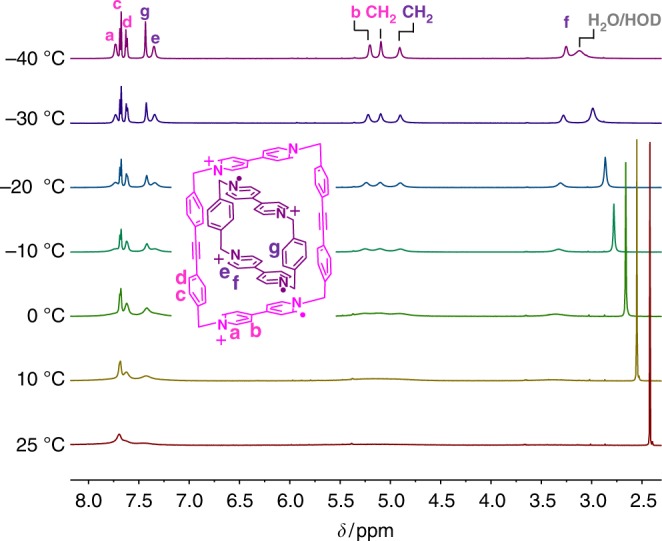
VT-NMR studies of [CBPQT ⊂ 1]4(+•). 1H NMR Spectra recorded from −40 to +25 °C for a 1:1 molar mixture of CBPQT2(+•) and 12(•+) (1.0 mM each) in CD3CN
Fig. 5
Fig. 5
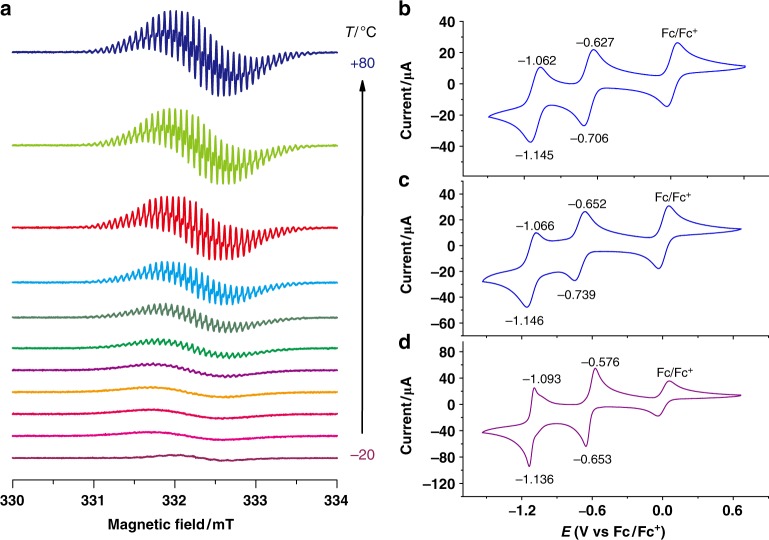
EPR characterization. a EPR Spectra recorded in 10 degree interval on a 1:1 molar mixture of CBPQT2(+•) and 12(+•) (0.50 mM each) in MeCN. Cyclic voltammograms of b 14+ (0.20 mM), c CBPQT4+ (0.20 mM), and d a 1:1 molar mixture of 14+ and CBPQT4+ (0.20 mM each)
Fig. 6
Fig. 6
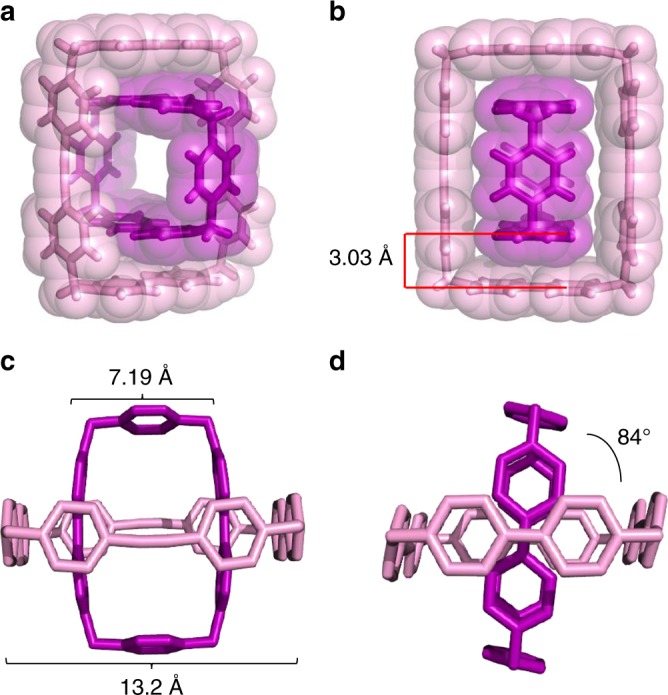
Solid-state superstructures of [CBPQT ⊂ 1]4(+•). a Perspective and b plan views depicted as tubular and space-filling representations. c, d Different side-on views, depicted as tubular representations. Hydrogen atoms in c and d are omitted for the sake of clarity
Fig. 7
Fig. 7
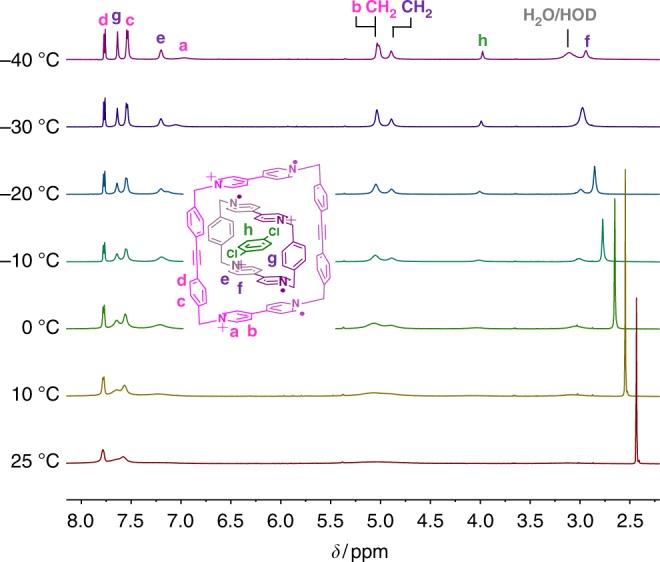
VT-NMR studies of [p-C6H4Cl2 ⊂ CBPQT ⊂ 1]4(+•) 1H NMR Spectra recorded from −40 to +25 °C for a 1:1:1 molar mixture of CBPQT2(+•), 12(+•) and 1,4-dichlorobenzene (1.0 mM each) in CD3CN
Fig. 8
Fig. 8
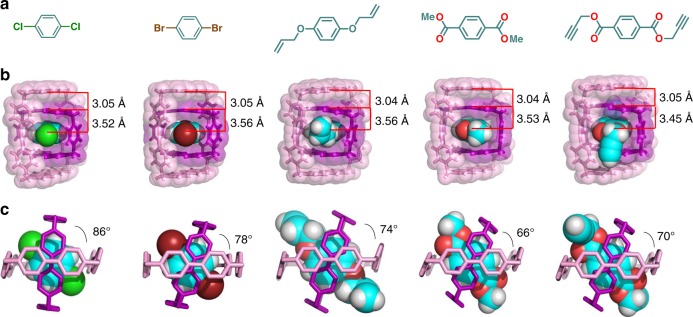
Solid-state superstructure of Russian doll assemblies with different guests inside the [CBPQT ⊂ 1]4(+•) complex. a Structural formulas of the guest molecules. b Perspective views depicted as tubular and space-filling representations. c Side-on views depicted as tubular representations. Hydrogen atoms are omitted for the sake of clarity

References

    1. Pedersen CJ. Cyclic polyethers and their complexes with metal salts. J. Am. Chem. Soc. 1967;89:7017–7036. doi: 10.1021/ja01002a035. - DOI
    1. Pedersen CJ. Crystalline salt complexes of macrocyclic polyethers. J. Am. Chem. Soc. 1970;92:386–391. doi: 10.1021/ja00705a605. - DOI
    1. Dietrich B, Lehn JM, Sauvage. JP. Diaza-polyoxa-macrocycles et macrobicycles. Tetrahedron Lett. 1969;10:2885–2888. doi: 10.1016/S0040-4039(01)88299-X. - DOI
    1. Cram DJ, et al. Spherands—ligands whose binding of cations relieves enforced electron-electron repulsions. J. Am. Chem. Soc. 1979;101:6752–6754. doi: 10.1021/ja00516a048. - DOI
    1. Lehn JM. Supramolecular chemistry—scope and perspectives molecules, supermolecules, and molecular devices (Nobel Lecture) Angew. Chem. Int. Ed. Engl. 1988;27:89–112. doi: 10.1002/anie.198800891. - DOI

Publication types