


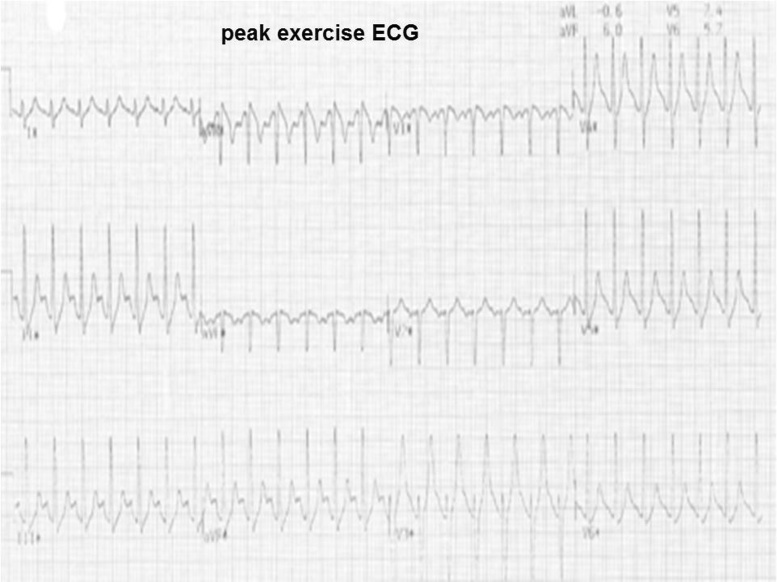
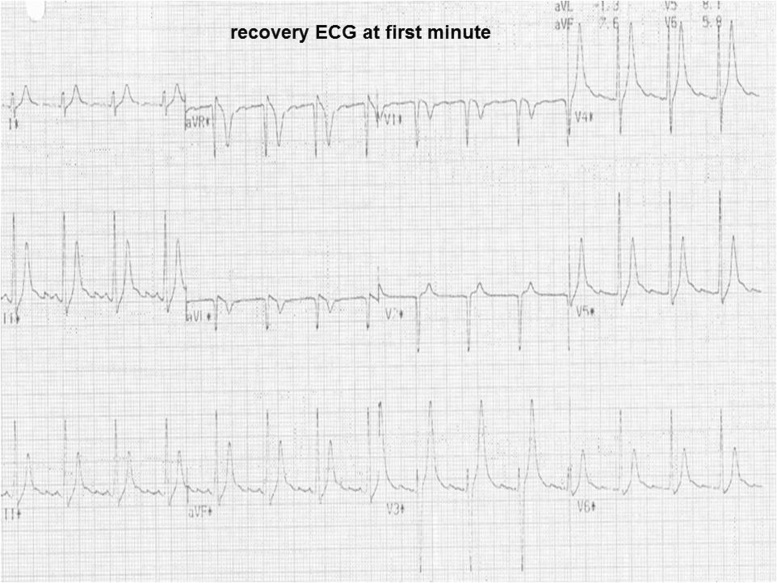
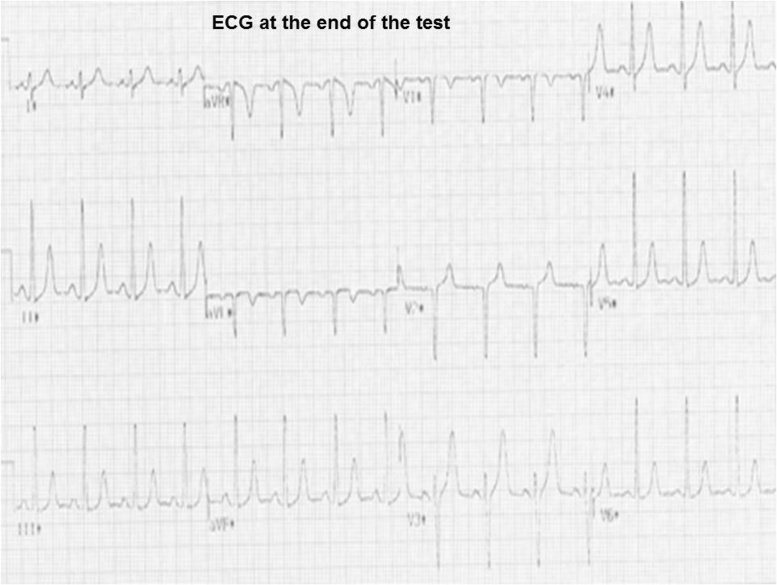
Exercise-related QT interval shortening with a peaked T wave in a boy with MEN 2 syndrome
- PMID: 30533133
- PMCID: PMC6275294
- DOI: 10.1016/j.jccase.2012.10.012
Exercise-related QT interval shortening with a peaked T wave in a boy with MEN 2 syndrome
Abstract
Multiple endocrine neoplasia 2 (MEN 2) is a hereditary syndrome associated with medullary thyroid carcinoma, pheochromocytoma (PCC), and hyperparathyroidism. PCCs in patients with MEN 2 are usually found in the adrenals after the manifestation of medullary thyroid cancer and are commonly bilateral and hormonally active. Unfortunately, a diagnosis of MEN 2 or PCC often is delayed until after the patient has developed an advanced MEN 2-related tumor. We present unusual electrocardiographic changes on exercise testing in MEN 2 syndrome. Transient peaked T waves and shortening QT during exercise stress testing may provide an early clue for undiagnosed PCC. <Learning objective: Stress testing is not just for the diagnosis of ischemia but it may be used to evaluate patients with symptoms that suggest exercise-induced arrhythmias. The pheochromacytoma is a disorder characterized by excess of catecholamines and is usually difficult to diagnose. Excessive sympathetic stimulation is toxic to myocytes and this toxicity may reveal itself as ECG changes such as peaked T waves and shortening of QT interval. Such changes on ECG during sympathetic stimulation such as exercise testing should raise the suspicion of pheochromacytoma.>.
Keywords: Exercise-induced arrhythmia; MEN syndrome.
Figures


References
-
- Brandi M.L., Gagel R.F., Angeli A., Bilezikian J.P., Beck-Peccoz P., Bordi C., Conte-Devolx B., Falchetti A., Gheri R.G., Libroia A., Lips C.J., Lombardi G., Mannelli M., Pacini F., Ponder B.A. Guidelines for diagnosis and therapy of MEN type 1 and type 2. J Clin Endocrinol Metab. 2001;86:5658–5671. - PubMed
-
- Yu R., Furmark L., Wong C. Cardiac abnormalities associated with pheochromocytoma and other adrenal tumors. Endocr Pract. 2009;15:10–16. - PubMed
-
- Stenström G., Swedberg K. QRS amplitudes, QTc intervals and ECG abnormalities in pheochromocytoma patients before, during and after treatment. Acta Med Scand. 1988;224:231–235. - PubMed
-
- Madias G.E., Agarwal H. Unusual ECG responses to exercise stress testing. J Electrocardiol. 2001;34:265–269. - PubMed
-
- Manankil M.F., Wang T., Bhat P.K. Transient peaked T waves during exercise stress testing: an unusual manifestation of reversible cardiac ischemia. J Electrocardiol. 2011;44:23–26. - PubMed
LinkOut - more resources
Full Text Sources
