. 2018 Dec 4:16:31.
doi: 10.1186/s12959-018-0186-0. eCollection 2018.

Exploratory evaluation of pharmacodynamics, pharmacokinetics and safety of rivaroxaban in children and adolescents: an EINSTEIN-Jr phase I study

Affiliations

Exploratory evaluation of pharmacodynamics, pharmacokinetics and safety of rivaroxaban in children and adolescents: an EINSTEIN-Jr phase I study

Dagmar Kubitza et al. Thromb J. .

Abstract

Background: The EINSTEIN-Jr program will evaluate rivaroxaban for the treatment of venous thromboembolism (VTE) in children, targeting exposures similar to the 20 mg once-daily dose for adults.

Methods: This was a multinational, single-dose, open-label, phase I study to describe the pharmacodynamics (PD), pharmacokinetics (PK) and safety of a single bodyweight-adjusted rivaroxaban dose in children aged 0.5-18 years. Children who had completed treatment for a venous thromboembolic event were enrolled into four age groups (0.5-2 years, 2-6 years, 6-12 years and 12-18 years) receiving rivaroxaban doses equivalent to 10 mg or 20 mg (either as a tablet or oral suspension). Blood samples for PK and PD analyses were collected within specified time windows.

Results: Fifty-nine children were evaluated. In all age groups, PD parameters (prothrombin time, activated partial thromboplastin time and anti-Factor Xa activity) showed a linear relationship versus rivaroxaban plasma concentrations and were in line with previously acquired adult data, as well as in vitro spiking experiments. The rivaroxaban pediatric physiologically based pharmacokinetic model, used to predict the doses for the individual body weight groups, was confirmed. No episodes of bleeding were reported, and treatment-emergent adverse events occurred in four children and all resolved during the study.

Conclusions: Bodyweight-adjusted, single-dose rivaroxaban had predictable PK/PD profiles in children across all age groups from 0.5 to 18 years. The PD assessments based on prothrombin time and activated partial thromboplastin time demonstrated that the anticoagulant effect of rivaroxaban was not affected by developmental hemostasis in children.

Trial registration: ClinicalTrials.gov number, NCT01145859.

Keywords: Developmental hemostasis; Pharmacodynamics; Pharmacokinetics; Rivaroxaban; Venous thromboembolism.


Conflict of interest statement

The protocol was approved by the Institutional Review Board or Ethics Committee of each participating center, if required, and de-identified data was retrieved.Not applicable.DK, SW, MB, KT and AWAL are employees of Bayer. GY, AC, PS, and PM have no competing to report. LRB has received research funds from Sanofi Aventis, and has received honoraria from Bayer and from Boehringer Ingelheim. CM has received honoraria from Bayer AG, Boehringer Ingelheim, and Bristol-Myers Squibb. GK has received honoraria from OPKO biologics, Bayer, Pfizer, CSL, Alnylam, Shire and Roche. IM has received consultancy fees from Bayer.Springer Nature remains neutral with regard to jurisdictional claims in published maps and institutional affiliations.

Figures
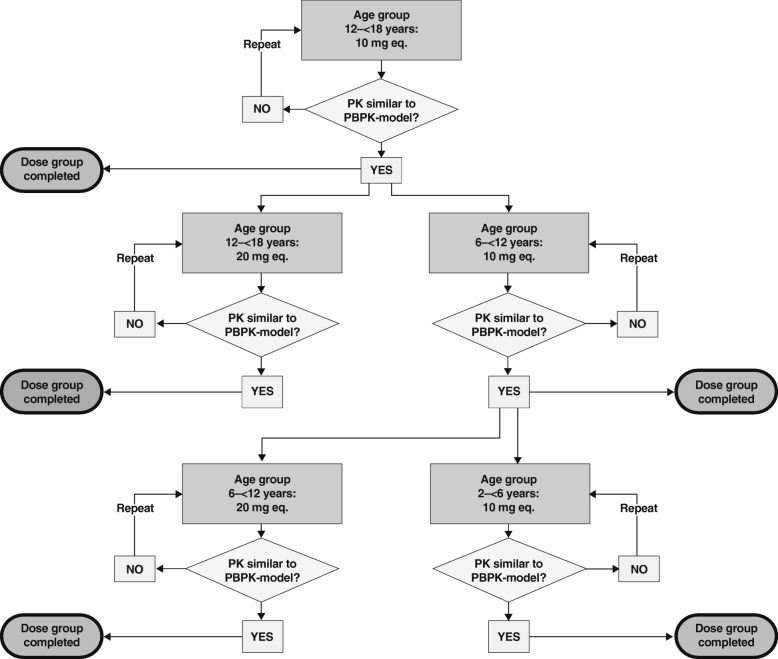
Fig. 1
Fig. 1
Staggered approach; decision tree of the Data Monitoring Committee. PBPK, physiologically based pharmacokinetic; PK, pharmacokinetics
Fig. 2
Fig. 2
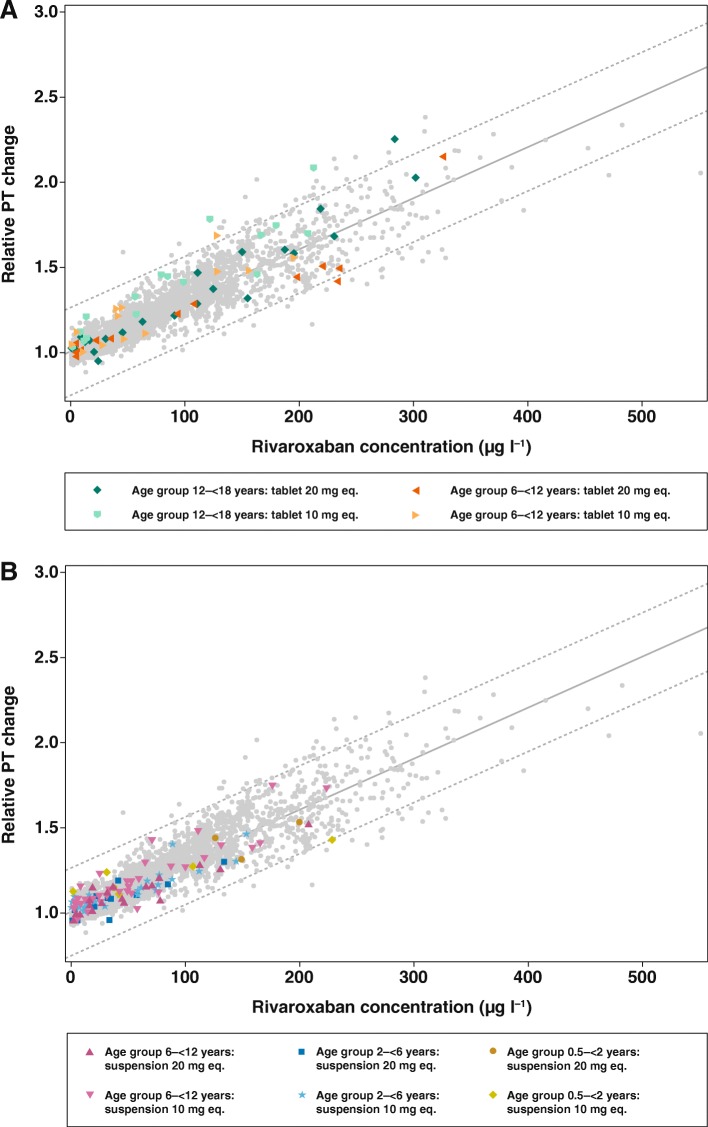
Prothrombin time changes from baseline for all ages and all doses with (a) rivaroxaban tablet and (b) rivaroxaban suspension. Light grey dots are data points from healthy adult volunteers; coloured dots represent individual data from children. A linear relationship was assumed for the concentration–response curve. 99% prediction intervals were used to depict the variability in the pooled data. The two reference populations consisted of healthy adult volunteers from phase I trials, who received either a single dose of rivaroxaban 10 mg (age 18–40 years, n = 171), or a single dose of rivaroxaban 20 mg (age 18–40 years, n = 101). PT change from baseline (x-fold) is individual PT at a distinct time point, divided by individual PT prior to drug administration. eq., equivalent; PT, prothrombin time
Fig. 3
Fig. 3
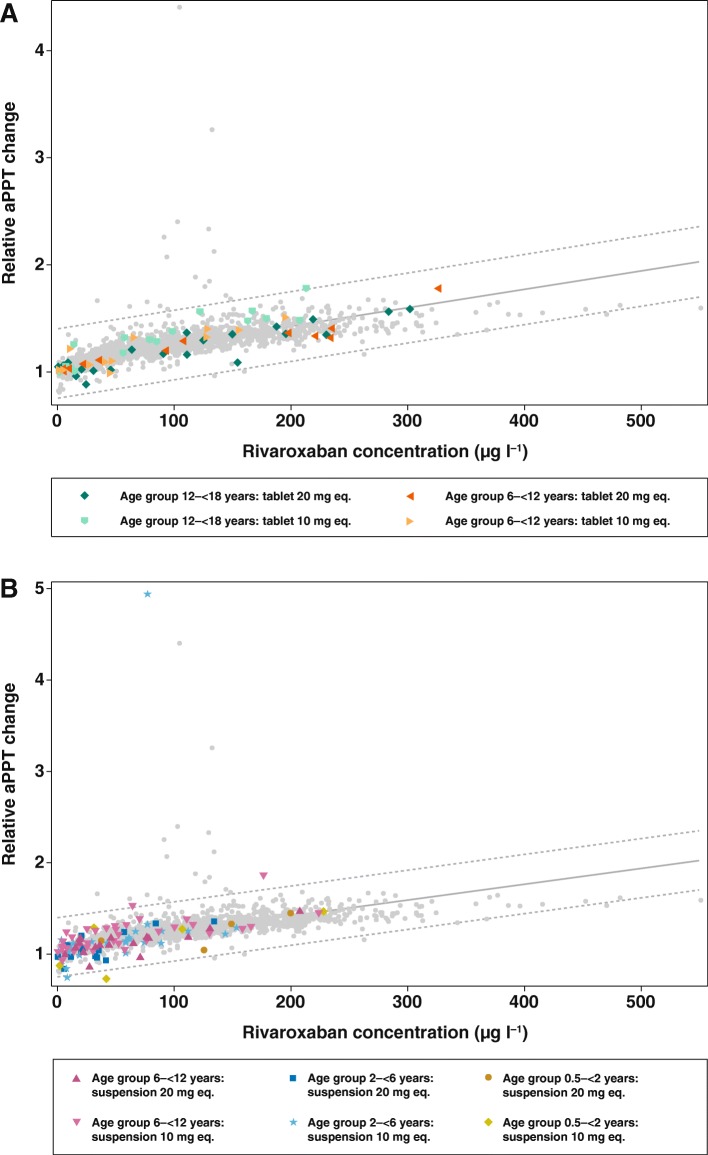
Activated partial thromboplastin time changes from baseline for all ages and all doses with (a) rivaroxaban tablet and (b) rivaroxaban suspension. Light grey dots are data points from healthy adult volunteers; coloured dots represent individual data from children. A linear relationship was assumed for the concentration–response curve. 99% prediction intervals were used to depict the variability in the pooled data. The two reference populations consist of healthy adult volunteers from phase I trials, who received either a single dose of rivaroxaban 10 mg (age 18–40 years, n = 171), or a single dose of rivaroxaban 20 mg (age 18–40 years, n = 101). aPTT change from baseline (x-fold) is individual aPTT at a distinct time point, divided by individual aPTT prior to drug administration. aPPT, activated partial thromboplastin time; eq., equivalent
Fig. 4
Fig. 4
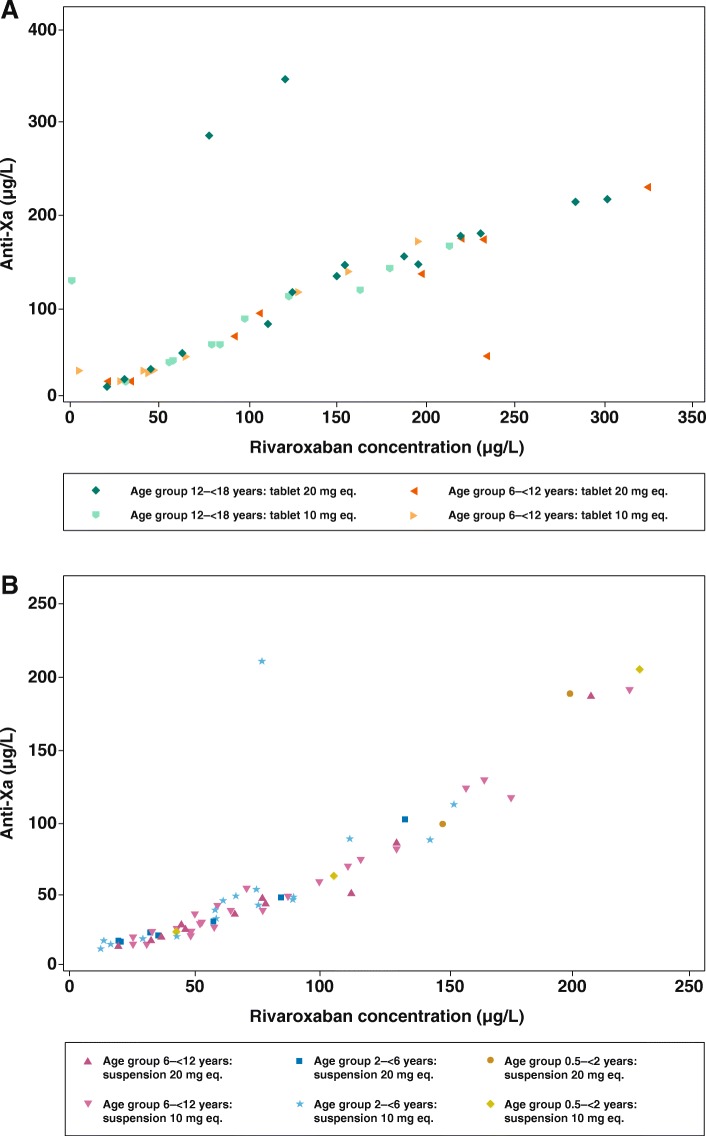
Anti-Factor Xa activity versus plasma concentrations; rivaroxaban 10 mg and 20 mg-equivalent doses for all age groups (n = 59) with (a) rivaroxaban tablet and (b) rivaroxaban suspension. Anti-Factor Xa activity within the 24 h after administration of rivaroxaban; eq., equivalent
Fig. 5
Fig. 5
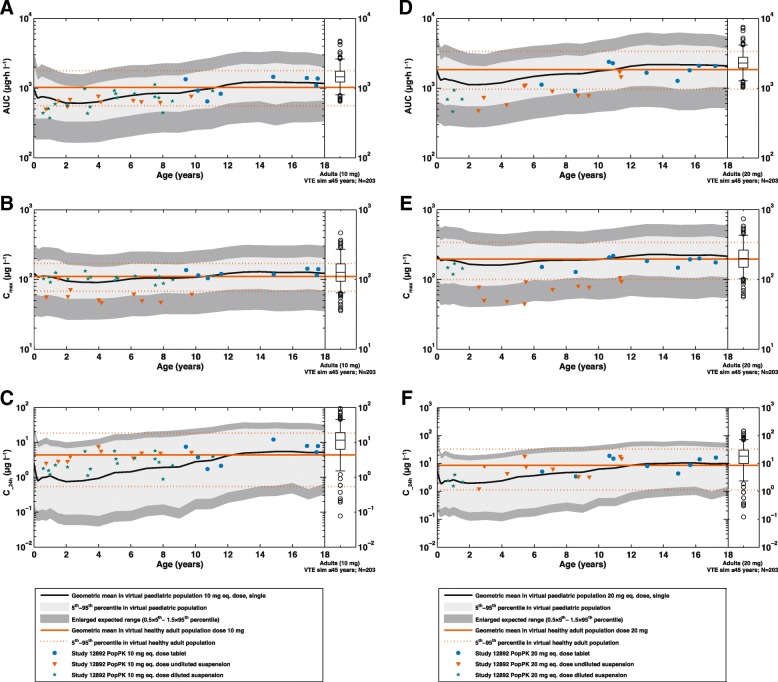
a Area under the plasma concentration–time curve from time 0–24 h (AUC); (b) maximum plasma concentration (Cmax) and (c) minimum plasma concentration measured 20–24 h after rivaroxaban administration (C_24h) versus age for rivaroxaban 10 mg dose equivalent; and (d) AUC, (e) Cmax and (f) C_24h versus age for rivaroxaban 20 mg dose equivalent, for children and adolescents between 6 months and 18 years of age, compared with the corresponding PBPK model predictions for children and adolescents, simulated via PBPK modelling and population PK modelling (box-whisker plot indicating the percentiles 5, 25, 50, 75 and 95). The grey shaded region shows the interval between the 5th and 95th percentiles of the population simulations with the PBPK model, the dashed shaded region shows an enlarged expected range due to uncertainties of some physiological parameters in children that may affect the absorption and clearance. The upper limit of this expanded range was calculated as 1.5 x 95th percentile and the lower limit was calculated as 0.5 x 5th percentile of the PBPK model estimate. PBPK, physiologically based pharmacokinetic; PK, pharmacokinetics

References

    1. Prins MH, Lensing AWA, Bauersachs R, van Bellen B, Bounameaux H, Brighton TA, et al. Oral rivaroxaban versus standard therapy for the treatment of symptomatic venous thromboembolism: a pooled analysis of the EINSTEIN-DVT and PE randomized studies. Thromb J. 2013;11:21. doi: 10.1186/1477-9560-11-21. - DOI - PMC - PubMed
    1. Monagle P, Ignjatovic V, Savoia H. Hemostasis in neonates and children: pitfalls and dilemmas. Blood Rev. 2010;24:63–68. doi: 10.1016/j.blre.2009.12.001. - DOI - PubMed
    1. Attard C, Monagle P, Kubitza D, Ignjatovic V. The in vitro anticoagulant effect of rivaroxaban in children. Thromb Res. 2012;130:804–807. doi: 10.1016/j.thromres.2012.07.009. - DOI - PubMed
    1. Attard C, Monagle P, Kubitza D, Ignjatovic V. The in-vitro anticoagulant effect of rivaroxaban in neonates. Blood Coagul Fibrinolysis. 2014;25:237–240. doi: 10.1097/MBC.0000000000000033. - DOI - PubMed
    1. Kearns GL, Abdel-Rahman SM, Alander SW, Blowey DL, Leeder JS, Kauffman RE. Developmental pharmacology-drug disposition, action, and therapy in infants and children. N Engl J Med. 2003;349:1157–1167. doi: 10.1056/NEJMra035092. - DOI - PubMed

Associated data