Review
. 2018 Nov 26:12:447.
doi: 10.3389/fncel.2018.00447. eCollection 2018.

An Integrated Cytoskeletal Model of Neurite Outgrowth

Affiliations
Review

An Integrated Cytoskeletal Model of Neurite Outgrowth

Kyle E Miller et al. Front Cell Neurosci. .

Abstract

Neurite outgrowth underlies the wiring of the nervous system during development and regeneration. Despite a significant body of research, the underlying cytoskeletal mechanics of growth and guidance are not fully understood, and the relative contributions of individual cytoskeletal processes to neurite growth are controversial. Here, we review the structural organization and biophysical properties of neurons to make a semi-quantitative comparison of the relative contributions of different processes to neurite growth. From this, we develop the idea that neurons are active fluids, which generate strong contractile forces in the growth cone and weaker contractile forces along the axon. As a result of subcellular gradients in forces and material properties, actin flows rapidly rearward in the growth cone periphery, and microtubules flow forward in bulk along the axon. With this framework, an integrated model of neurite outgrowth is proposed that hopefully will guide new approaches to stimulate neuronal growth.

Keywords: actin; active matter; axonal elongation; axonal transport; dynein; growth cone; microtubule; non-muscle myosin II.


Figures

FIGURE 1
FIGURE 1
Overview of the neurite and growth cone. (A) Phase contrast image of an Aplysia bag cell neuron. (B) Schematic of the neuronal growth cone depicting different cytoplasmic regions and cytoskeletal structures. Adapted from O’Toole et al. (2015) with permission from Elsevier.
FIGURE 2
FIGURE 2
An integrated cytoskeletal model of neurite outgrowth. (A) Summary of the mechanisms, structures/proteins, and functions reviewed in the manuscript. (B) A diagram of the interrelationship between the structures. (C) Overview of significant sources of internal force generation; arrows pointing together indicate a contractile force dipole, a line with arrowheads on each end represents an extensile force dipole. The length of the arrows (or pairs of arrows) gives a relative indication of the force associated with each process. (D) Traction forces exerted on the substrate; the length of the arrows indicates relative magnitude. (E) Flow map, arrow length indicates relative velocity. The force and velocity vectors are shown over a blurred image of the underlying structure to give a sense of relative location.
FIGURE 3
FIGURE 3
The axonal actin cortex as a weakly ordered meshwork. Hypothetical interactions of axonal NMII filaments with actin and spectrin in a weakly organized meshwork. Myosin filament reprinted from Niederman and Pollard (1975) with permission from Elsevier.
FIGURE 4
FIGURE 4
Microtubule polarity and length increase during axonal outgrowth. (A) Initial growth cone with the arrows representing the length and orientation of MTs. (B) During neurogenesis, MT sliding adds new short MTs with mixed orientations. (C) As axons elongate polarity and MT length increase, while sliding and MT number decrease.
FIGURE 5
FIGURE 5
Mass addition to the growth cone does not drive axonal elongation. Differential interference contrast images of Aplysia bag cell neuronal growth cone immediately after cell plating (left), 2 h later (middle), and 7 h later (right). Scale bar: 10 mμm. Reprinted from Ren and Suter (2016) with permission from Hindawi.
FIGURE 6
FIGURE 6
Neuronal force balance. Strong contractile forces by NMIIB and NMIIC at the leading edge pull the transition zone and central domain forward. These forces are countered by NMIIA in the axon and assisted by extensile forces generated through dynein mediated sliding of MTs and MT assembly. Axonal elongation occurs when the traction forces that pull the transition zone forward are higher than the net contractile forces generated in the axon. Arrows represent forces.
FIGURE 7
FIGURE 7
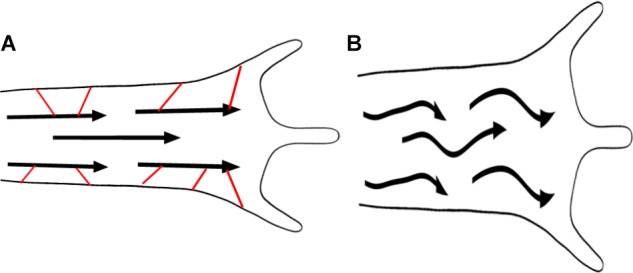
Microtubule/actin coupling promotes elongation. Loss of MT – actin cross-linkers shown in red (A) leads to MT buckling (B), shorter axons and thicker growth cones. MTs are represented by arrows.

References

    1. Alves-Silva J., Sanchez-Soriano N., Beaven R., Klein M., Parkin J., Millard T. H., et al. (2012). Spectraplakins promote microtubule-mediated axonal growth by functioning as structural microtubule-associated proteins and EB1-dependent +TIPs (tip interacting proteins). J. Neurosci. 32 9143–9158. 10.1523/JNEUROSCI.0416-12.2012 - DOI - PMC - PubMed
    1. Amin L., Ercolini E., Ban J., Torre V. (2013). Comparison of the force exerted by hippocampal and DRG growth cones. PLoS One 8:e73025. 10.1371/journal.pone.0073025 - DOI - PMC - PubMed
    1. Amin L., Ercolini E., Shahapure R., Migliorini E., Torre V. (2012). The role of membrane stiffness and actin turnover on the force exerted by DRG lamellipodia. Biophys. J. 102 2451–2460. 10.1016/j.bpj.2012.04.036 - DOI - PMC - PubMed
    1. Athamneh A. I., Cartagena-Rivera A. X., Raman A., Suter D. M. (2015). Substrate deformation predicts neuronal growth cone advance. Biophys. J. 109 1358–1371. 10.1016/j.bpj.2015.08.013 - DOI - PMC - PubMed
    1. Athamneh A. I., Suter D. M. (2015). Quantifying mechanical force in axonal growth and guidance. Front. Cell. Neurosci. 9:359. 10.3389/fncel.2015.00359 - DOI - PMC - PubMed