


Comparison of phase mapping and electrogram-based driver mapping for catheter ablation in atrial fibrillation
- PMID: 30536679
- PMCID: PMC6542555
- DOI: 10.1111/pace.13573
Comparison of phase mapping and electrogram-based driver mapping for catheter ablation in atrial fibrillation
Abstract
Introduction: Adjunctive driver-guided ablation in addition to pulmonary vein isolation has been proposed as a strategy to improve procedural success and outcomes for various populations with atrial fibrillation (AF). First, this study aimed to evaluate the different mapping techniques for driver/rotor identification and second to evaluate the benefits of driver/rotor-guided ablation in patients with paroxysmal and persistent AF (PerAF).
Methods: We searched the electronic database in PubMed using the keywords "atrial fibrillation," "rotor," "rotational driver," "atrial fibrillation source," and "drivers" for both randomized controlled trials and observational controlled trials. Clinical studies reporting efficacy or safety outcomes of driver-guided ablation for paroxysmal AF or (PerAF) were identified. We performed subgroup analyses comparing different driver mapping methods in patients with PerAF. The odds ratios (ORs) with random effects were analyzed.
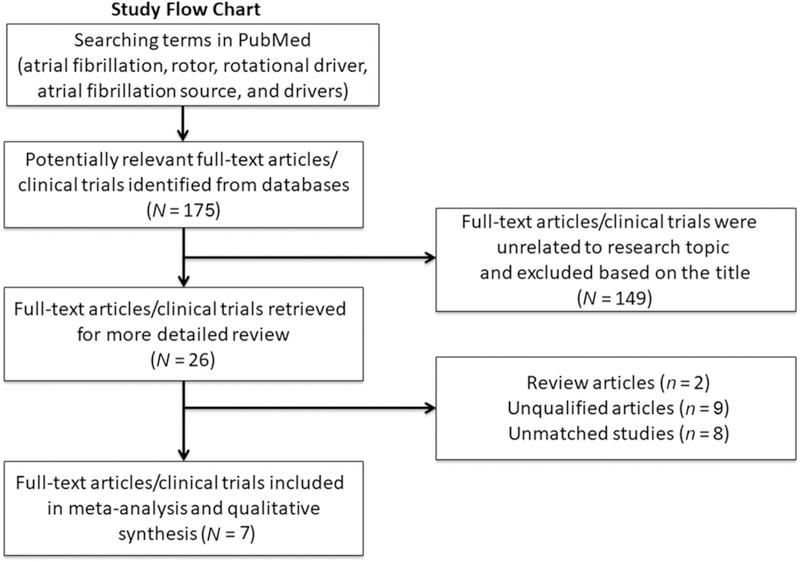
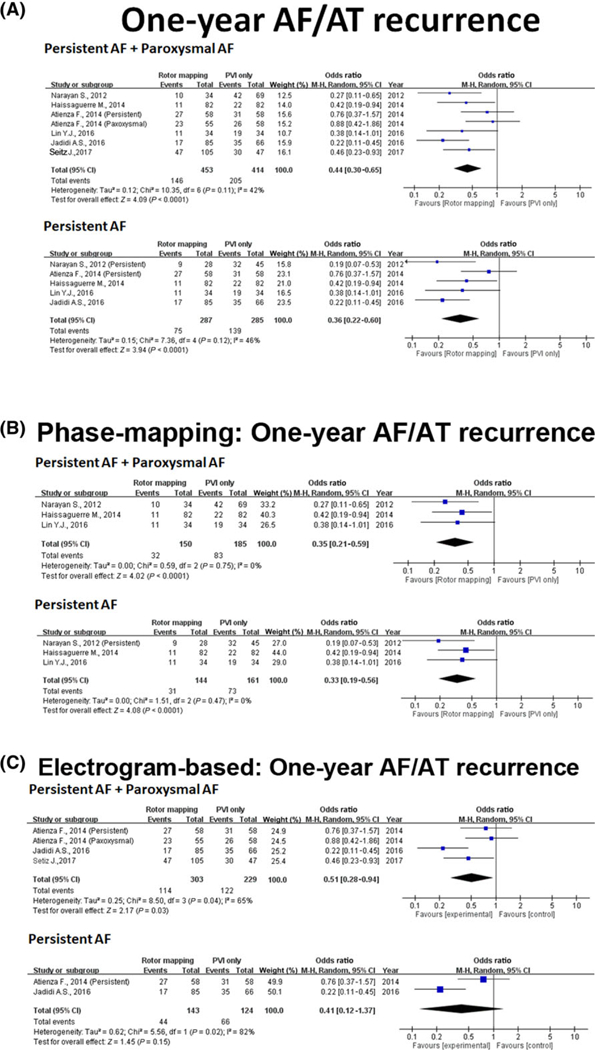
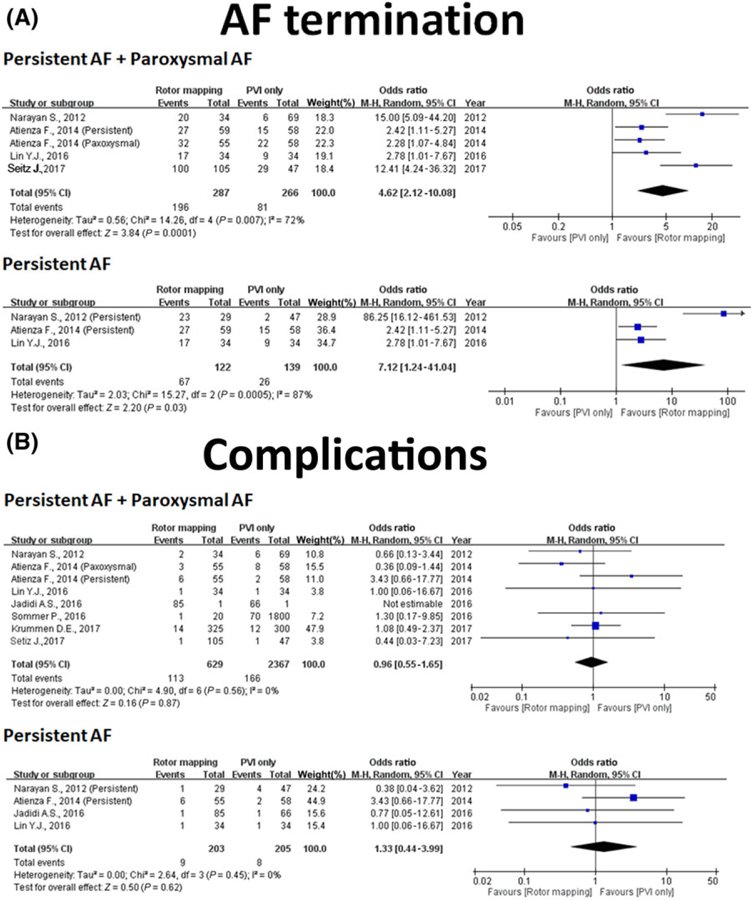
Results: Out of 175 published articles, seven met the inclusion criteria, of which two were randomized controlled trials, one was quasiexperimental study, and four observational studies (three case-controlled studies and one cross-sectional study). Overall, adjunctive driver-guided ablation was associated with higher rates of acute AF termination (OR: 4.62, 95% confidence interval [CI]: 2.12-10.08; P < 0.001), lower recurrence of any atrial arrhythmia (OR: 0.44, 95% CI: 0.30-0.065; P < 0.001), and comparable complication incidence.
Conclusions: Adjunctive driver-guided catheter ablation suggested an increased freedom from AF/AT relative to conventional strategies, irrespective of the mapping techniques. Furthermore, phase mapping appears to be superior to electrogram-based driver mapping in PerAF ablation.
Keywords: atrial fibrillation; catheter ablation; driver; meta-analysis; phase-mapping.
© 2018 Wiley Periodicals, Inc.
Conflict of interest statement
CONFLICTS OF INTEREST
The authors declare no conflicts of interest.
Figures
References
-
- Nattel S New ideas about atrial fibrillation 50 years on. Nature 2002;415:219–226. - PubMed
-
- Haïssaguerre M, Jais P, Shah DC, et al. Spontaneous initiation of atrial fibrillation by ectopic beats originating in the pulmonary veins. N Engl J Med 1998;339:659–666. - PubMed
-
- Chen SA, Hsieh MH, Tai CT, et al. Initiation of atrial fibrillation by ectopic beats originating from the pulmonary veins: Electrophysiological characteristics, pharmacological responses, and effects of radiofrequency ablation. Circulation 1999;100:1879–1886. - PubMed
-
- Lo LW, Lin YJ, Chang SL, et al. Predictors and characteristics of multiple (more than 2) catheter ablation procedures for atrial fibrillation. J Cardiovasc Electrophysiol 2015;26:1048–1056. - PubMed
Publication types
MeSH terms
Grants and funding
- V107C-054/Szu-Yuan Research Foundation of Internal Medicine and Taipei Veterans General Hospital/International
- K23 HL070529/HL/NHLBI NIH HHS/United States
- MOST 106-2314-B-010-046-MY3/Ministry of Science and Technology, Taiwan/International
- 107-2314-B-010-061-MY2/Ministry of Science and Technology, Taiwan/International
- MOST 106-2314-B-075-073-MY3/Ministry of Science and Technology, Taiwan/International
- V107C-060/Szu-Yuan Research Foundation of Internal Medicine and Taipei Veterans General Hospital/International
- K24 HL103800/HL/NHLBI NIH HHS/United States
- V107B-014/Szu-Yuan Research Foundation of Internal Medicine and Taipei Veterans General Hospital/International
- R01 HL083359/HL/NHLBI NIH HHS/United States
- MOST 106-2314-B-075-006-MY3/Ministry of Science and Technology, Taiwan/International
LinkOut - more resources
Full Text Sources
Other Literature Sources
Medical
Miscellaneous
