. 2019 Mar;44(4):817-825.
doi: 10.1038/s41386-018-0282-7. Epub 2018 Nov 27.

Δ-9-Tetrahydrocannabinol and Cannabidiol produce dissociable effects on prefrontal cortical executive function and regulation of affective behaviors

Affiliations

Δ-9-Tetrahydrocannabinol and Cannabidiol produce dissociable effects on prefrontal cortical executive function and regulation of affective behaviors

Hanna J Szkudlarek et al. Neuropsychopharmacology. 2019 Mar.

Abstract

The use of cannabis for therapeutic and recreational purposes is growing exponentially. Nevertheless, substantial questions remain concerning the potential cognitive and affective side-effects associated with cannabis exposure. In particular, the effects of specific marijuana-derived phytocannabinoids on neural regions such as the prefrontal cortex (PFC) are of concern, given the role of the PFC in both executive cognitive function and affective processing. The main biologically active phytocannabinoids, ∆-9-tetrahydrocannabinol (THC) and cannabidiol (CBD), interact with multiple neurotransmitter systems important for these processes directly within the PFC. Considerable evidence has demonstrated that acute or chronic THC exposure may induce psychotomimetic effects, whereas CBD has been shown to produce potentially therapeutic effects for both psychosis and/or anxiety-related symptoms. Using an integrative combination of cognitive and affective behavioral pharmacological assays in rats, we report that acute intra-PFC infusions of THC produce anxiogenic effects while producing no impairments in executive function. In contrast, acute infusions of intra-PFC CBD impaired attentional set-shifting and spatial working memory, without interfering with anxiety or sociability behaviors. In contrast, intra-PFC CBD reversed the cognitive impairments induced by acute glutamatergic antagonism within the PFC, and blocked the anxiogenic properties of THC, suggesting that the therapeutic properties of CBD within the PFC may be present only during pathologically aberrant states within the PFC. Interestingly, the effects of PFC THC vs. CBD were found to be mediated through dissociable CB1 vs. 5-HT1A-dependent receptor signaling mechanisms, directly in the PFC.


Conflict of interest statement

The authors declare no competing interests.

Figures
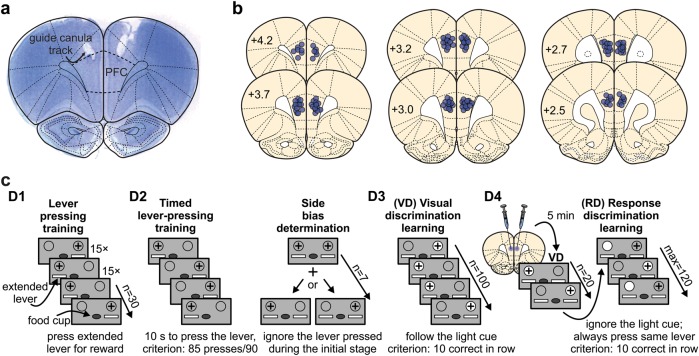
Fig. 1
Fig. 1
Histology and set-shift procedure. a Microphotograph of Cresyl violet stained coronal section containing guide canulae tracks for injections directly in the prefrontal cortex (PFC). b Schematic representation of the injection sites (circles) superimposed on the coronal plane of a rat brain (modified from [25]). Numbers on the schemes indicate distance from Bregma point. c Experimental timeline for the attentional set-shift procedure. The grey rectangles represent front panel of the operant box, circles correspond to the light cues (gray = light off; white = light on), white rectangles correspond to extended levers, the lever rewarded with sucrose pellet is indicated with plus sign above it; D1-D4 indicate different days of the procedure. Note that rats were injected with the drug solution on the last day of the procedure
Fig. 2
Fig. 2
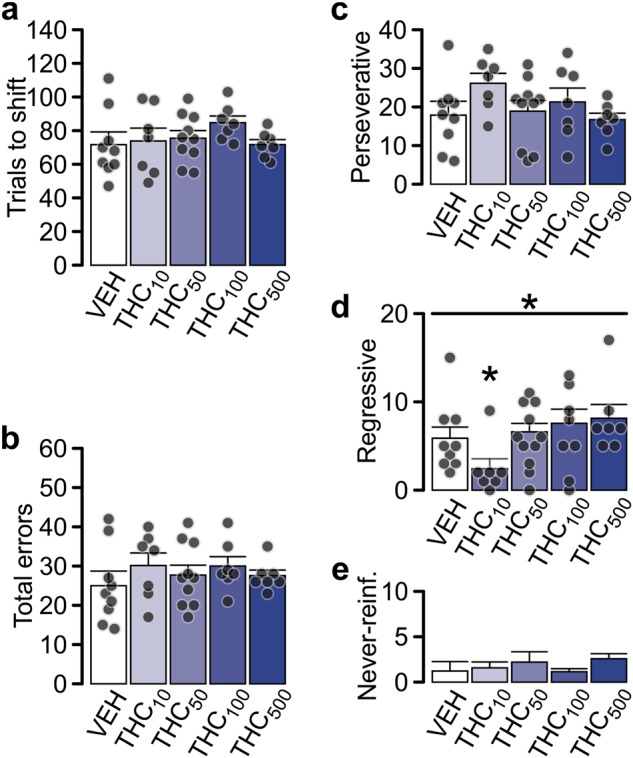
Intra-PFC THC treatment does not affect attentional set-shifting. a The number of trials needed to set-shift from visual to response strategy or the number of errors (b) was not affected with THC treatment. Subcategorization of errors revealed that the number of perseverative errors (c) or never-reinforced errors (e) was unchanged relative to VEH control. The number of regressive errors (d) in THC10 group was significantly lower than in the VEH control. Subscript numbering indicates drug concentrations in ng/hemisphere. Black circles indicate data points (not shown in e for clarity). Data represent mean ± s.e.m. Group sizes (n): VEH (9), THC10 (7), THC50 (10), THC100 (7), THC500 (7). Respective treatment groups were compared with one-way ANOVA followed with Gabriel post-hoc or Kruskal–Wallis test followed with Mann–Whitney U tests. *p < 0.05 vs. VEH group
Fig. 3
Fig. 3
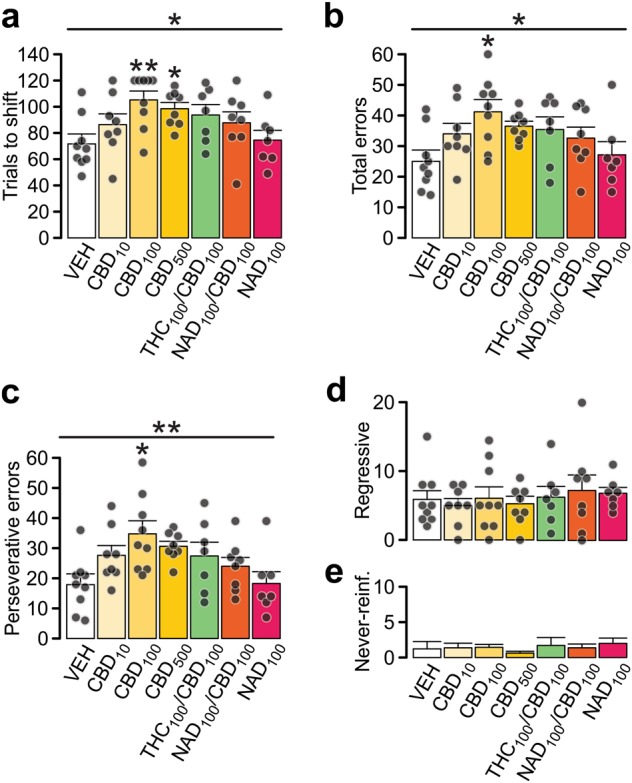
Intra-PFC CBD treatment impairs attentional set-shifting. a The number of trials needed to set-shift from visual to response strategy was increased with intra-PFC CBD treatment. Subscript numbering indicates drug concentrations in ng/hemisphere. Black circles indicate data points (not shown in (e) for clarity). The CBD-induced impairment was weakened by co-application of THC or the 5-HT1a receptor antagonist, NAD299. NAD299 alone did not affect set-shifting. b, Total number of errors performed during set-shifting task was increased in the CBD-treated rats. ce, Errors were categorized into perseverative (c), regressive (d) or never-reinforced (e). Detailed analysis revealed that rats that needed more trials to complete the task showed a specific increase in perseverance suggesting impaired flexibility. Data represent mean ± s.e.m. Group sizes (n): VEH (9, same as in Fig. 2), CBD10 (8), CBD100(9), CBD500(8), CBD100/THC100 (7), CBD100/NAD299100 (8), NAD299100 (7). Respective treatment groups were compared with one-way ANOVA followed with Gabriel post-hoc; or Kruskal–Wallis test followed with Mann–Whitney U tests. *p < 0.05; **p < 0.01 vs. VEH group
Fig. 4
Fig. 4
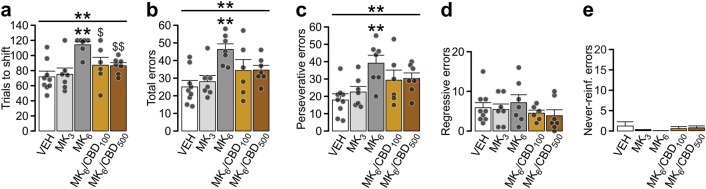
Intra-PFC CBD blocks MK801-induced impairment of set-shifting behavior. Blocking NMDA receptors within PFC using high dose of non-competitive antagonist MK801 (concentrations given in µg/hemisphere) induced impairment that was rescued with co-injection of CBD. a The number of trials to shift and (b) total number of errors performed during set-shifting task was increased in the MK801 treated rats. ce Errors were categorized into perseverative (c), regressive (d) or never-reinforced (e). Detailed analysis revealed that rats that needed more trials to complete the task showed a specific increase in perseverance suggesting impaired flexibility. Data represent mean ± s.e.m. Group sizes (n): VEH (9, same as in Fig. 2), MK8013 (7), MK8016 (7), MK8016/CBD100 (6), MK8016/CBD500 (7). Respective treatment groups were compared with one-way ANOVA followed with Gabriel post-hoc; or Kruskal–Wallis test followed with Mann–Whitney U tests. *p < 0.05; **p < 0.01 vs. VEH group; $p < 0.05; $$p < 0.01 vs. MK8016
Fig. 5
Fig. 5
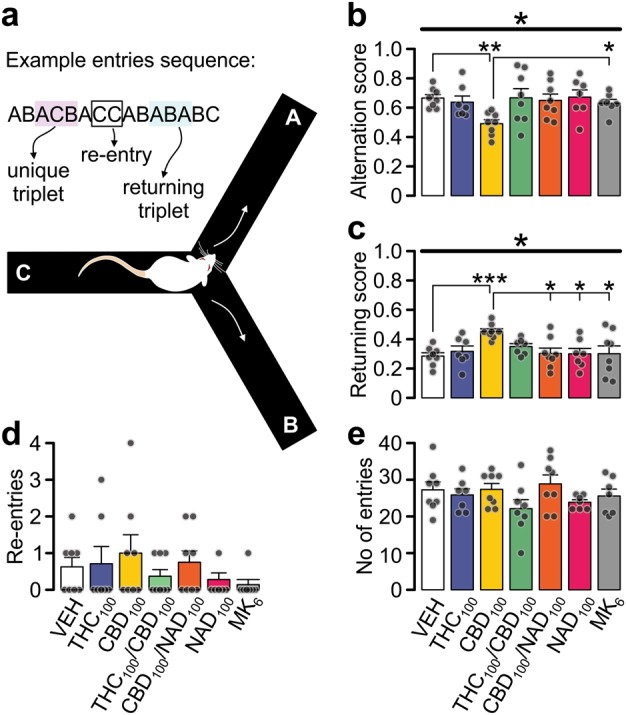
Intra-PFC Cannabidiol induces deficits in spontaneous alternation behavior. a Schematic representation of the Y-maze apparatus and the criteria for measurements. b Alternation score of rats injected intra-PFC with CBD was greatly reduced suggesting impairments of spatial working memory. c Returning scores were significantly increased in CBD-treated rats while (d) number of re-entries was not changed. e The total number of arm entries was not changed by the treatment indicating that the effect of CBD on alternation was not related to changes in locomotion. None of the measured parameters was changed upon blockade of NMDA receptors with MK801. Data represent mean ± s.e.m. Group sizes (n) and drug concentrations in ng/hemisphere, except of MK801 (in µg/hemisphere): VEH (8), THC100 (7), CBD100 (8), CBD100/THC100 (8), CBD100/NAD299100 (8), NAD299100 (7), MK8016 (7). Treatment groups were compared with one-way ANOVA (b, c, e) followed with Games-Howell post-hoc test; or Kruskal–Wallis test (d). *p < 0.05; **p < 0.01; ***p < 0.001
Fig. 6
Fig. 6
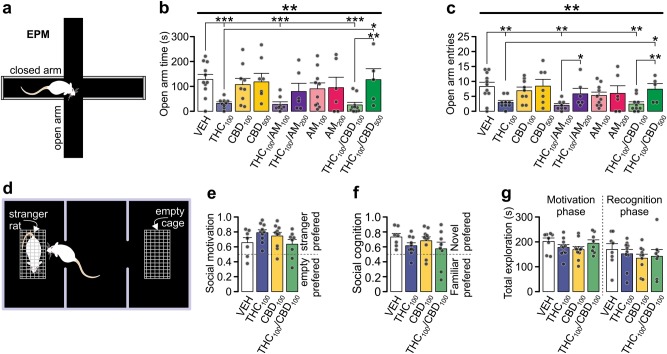
Effects of THC and CBD on anxiety-like behaviors. a Schematic summary of the elevated plus maze test. Anxiety-like behaviors of rats treated with THC was increased as the time that animals spent in the open arms (b) and the number of entries to the open arms (c) were decreased. This effect was reversed by co-application of CB1 receptor antagonist AM251 or higher concentration of CBD. Data represent mean ± s.e.m. Group sizes (n): VEH (11), THC100 (9), CBD100(9), CBD500(7), THC100/AM251100 (8), THC100/AM251200 (6), AM251100 (10), AM251200 (6), THC100/CBD100 (10), THC100/CBD500 (5); subscripts indicate concentration in ng/hemisphere d Schematic of the three-chambered social approach apparatus. The test consisted of two phases. During phase I (sociability test), a stranger rat was enclosed in one of the cages as depicted on the scheme. During phase II (social memory test), a new rat was added in the previously empty cage. The time that the treated rat spent exploring enclosures during both phases was measured and corresponding scores were calculated. Social motivation (e) and social cognition (f) were not affected with the treatments. Also the total exploration times (g) did not differ between the groups. Data represent mean ± s.e.m. Group sizes: VEH (8), THC100 (10), CBD100 (10), THC100/CBD100 (8); subscripts indicate concentrations in ng/hemisphere. Respective treatment groups were compared with one-way ANOVA (eg) or Kruskal–Wallis (b, c) test followed with Mann–Whitney U test. *p < 0.05; **p < 0.01; ***p < 0.001

References

    1. Fogaça MV, Reis FM, Campos AC, Guimarães FS. Effects of intra-prelimbic prefrontal cortex injection of cannabidiol on anxiety-like behavior: involvement of 5HT1A receptors and previous stressful experience. Eur Neuropsychopharmacol. 2014;24:410–9. doi: 10.1016/j.euroneuro.2013.10.012. - DOI - PubMed
    1. Lemos JI, Resstel LB, Guimarães FS. Involvement of the prelimbic prefrontal cortex on cannabidiol-induced attenuation of contextual conditioned fear in rats. Behav Brain Res. 2010;207:105–11. doi: 10.1016/j.bbr.2009.09.045. - DOI - PubMed
    1. Rubino T, Guidali C, Vigano D, Realini N, Valenti M, Massi P, et al. CB1 receptor stimulation in specific brain areas differently modulate anxiety-related behavior. Neuropharmacology. 2008;54:151–60. doi: 10.1016/j.neuropharm.2007.06.024. - DOI - PubMed
    1. D’Souza DC, Perry E, MacDougall L, Ammerman Y, Cooper T, Wu YT, et al. The psychotomimetic effects of intravenous delta-9-tetrahydrocannabinol in healthy individuals: implications for psychosis. Neuropsychopharmacology. 2004;29:1558–72. doi: 10.1038/sj.npp.1300496. - DOI - PubMed
    1. Bhattacharyya S, Fusar-Poli P, Borgwardt S, Martin-Santos R, Nosarti C, O’Carroll C, et al. Modulation of mediotemporal and ventrostriatal function in humans by delta9-tetrahydrocannabinol: a neural basis for the effects of cannabis sativa on learning and psychosis. Arch Gen Psychiatry. 2009;66:442–51. doi: 10.1001/archgenpsychiatry.2009.17. - DOI - PubMed

Publication types

MeSH terms