


Clinical effects of repetitive transcranial magnetic stimulation combined with atomoxetine in the treatment of attention-deficit hyperactivity disorder
- PMID: 30538481
- PMCID: PMC6263241
- DOI: 10.2147/NDT.S182527
Clinical effects of repetitive transcranial magnetic stimulation combined with atomoxetine in the treatment of attention-deficit hyperactivity disorder
Abstract
Objective: To explore the effect of repetitive transcranial magnetic stimulation (rTMS) combined with atomoxetine (ATX) in the treatment of attention-deficit hyperactivity disorder (ADHD).
Methods: Sixty-four patients with newly diagnosed ADHD were enrolled from January 2016 to October 2017 from Psychological Centre for Adolescents and Children at 102th Hospital of People's Liberation Army of China. These patients were randomly assigned to three groups according to treatment method: the rTMS group, the ATX group, and the rTMS+ ATX group. Before treatment and 6 weeks after treatment, clinical symptoms and executive functions of ADHD patients were evaluated with the Swanson, Nolan, and Pelham, Version IV (SNAP-IV) Questionnaire, continuous performance test, three subtests (arithmetic, digit span, and coding) of Wechsler Intelligence Scale for Children, as well as Iowa Gambling Tasks (IGT). The effects of treatment were compared among three groups.
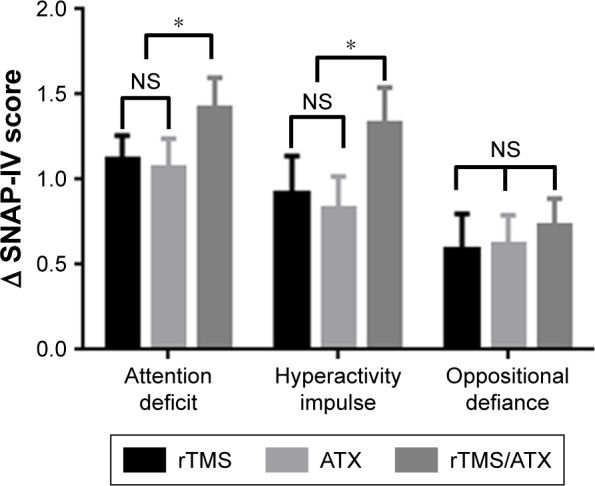
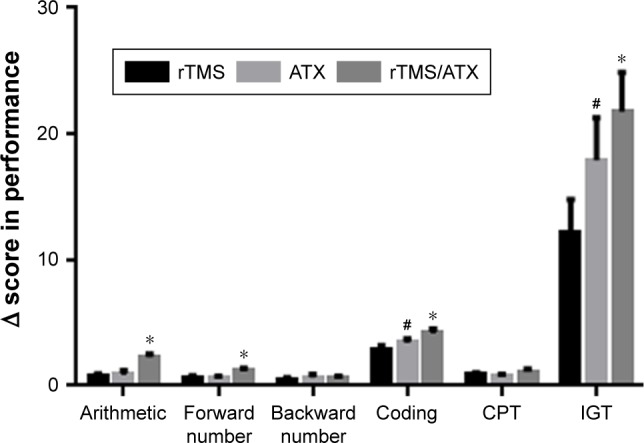
Results: After 6 weeks of treatment, the scores of all factors in the SNAP-IV questionnaire were lower than those before treatment in the three groups; the scores of three subtests of Wechsler Intelligence Scale for Children, continuous performance test, and IGT were also significantly higher than those before treatment. The rTMS+ ATX group had a better improvement in attention deficits and hyperactivity impulse on the SNAP-IV questionnaire compared with the other groups, and also had a higher efficacy on cold and hot executive functions such as arithmetic, forward numbers, coding, and IGT. In addition, the ATX group performed better than the rTMS group in coding and IGT.
Conclusion: rTMS, ATX, and the combination therapy are effective in improving core symptoms and executive function in patients with ADHD. The combined treatment has significant therapeutic advantages over the single treatment groups. Compared with rTMS, the drug therapy has a better improvement in coding and IGT.
Keywords: atomoxetine; attention-deficit hyperactivity disorder; executive function; repetitive transcranial magnetic stimulation.
Conflict of interest statement
Disclosure The authors report no conflicts of interest in this work.
Figures
References
-
- Association AP. Diagnostic and Statistical Manual of Mental Disorders: DSM-5. Arlington, VA: American Psychiatric Association; 2013. p. 947.
-
- Gornick MC, Addington A, Shaw P, et al. Association of the dopamine receptor D4 (DRD4) gene 7-repeat allele with children with attention-deficit/hyperactivity disorder (ADHD): an update. Am J Med Genet B Neuropsychiatr Genet. 2007;144B(3):379–382. - PubMed
-
- Rubia K, Smith AB, Brammer MJ, Taylor E. Temporal lobe dysfunction in medication-naïve boys with attention-deficit/hyperactivity disorder during attention allocation and its relation to response variability. Biol Psychiatry. 2007;62(9):999–1006. - PubMed
LinkOut - more resources
Full Text Sources
