The Influence of Oxygen Saturation on the Relationship Between Hemoglobin Mass and VO 2 max
- PMID: 30539125
- PMCID: PMC6225968
- DOI: 10.1055/a-0655-7207
The Influence of Oxygen Saturation on the Relationship Between Hemoglobin Mass and VO 2 max
Abstract
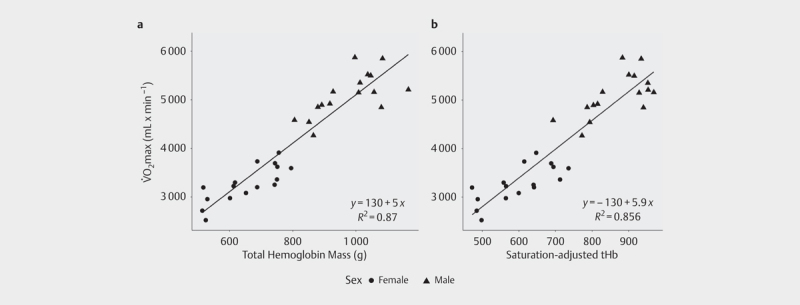
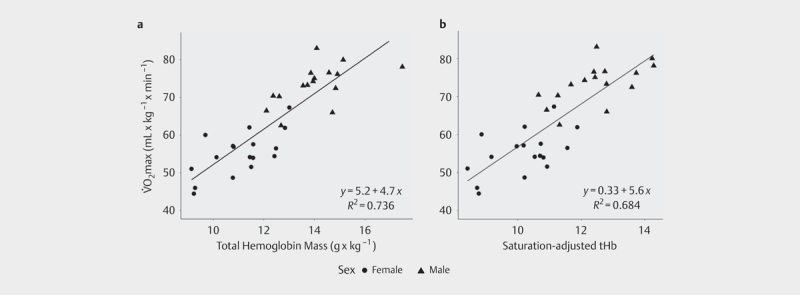
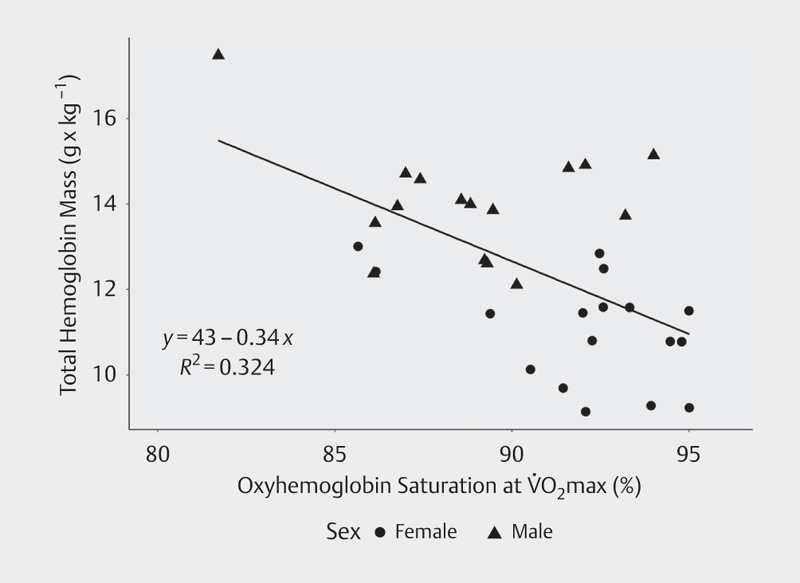
Hemoglobin mass (tHb) is a key determinant of maximal oxygen uptake (VO 2 max). We examined whether oxyhemoglobin desaturation (ΔS a O 2 ) at VO 2 max modifies the relationship between tHb and VO 2 max at moderate altitude (1,625 m). Seventeen female and 16 male competitive, endurance-trained moderate-altitude residents performed two tHb assessments and two graded exercise tests on a cycle ergometer to determine VO 2 max and ΔS a O 2 . In males and females respectively, VO 2 max (ml·kg -1 ·min -1 ) ranged from 62.5-83.0 and 44.5-67.3; tHb (g·kg -1 ) ranged from 12.1-17.5 and 9.1-13.0; and S a O 2 at VO 2 max (%) ranged from 81.7-94.0 and 85.7-95.0. tHb was related to VO 2 max when expressed in absolute terms and after correcting for body mass (r=0.94 and 0.86, respectively); correcting by ΔS a O 2 did not improve these relationships (r=0.93 and 0.83). Additionally, there was a negative relationship between tHb and S a O 2 at VO 2 max (r=-0.57). In conclusion, across a range of endurance athletes at moderate altitude, the relationship between tHb and VO 2 max was found to be similar to that observed at sea level. However, correcting tHb by ΔS a O 2 did not explain additional variability in VO 2 max despite significant variability in ΔS a O 2 ; this raises the possibility that tHb and exercise-induced ΔS a O 2 are not independent in endurance athletes.
Keywords: altitude; endurance performance; exercise-induced desaturation; hypoxia; oxygen transport.
Conflict of interest statement
Figures
References
-
- Bassett D R, Howley E T. Limiting factors for maximum oxygen uptake and determinants of endurance performance. Med Sci Sports Exerc. 2000;32:70–84. - PubMed
-
- Brocherie F, Millet G P, Hauser A, Steiner T, Rysman J, Wehrlin J P, Girard O. “Live high–train low and high” hypoxic training improves team-sport performance. Med Sci Sports Exerc. 2015;47(10):2140–2149. - PubMed
-
- Brothers M D, Hilger K, Carson J M, Sullivan L, Byrnes W C. GXT responses in altitude-acclimatized cyclists during sea-level simulation. Med Sci Sports Exerc. 2007;39:1727–1735. - PubMed
-
- Buchfuhrer M J, Hansen J E, Robinson T E, Sue D Y, Wasserman K, Whipp B J. Optimizing the exercise protocol for cardiopulmonary assessment. J Appl Physiol. 1983;55:1558–1564. - PubMed
-
- Dempsey J, Amann M, Harms C, Wetter T. Respiratory system limitations to performance in the healthy athlete: Some answers, more questions! Dtsch Z Für Sportmed. 2012:157–162.
LinkOut - more resources
Full Text Sources