. 2018 Dec 10:114:e180438.
doi: 10.1590/0074-02760180438.

Complete and de novo assembly of the Leishmania braziliensis (M2904) genome

Affiliations

Complete and de novo assembly of the Leishmania braziliensis (M2904) genome

Sandra González-de la Fuente et al. Mem Inst Oswaldo Cruz. .

Abstract

Leishmania braziliensis is the etiological agent of American mucosal leishmaniasis, one of the most severe clinical forms of leishmaniasis. Here, we report the assembly of the L. braziliensis (M2904) genome into 35 continuous chromosomes. Also, the annotation of 8395 genes is provided. The public availability of this information will contribute to a better knowledge of this pathogen and help in the search for vaccines and novel drug targets aimed to control the disease caused by this Leishmania species.


Figures
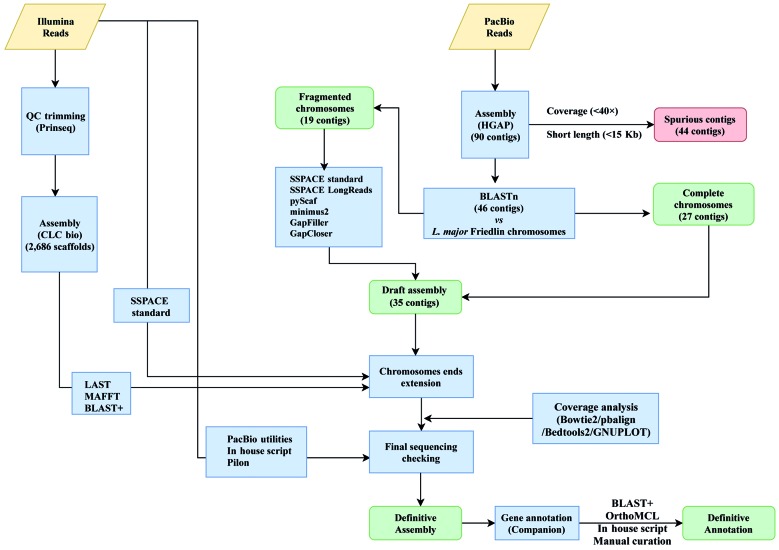
Fig. 1:
Fig. 1:. schematic overview of the Leishmania braziliensis genome assembly workflow. Input files (Illumina and PacBio reads) are shown in yellow rhomboids. Both different assembly processes and software used are represented in blue boxes. Output files are shown in green boxes and discarded data are shown in red boxes.
Fig. 2:
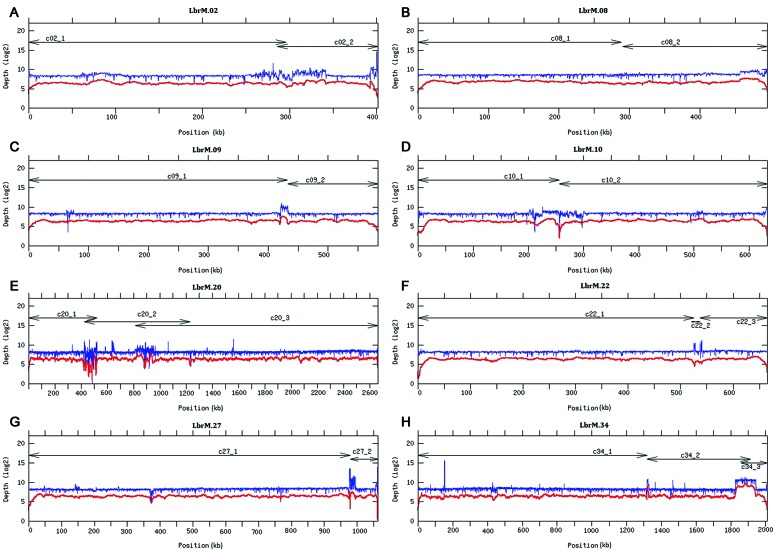
Fig. 2:. read-depth analysis throughout the chromosomes formed by the union of two or more PacBio-assembled contigs. Coverage (log2 value) was appointed by sliding window analysis (bin 200 bp) with either Illumina (in blue) and PacBio (in red) reads, along chromosomes 2, 8, 9, 10, 20, 22, 27 and 34. Contigs lengths are shown by arrowheads lines. Chromosomes 2, 20, and 22 (panels A, E and F) were joined using the minimus 2 assembler. Chromosomes 8 (panel B) and 9 (panel C) were joined by the SSPACE-standard tool. Moreover, chromosome 27 (panel G) was joined by the SSPACE-LongRead tool and chromosome 10 (panel D) was joined with the pyScaf scaffolder tool. Finally, pyScaf and minimus2 were necessary for joining chromosome 34 (panel H).
Fig. 3:
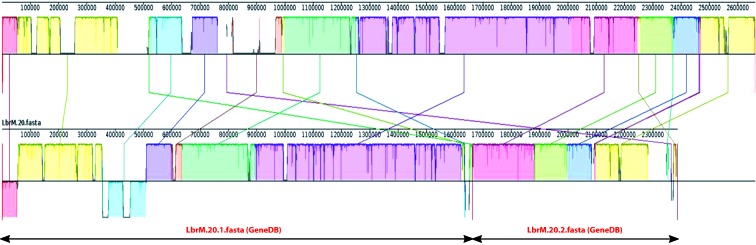
Fig. 3:. schematic illustration of chromosomal fusion (20 and 34) in the chromosome 20 of Leishmania braziliensis genome. Pairwise alignments between the L. braziliensis newly assembled genome (top) and the current reference genome (bottom), which is fragmented in two scaffolds (LbrM.20.1 and LbrM.20.2), were generated using Mauve genome alignment tool with default settings. This tool uses different colors to represent synteny blocks. Sections located underneath the x-axis show inversion events. The sizes of the two contigs of the current reference genome for chromosome 20 are shown by lines with arrow-heads.

References

    1. Herwaldt BL. Leishmaniasis. Lancet. 1999;354(9185):1191–1199. - PubMed

    1. Alvar J, Velez ID, Bern C, Herrero M, Desjeux P, Cano J. Leishmaniasis worldwide and global estimates of its incidence. PLoS One. 2012;7(5):e35671. - PMC - PubMed
    1. Ivens AC, Peacock CS, Worthey EA, Murphy L, Aggarwal G, Berriman M. The genome of the kinetoplastid parasite, Leishmania major. Science. 2005;309(5733):436–442. - PMC - PubMed
    1. Cantacessi C, Dantas-Torres F, Nolan MJ, Otranto D. The past, present, and future of Leishmania genomics and transcriptomics. Trends Parasitol. 2015;31(3):100–108. - PMC - PubMed
    1. Peacock CS, Seeger K, Harris D, Murphy L, Ruiz JC, Quail MA. Comparative genomic analysis of three Leishmania species that cause diverse human disease. Nat Genet. 2007;39(7):839–847. - PMC - PubMed

MeSH terms