Real-time Mobile Monitoring of the Dynamic Associations Among Motor Activity, Energy, Mood, and Sleep in Adults With Bipolar Disorder
- PMID: 30540352
- PMCID: PMC6439734
- DOI: 10.1001/jamapsychiatry.2018.3546
Real-time Mobile Monitoring of the Dynamic Associations Among Motor Activity, Energy, Mood, and Sleep in Adults With Bipolar Disorder
Abstract
Importance: Biologic systems involved in the regulation of motor activity are intricately linked with other homeostatic systems such as sleep, feeding behavior, energy, and mood. Mobile monitoring technology (eg, actigraphy and ecological momentary assessment devices) allows the assessment of these multiple systems in real time. However, most clinical studies of mental disorders that use mobile devices have not focused on the dynamic associations between these systems.
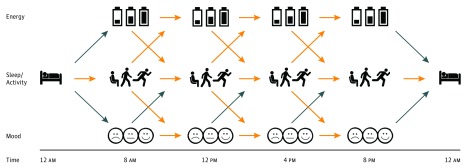
Objectives: To examine the directional associations among motor activity, energy, mood, and sleep using mobile monitoring in a community-identified sample, and to evaluate whether these within-day associations differ between people with a history of bipolar or other mood disorders and controls without mood disorders.
Design, setting, and participants: This study used a nested case-control design of 242 adults, a subsample of a community-based sample of adults. Probands were recruited by mail from the greater Washington, DC, metropolitan area from January 2005 to June 2013. Enrichment of the sample for mood disorders was provided by volunteers or referrals from the National Institutes of Health Clinical Center or by participants in the National Institute of Mental Health Mood and Anxiety Disorders Program. The inclusion criteria were the ability to speak English, availability to participate, and consent to contact at least 2 living first-degree relatives. Data analysis was performed from June 2013 through July 2018.
Main outcomes and measures: Motor activity and sleep duration data were obtained from minute-to-minute activity counts from an actigraphy device worn on the nondominant wrist for 2 weeks. Mood and energy levels were assessed by subjective analogue ratings on the ecological momentary assessment (using a personal digital assistant) by participants 4 times per day for 2 weeks.
Results: Of the total 242 participants, 92 (38.1%) were men and 150 (61.9%) were women, with a mean (SD) age of 48 (16.9) years. Among the participants, 54 (22.3%) had bipolar disorder (25 with bipolar I; 29 with bipolar II), 91 (37.6%) had major depressive disorder, and 97 (40.1%) were controls with no history of mood disorders. A unidirectional association was found between motor activity and subjective mood level (β = -0.018, P = .04). Bidirectional associations were observed between motor activity (β = 0.176; P = .03) and subjective energy level (β = 0.027; P = .03) as well as between motor activity (β = -0.027; P = .04) and sleep duration (β = -0.154; P = .04). Greater cross-domain reactivity was observed in bipolar disorder across all outcomes, including motor activity, sleep, mood, and energy.
Conclusions and relevance: These findings suggest that interventions focused on motor activity and energy may have greater efficacy than current approaches that target depressed mood; both active and passive tracking of multiple regulatory systems are important in designing therapeutic targets.
Conflict of interest statement
Figures
References
-
- Myers J, McAuley P, Lavie CJ, Despres JP, Arena R, Kokkinos P. Physical activity and cardiorespiratory fitness as major markers of cardiovascular risk: their independent and interwoven importance to health status. Prog Cardiovasc Dis. 2015;57(4):306-314. doi: 10.1016/j.pcad.2014.09.011 - DOI - PubMed