


Supporting breast cancer screening decisions for caregivers of older women with dementia: study protocol for a randomized controlled trial
- PMID: 30541634
- PMCID: PMC6292112
- DOI: 10.1186/s13063-018-3039-z
Supporting breast cancer screening decisions for caregivers of older women with dementia: study protocol for a randomized controlled trial
Abstract
Background: Alzheimer's disease and related dementias (ADRD) impact a woman's life expectancy and her ability to participate in medical decision-making about breast cancer screening, necessitating the involvement of family caregivers. Making decisions about mammography screening for women with ADRD is stressful. There are no data that suggest that breast cancer screening helps women with ADRD live longer or better. Decision aids may improve the quality of decision-making about mammography for ADRD patients and may inform family caregivers about the risks, benefits, and need for decision-making around mammography screening.
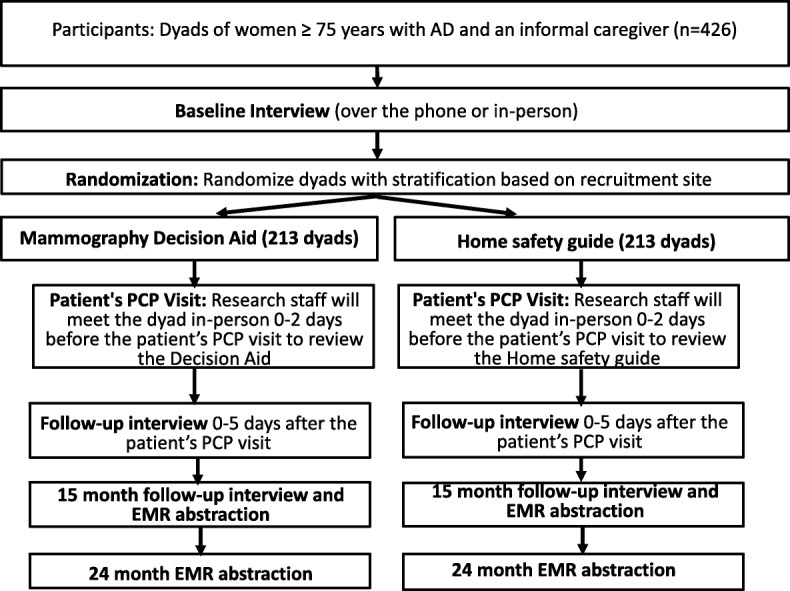
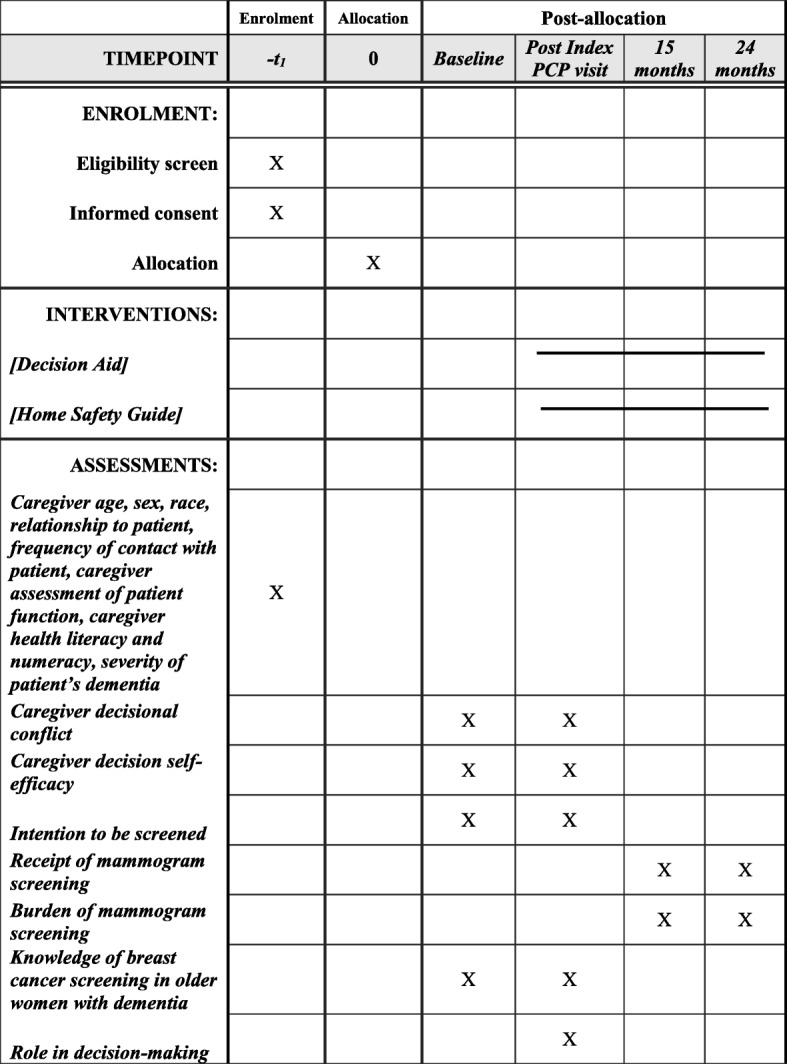
Methods/design: The Decisions about Cancer Screening in Alzheimer's Disease (DECAD) trial, a randomized controlled clinical trial, will enroll 426 dyads of older women with ADRD (≥75 years) and a family caregiver from clinics and primary-care practices in Indiana to test a novel, evidence-based decision aid. This decision aid includes information about the impact of ADRD on life expectancy, the benefit of mammograms, and the impact on the quality of life for older women with ADRD. Dyads will be randomized to receive the decision aid or active control information about home safety. This trial will examine the effect on the caregiver's decisional conflict (primary outcome) and the caregiver's decision-making self-efficacy (secondary outcome). A second follow-up at 15 months will include a brief, semi-structured interview with the caregiver regarding the patient's experience with mammograms and decision-making about mammograms. At the same time, a review of the patient's electronic medical record (EMR) will look at discussions about mammography with their primary-care physician and mammogram orders, receipt, results, and burden (e.g., additional diagnostic procedures due to false-positive results, identification of an abnormality on the screening exam but further work-up declined, and identification of a clinically unimportant cancer). A third follow-up at 24 months will extract EMR data on mammogram orders, occurrences, results, and the burden of mammograms.
Discussion: We hypothesize that caregivers who receive the decision aid will have lower levels of decisional conflict and higher levels of decision-making self-efficacy compared to the control group. We also hypothesize that the DECAD decision aid will reduce mammography use among older women with ADRD.
Trial registration: Clinical Trials Register, NCT03282097 . Registered on 13 September 2017.
Keywords: Alzheimer’s disease; breast cancer; dementia; mammography; screening.
Conflict of interest statement
Ethics approval and consent to participate
All participants will provide informed consent before beginning the study. All team members have been trained to introduce, show, and take questions about the informed consent, the assessments, and any discomfort associated with the interventions before the patients sign the informed consent. The study protocol has been approved by Indiana University’s institutional review board (1501278953A022) and will be conducted according to the principles of the Declaration of Helsinki and in compliance with the National Institutes of Health policy and data safety monitoring guidelines.
Competing Interests
The authors declare that they have no competing interests.
Publisher’s Note
Springer Nature remains neutral with regard to jurisdictional claims in published maps and institutional affiliations.
Figures
Similar articles
-
Examining the benefits and harms of Alzheimer's disease screening for family members of older adults: study protocol for a randomized controlled trial.Trials. 2020 Feb 19;21(1):202. doi: 10.1186/s13063-019-4029-5. Trials. 2020. PMID: 32075686 Free PMC article.
-
Tailoring and evaluating an intervention to improve shared decision-making among seniors with dementia, their caregivers, and healthcare providers: study protocol for a randomized controlled trial.Trials. 2018 Jun 25;19(1):332. doi: 10.1186/s13063-018-2697-1. Trials. 2018. PMID: 29941020 Free PMC article.
-
Supporting caregivers of veterans with Alzheimer's disease and traumatic brain injury: study protocol for a randomized controlled trial.Trials. 2020 Apr 19;21(1):340. doi: 10.1186/s13063-020-4199-1. Trials. 2020. PMID: 32306982 Free PMC article.
-
Helping Caregivers and Their Children with Early Appendicitis Make Treatment Decisions with an App [Internet].Washington (DC): Patient-Centered Outcomes Research Institute (PCORI); 2020 Feb. Washington (DC): Patient-Centered Outcomes Research Institute (PCORI); 2020 Feb. PMID: 39631004 Free Books & Documents. Review.
-
Screening mammography in older women: a review.JAMA. 2014 Apr 2;311(13):1336-47. doi: 10.1001/jama.2014.2834. JAMA. 2014. PMID: 24691609 Free PMC article. Review.
Cited by
-
Systematic Development of Patient Decision Aids: An Update from the IPDAS Collaboration.Med Decis Making. 2021 Oct;41(7):736-754. doi: 10.1177/0272989X211014163. Epub 2021 Jun 19. Med Decis Making. 2021. PMID: 34148384 Free PMC article.
-
Rural-urban disparities in preventive breast and cervical cancer screening among women with early-onset dementia.BMC Womens Health. 2023 May 11;23(1):255. doi: 10.1186/s12905-023-02301-7. BMC Womens Health. 2023. PMID: 37170251 Free PMC article.
-
Breast cancer screening among Medicare Advantage enrollees with dementia.BMC Health Serv Res. 2024 Mar 5;24(1):283. doi: 10.1186/s12913-024-10740-7. BMC Health Serv Res. 2024. PMID: 38443911 Free PMC article.
-
Association Between Cancer Screening Patterns and Carer Literacy in Individuals With Cognitive Decline: An Observational Study.Cancer Med. 2024 Oct;13(20):e70311. doi: 10.1002/cam4.70311. Cancer Med. 2024. PMID: 39440694 Free PMC article.
References
-
- Data on Seer (Surveillance, Epidemiology and End Results) cancer statistics. Available from: https://seer.cancer.gov/. Acccessed 13 Dec 2016.
-
- Alzheimer's disease facts and figures. Alzheimers Dement. 2016;12(4):459–509. - PubMed
-
- Fowler NR, Barnato AE, Schonberg MA, Torke AM. Cancer screening in adults with cognitive impairment. J Am Geriatr Soc. 2014;62(s1):S131.
-
- Choosing Wisely: An initiative of the ABIM Foundation [online]. Available at www.choosingwisly.org. Accessed 20 Dec 2017.
Publication types
MeSH terms
Associated data
Grants and funding
LinkOut - more resources
Full Text Sources
Medical
