


Characterization of the virulence of a non-RT027, non-RT078 and binary toxin-positive Clostridium difficile strain associated with severe diarrhea
- PMID: 30542069
- PMCID: PMC6291415
- DOI: 10.1038/s41426-018-0211-1
Characterization of the virulence of a non-RT027, non-RT078 and binary toxin-positive Clostridium difficile strain associated with severe diarrhea
Abstract
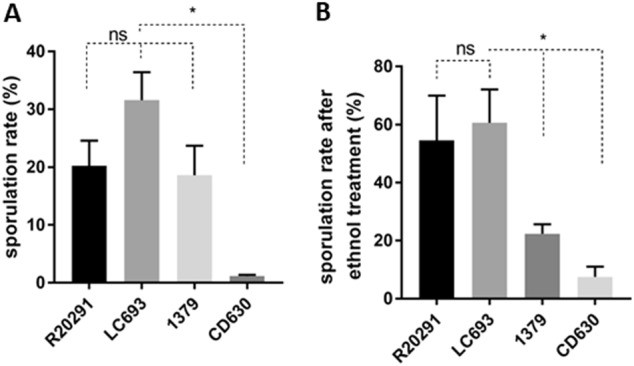
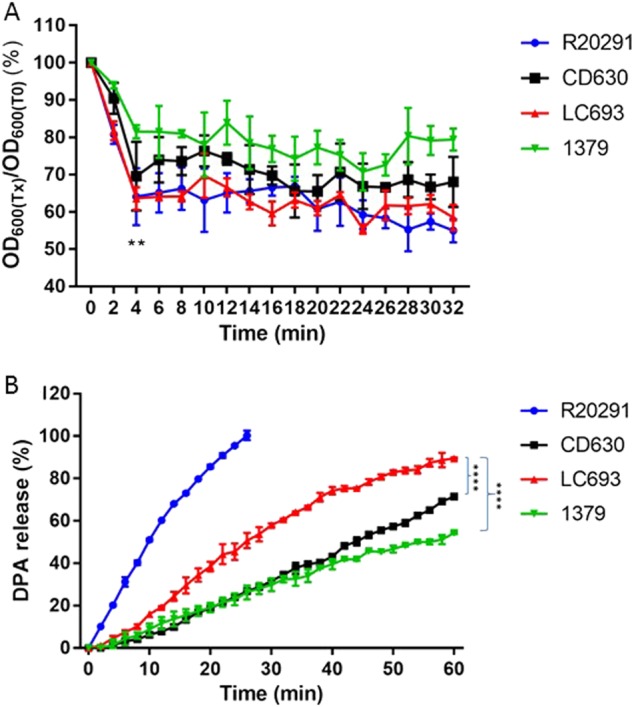
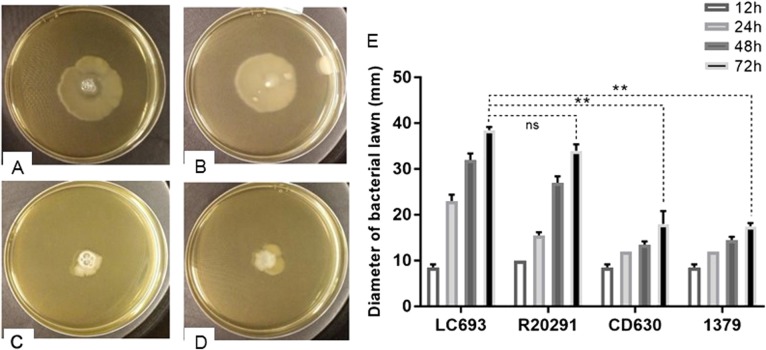
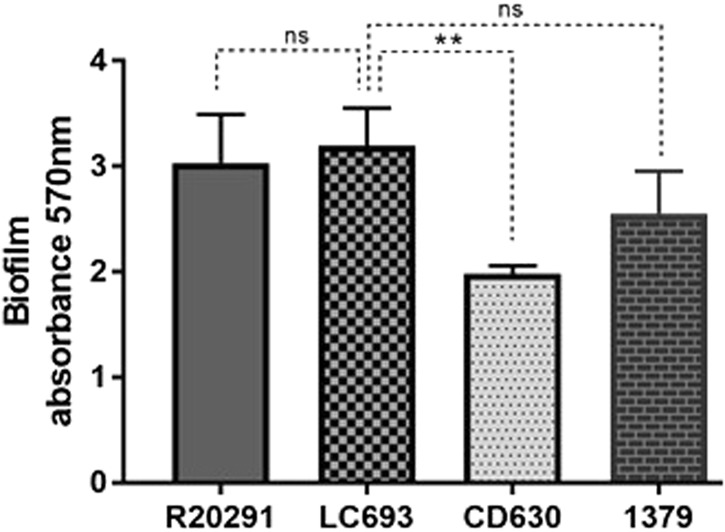
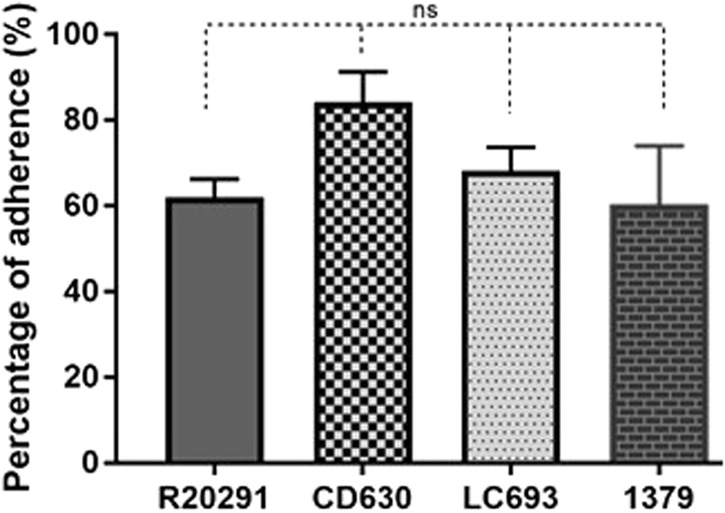
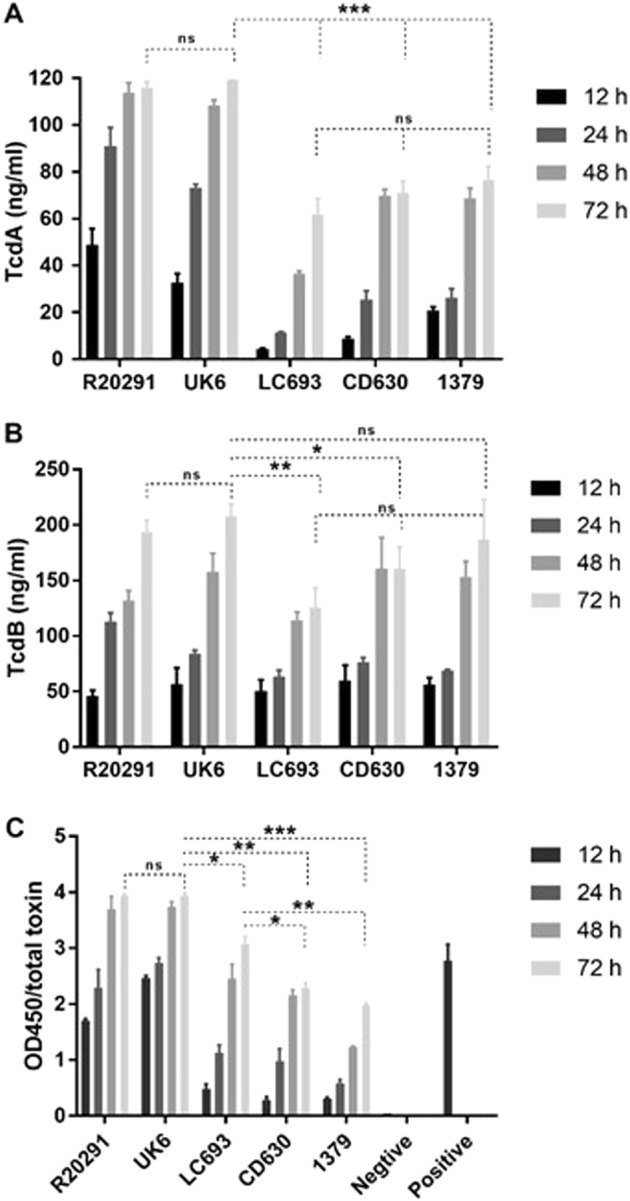
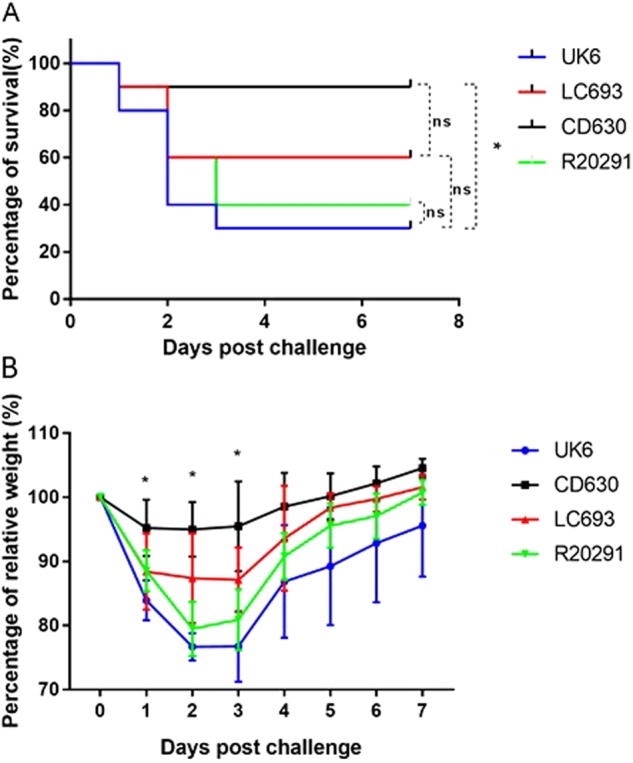
The expression of the Clostridium difficile binary toxin CDT is generally observed in the RT027 (ST1) and RT078 (ST11) C. difficile isolates, which are associated with severe C. difficile infection (CDI). However, we recently reported that the non-RT027 and non-RT078 C. difficile strain LC693 (TcdA+TcdB+ CDT+, ST201) caused severe diarrhea in a patient in Xiangya Hospital in China. C.difficile LC693 is a member of Clade 3, and in this study, we identified LC693 as RT871 and compared its virulence and pathogenicity to those of C.difficile R20291 (TcdA+TcdB+CDT+, ST1/RT027), UK6 (TcdA+TcdB+CDT+, ST35/RT027), CD630 (TcdA+TcdB+CDT-, ST54, RT012), and 1379 (TcdA+TcdB+CDT-, ST54/RT012), with strain 1379 being an epidemic C.difficile isolate from the same hospital. LC693 displayed a higher sporulation rate than R20291, CD630 or strain 1379. LC693 was comparable to R20291 with respect to spore germination, motility, and biofilm formation, but showed a faster germination rate, higher motility and a higher biofilm formation capability compared to CD630 and strain 1379. The adherence of spores to human gut epithelial cells was similar for all strains.The total toxin release of LC693 was lower than that of R20291, but higher than that of CD630 and strain 1379. Finally, in a mouse model of CDI, LC693 was capable of causing moderate to severe disease. Our findings demonstrate the pathogenicity of non-RT027 and non-RT078 binary toxin-positive C. difficile strains. Furthermore, our data indicate that LC693 may be more virulent than strain 1379, an epidemic strain from the same hospital, and provide the first phenotypic characterization of a non-RT027 and non-RT078 binary toxin-positive ST201 isolate.
Conflict of interest statement
The authors declare that they have no conflict of interest.
Figures
Similar articles
-
Phenotypic characterisation of Clostridium difficile PCR ribotype 251, an emerging multi-locus sequence type clade 2 strain in Australia.Anaerobe. 2019 Dec;60:102066. doi: 10.1016/j.anaerobe.2019.06.019. Epub 2019 Jun 28. Anaerobe. 2019. PMID: 31260740
-
Genome characterization of a novel binary toxin-positive strain of Clostridium difficile and comparison with the epidemic 027 and 078 strains.Gut Pathog. 2017 Aug 7;9:42. doi: 10.1186/s13099-017-0191-z. eCollection 2017. Gut Pathog. 2017. PMID: 28794800 Free PMC article.
-
A series of three cases of severe Clostridium difficile infection in Australia associated with a binary toxin producing clade 2 ribotype 251 strain.Anaerobe. 2019 Feb;55:117-123. doi: 10.1016/j.anaerobe.2018.11.009. Epub 2018 Nov 27. Anaerobe. 2019. PMID: 30500477
-
Virulence factors of Clostridium difficile and their role during infection.Anaerobe. 2016 Feb;37:13-24. doi: 10.1016/j.anaerobe.2015.10.009. Epub 2015 Oct 24. Anaerobe. 2016. PMID: 26596863 Review.
-
Clostridium difficile virulence factors: Insights into an anaerobic spore-forming pathogen.Gut Microbes. 2014;5(5):579-93. doi: 10.4161/19490976.2014.969632. Gut Microbes. 2014. PMID: 25483328 Free PMC article. Review.
Cited by
-
Unique growth and morphology properties of Clade 5 Clostridioides difficile strains revealed by single-cell time-lapse microscopy.bioRxiv [Preprint]. 2025 May 16:2024.02.13.580212. doi: 10.1101/2024.02.13.580212. bioRxiv. 2025. Update in: PLoS Pathog. 2025 May 21;21(5):e1013155. doi: 10.1371/journal.ppat.1013155. PMID: 40463200 Free PMC article. Updated. Preprint.
-
An Update on Clostridioides difficile Binary Toxin.Toxins (Basel). 2022 Apr 27;14(5):305. doi: 10.3390/toxins14050305. Toxins (Basel). 2022. PMID: 35622552 Free PMC article. Review.
-
Unique growth and morphology properties of Clade 5 Clostridioides difficile strains revealed by single-cell time-lapse microscopy.PLoS Pathog. 2025 May 21;21(5):e1013155. doi: 10.1371/journal.ppat.1013155. eCollection 2025 May. PLoS Pathog. 2025. PMID: 40397889 Free PMC article.
-
Characterization of the virulence of three novel clade 2 Clostridioides (Clostridium) difficile strains and a two-year screening in animals and humans in Brazil.PLoS One. 2022 Aug 26;17(8):e0273013. doi: 10.1371/journal.pone.0273013. eCollection 2022. PLoS One. 2022. PMID: 36026500 Free PMC article.
-
Host Immune Responses to Clostridioides difficile: Toxins and Beyond.Front Microbiol. 2021 Dec 21;12:804949. doi: 10.3389/fmicb.2021.804949. eCollection 2021. Front Microbiol. 2021. PMID: 34992590 Free PMC article. Review.
References
MeSH terms
Substances
Grants and funding
- R01-AI132711/U.S. Department of Health & Human Services | NIH | National Institute of Allergy and Infectious Diseases (NIAID)
- R21 AI113470/AI/NIAID NIH HHS/United States
- R01 AI132711/AI/NIAID NIH HHS/United States
- R03 DK112004/DK/NIDDK NIH HHS/United States
- K01 DK092352/DK/NIDDK NIH HHS/United States
LinkOut - more resources
Full Text Sources
Medical
Molecular Biology Databases
