. 2019 Mar;44(4):733-742.
doi: 10.1038/s41386-018-0295-2. Epub 2018 Dec 12.

A diet enriched with curcumin promotes resilience to chronic social defeat stress

Affiliations

A diet enriched with curcumin promotes resilience to chronic social defeat stress

Antonio V Aubry et al. Neuropsychopharmacology. 2019 Mar.

Abstract

Chronic exposure to stress is a well-known risk factor for the development of mood and anxiety disorders. Promoting resilience to stress may prevent the development of these disorders, but resilience-enhancing compounds are not yet clinically available. One compound that has shown promise in the clinical setting is curcumin, a polyphenol compound found in the rhizome of the turmeric plant (Curcuma longa) with known anti-inflammatory and antidepressant properties. Here, we tested the efficacy of 1.5% dietary curcumin at promoting resilience to chronic social defeat stress (CSDS) in 129/SvEv mice, a strain that we show is highly susceptible to this type of stress. We found that administration of curcumin during CSDS produced a 4.5-fold increase in stress resilience, as measured by the social interaction test. Although the overall effects of curcumin were striking, we identified two distinct responses to curcumin. While 64% of defeated mice on curcumin were resilient (responders), the remaining 36% of mice were susceptible to the effects of stress (non-responders). Interestingly, responders released less corticosterone following acute restraint stress and had lower levels of peripheral IL-6 than nonresponders, implicating a role for the NF-κB pathway in treatment response. Importantly, curcumin also prevented anxiety-like behavior in both responders and non-responders in the elevated-plus maze and open field test. Collectively, our findings provide the first preclinical evidence that curcumin promotes resilience to CSDS and suggest that curcumin may prevent the emergence of a range of anxiety-like symptoms when given to individuals during exposure to chronic social stress.


Conflict of interest statement

The authors declare that they have no conflict of interest.

Figures
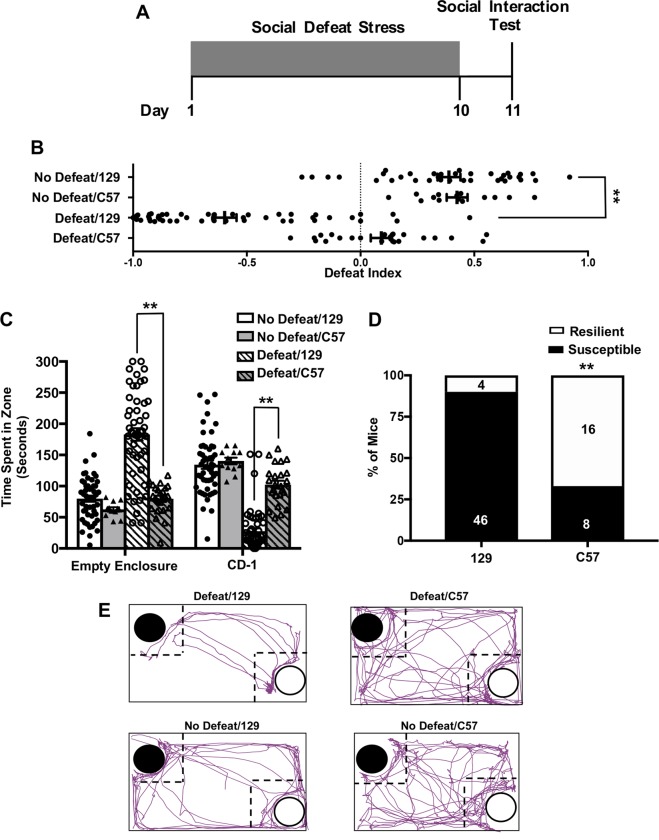
Fig. 1
Fig. 1
129/SvEv mice are more susceptible to CSDS than C57BL/6J mice. a Schematic of behavioral procedures. b Distribution of DI scores for control and defeated mice of each strain. Mice with DI scores below 0 and were categorized as susceptible. c Time spent with the empty enclosure and the enclosure containing a novel CD-1. Defeated 129Sv/Ev mice spent significantly more time with the empty enclosure and less time with the CD-1 than non-defeated mice of the same strain and defeated C57BL/6J mice. Data represent mean ± SEM. d Percent of defeated mice of each strain categorized as resilient or susceptible. Number of animals is indicated inside the bar graph. e The path (purple) of a representative mouse from each group during the social interaction test (black circle indicates CD-1; white circle indicates empty enclosure; dotted-line indicates interaction zone). No defeat/129 (n = 50), no defeat/C57 (n = 12), defeat/129 (n = 50), and defeat C57 (n = 24). **p < 0.0001; ^^p < 0.0001 vs. defeat/129
Fig. 2
Fig. 2
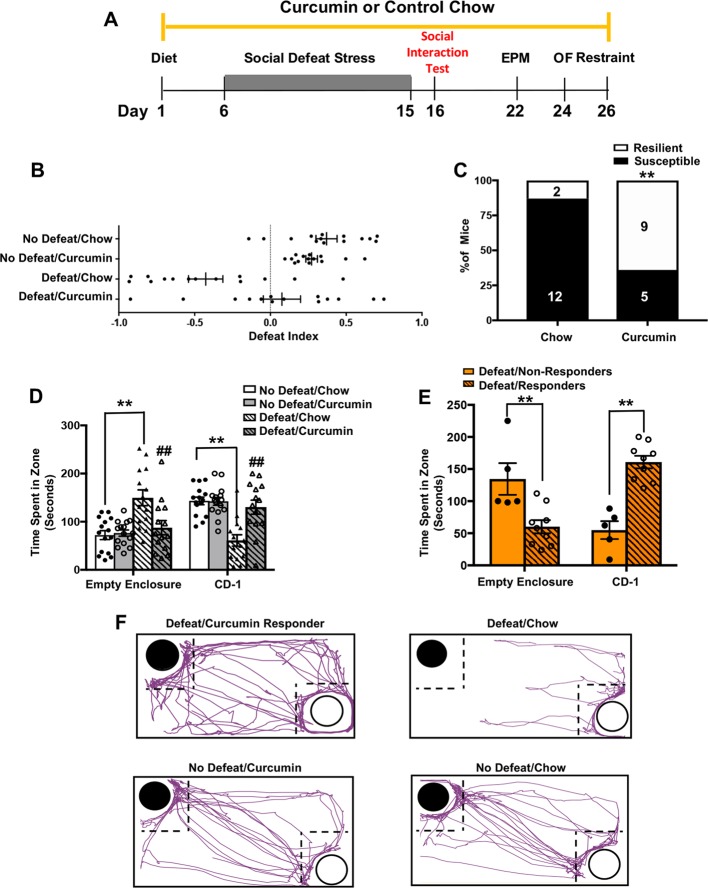
Dietary curcumin promotes resilience to CSDS. a Schematic of behavioral procedures. b Distribution of DI scores for defeated and non-defeated 129/SvEv mice fed dietary curcumin or control chow. There were more defeated mice on curcumin than defeated mice on control chow that were categorized as resilient (DI > 0). c Percent of defeated mice on each chow (control chow or curcumin) that were categorized as resilient or susceptible. Number of animals is indicated inside the bar graph. d Time spent with the empty enclosure and the enclosure containing a novel CD-1. Defeated mice on control chow spent more time with the empty enclosure and less time with the CD-1 than defeated mice on curcumin (p < 0.0001 for each comparison) and non-defeated mice on control chow (p < 0.0001 for each comparison). e Time that defeated mice on curcumin spent with either the empty enclosure or the enclosure containing a novel CD-1. Mice that were curcumin responders (DI > 0; n = 9) spent significantly less time with the empty enclosure (p = 0.001) and more time with the CD-1 (p = 0.0001) than curcumin non-responders (DI < 0; n = 5). f The path (purple) of a representative mouse from each group during the social interaction test (black circle indicates CD-1; white circle indicates empty enclosure; dotted-line indicates interaction zone). Data represent mean ± SEM. No defeat/chow (n = 14), no defeat/curcumin (n = 14), defeat/chow (n = 14), defeat/curcumin (n = 14). **p < 0.0001; ##p < 0.0001 vs. defeat/chow. Defeat/responders (n = 5), defeat/non-responders (n = 5)
Fig. 3
Fig. 3
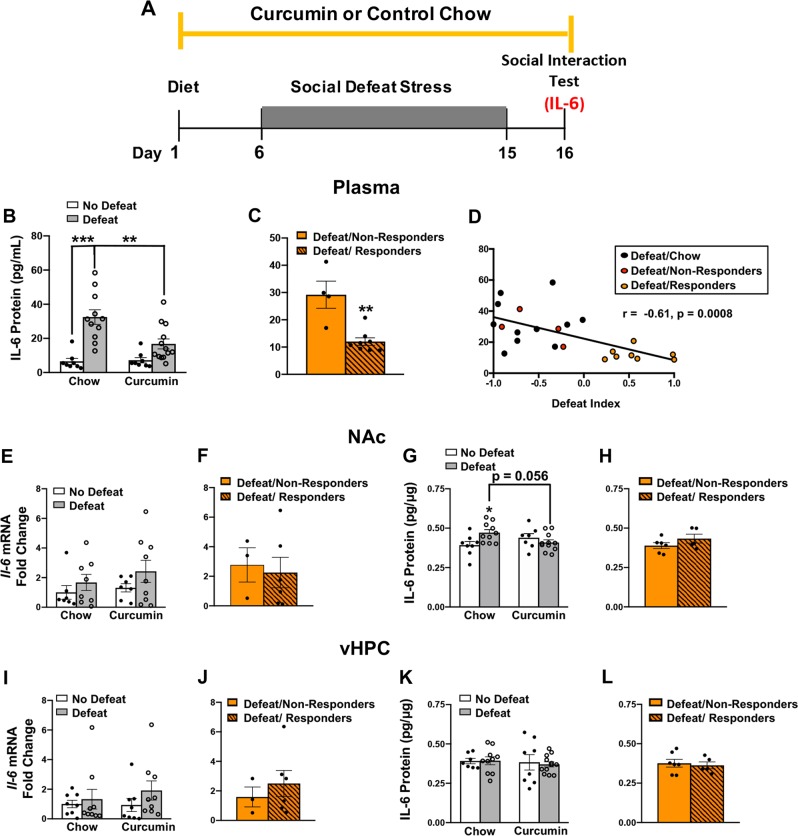
Dietary curcumin attenuates CSDS-induced production of IL-6. a Schematic of behavioral procedures. b, c Plasma IL-6 collected immediately following the social interaction test. b Defeated mice on control chow had significantly more plasma IL-6 than non-defeated mice on control chow (p < 0.0001) and defeated mice on curcumin (p = 0.001). c Curcumin responders (DI > 0) had significantly less plasma IL-6 than curcumin non-responders (DI < 0). d Scatterplot showing a significant negative correlation between DI scores and IL-6 levels in the plasma of defeated mice (r = −0.61, p < 0.001). e, f IL-6 mRNA in the NAc expressed as fold change relative to non-defeated mice on control chow. g, h IL-6 protein in the NAc. g Defeated mice on control chow had significantly higher levels of IL-6 protein in the NAc than non-defeated mice on control chow (p < 0.05) and defeated mice on curcumin (p = 0.056). h Curcumin responders and non-responders had similar levels of IL-6 protein in the NAc. i, j IL-6 mRNA in the vHPC expressed as fold change relative to non-defeated mice on control chow. k, l IL-6 protein in the vHPC. No significant group differences were detected in the vHPC. Data represent mean ± SEM. No defeat/chow (n = 9–11), no defeat/curcumin (n = 8–11), defeat/chow (n = 8–13), defeat/curcumin (n = 8–13). *p < 0.05 vs. no defeat/chow, **p < 0.01, ***p < 0.0001. Defeat/responders (n = 3–7), defeat/non-responders (n = 5–7)
Fig. 4
Fig. 4
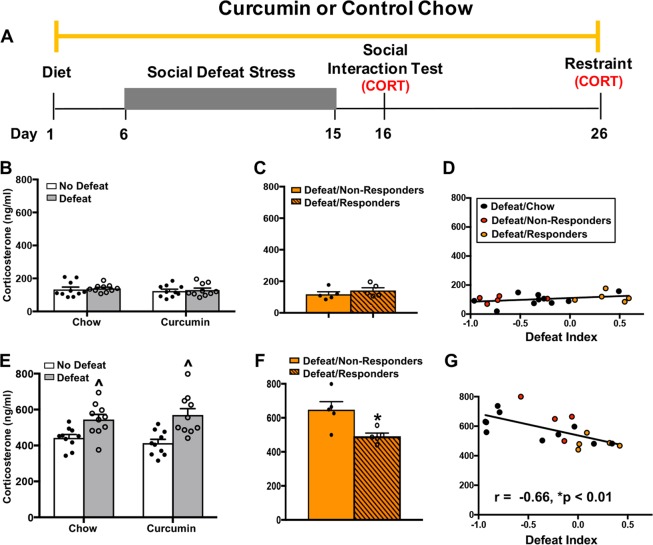
Curcumin blocks stress-induced increases in HPA axis activation in responders. a Schematic of behavioral procedures. b, c Plasma corticosterone collected immediately following the social interaction test. d Scatterplot showing that there was no correlation between DI scores and corticosterone levels in defeated mice. No defeat/chow (n = 10); no defeat/curcumin (n = 10); defeat/chow (n = 10); defeat/curcumin (n = 10); defeat/responders (n = 5); defeat/non-responders (n = 5). e, f Plasma corticosterone collected immediately following 15 min of restraint stress. Defeated mice had higher levels of corticosterone, regardless of diet. Curcumin responders (DI > 0) had lower levels of corticosterone than curcumin non-responders (DI < 0) (p < 0.05). g Scatterplot showing a significant negative correlation between DI scores and corticosterone levels in defeated mice (r = −0.65, p < 0.01). No defeat/chow (n = 10), no defeat/curcumin (n = 10), defeat chow (n = 10), defeat/curcumin (n = 10), defeat/responders (n = 5), and defeat/non-responders (n = 5). Data represent mean ± SEM. *p < 0.05, ^p < 0.05 vs. no defeat group on the same diet
Fig. 5
Fig. 5
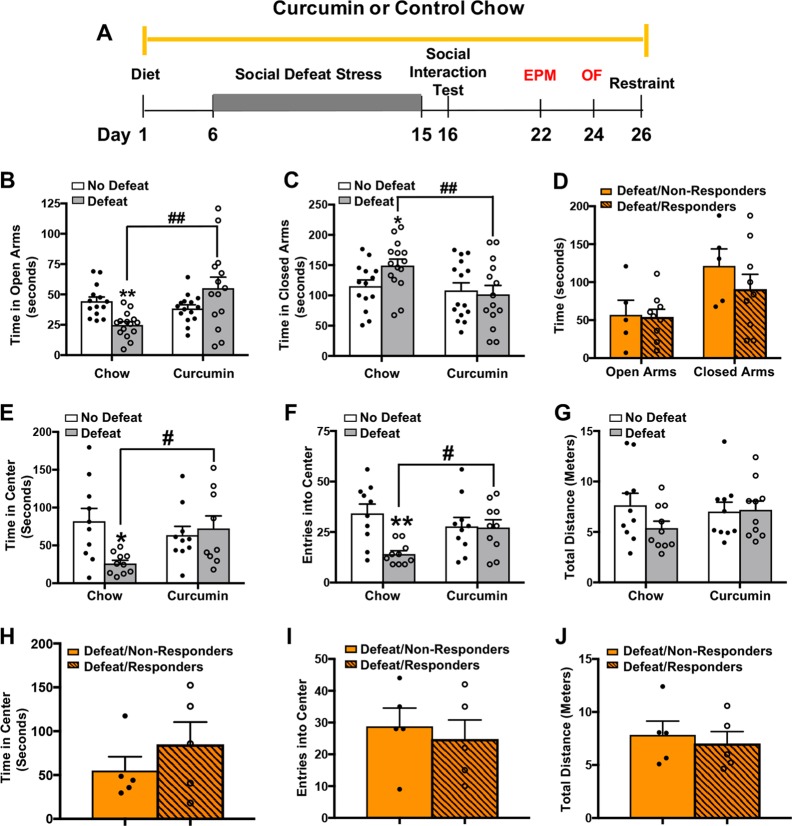
Dietary curcumin protects against the anxiety-like effects of CSDS in the EPM and OF. a Schematic of behavioral procedures. b, c Defeated mice on control chow spent less time in the open arms and more time in the closed arms of the EPM than non-defeated mice on control chow and defeated mice on curcumin. d Curcumin responders (DI > 0) and non-responders (DI < 0) did not differ in the amount of time spent in the open or closed arms of the EPM. e, f Defeated mice on control chow spent less time and made fewer entries into the center of the OF than non-stressed mice on control chow and defeated mice on curcumin. g Groups did not differ in total distance traveled. h–j There were no significant differences between curcumin responders and non-responders in time spent in the center, entries into the center, or total distance traveled in the OF. Data represent mean ± SEM. For EPM: no defeat/chow (n = 14), no defeat/curcumin (n = 14), defeat/chow (n = 14), defeat/curcumin (n = 14), defeat/responders (n = 9), and defeat/non-responders (n = 5). **p < 0.0001 vs. no defeat/chow, *p < 0.05 vs. no defeat/chow, ##p < 0.001. For OF: no defeat/chow (n = 10), no defeat/curcumin (n = 10), defeat/chow (n = 10), defeat/curcumin (n = 10), defeat/responders (n = 5), defeat/non-responders (n = 5). **p < 0.001 vs. no defeat/chow, *p < 0.01 vs. no defeat/chow, #p < 0.05

References

    1. Kessler RC, Petukhova M, Sampson NA, Zaslavsky AM, Wittchen HU. Twelve-month and lifetime prevalence and lifetime morbid risk of anxiety and mood disorders in the United States. Int J Methods Psychiatr Res. 2012;21:169–84. doi: 10.1002/mpr.1359. - DOI - PMC - PubMed
    1. Kendler KS, Karkowski LM, Prescott CA. Causal relationship between stressful life events and the onset of major depression. Am J Psychiatry. 1999;156:837–41. doi: 10.1176/ajp.156.6.837. - DOI - PubMed
    1. Köhler CA, Evangelou E, Stubbs B, Solmi M, Veronese N, et al. Mapping risk factors for depression across the lifespan: An umbrella review of evidence from meta-analyses and Mendelian randomization studies. J Psychiatr Res 2018;5:1–9. - PubMed

    1. Bagot RC, Cates HM, Purushothaman I, Lorsch ZS, Walker DM, et al. Circuit-wide transcriptional profiling reveals brain region-specific gene networks regulating depression susceptibility. Neuron. 2016;90:969–83. doi: 10.1016/j.neuron.2016.04.015. - DOI - PMC - PubMed
    1. Krishnan V, Han MH, Graham DL, Berton O, Renthal W, et al. Molecular adaptations underlying susceptibility and resistance to social defeat in brain reward regions. Cell. 2007;131:391–404. doi: 10.1016/j.cell.2007.09.018. - DOI - PubMed

Publication types

MeSH terms