


Effect of 25-hydroxyvitamin D on Helicobacter pylori eradication in patients with type 2 diabetes
- PMID: 30542778
- PMCID: PMC6394653
- DOI: 10.1007/s00508-018-1416-y
Effect of 25-hydroxyvitamin D on Helicobacter pylori eradication in patients with type 2 diabetes
Erratum in
-
Correction to: Effect of 25-hydroxyvitaminD on Helicobacter pylori eradication in patients with type 2 diabetes.Wien Klin Wochenschr. 2019 Jan;131(1-2):48. doi: 10.1007/s00508-018-1438-5. Wien Klin Wochenschr. 2019. PMID: 30631939 Free PMC article.
Abstract
Background: Various studies have reported a lower Helicobacter pylori eradication rate and a more frequent reinfection rate in type 2 diabetes mellitus (T2DM). Vitamin D has anti-inflammatory and immunoregulatory activity and the role of the vitamin D receptor (VDR) in the antimicrobial activity against H. pylori has been reported. When it comes to the risk factors of H. pylori eradication, the function of vitamin D is not always taken into account. The aim of this study was to assess the role of 25-hydroxyvitamin D in H. pylori eradication in T2DM.
Methods: In this retrospective study data from 160 patients with T2DM who underwent eradication therapy for H. pylori in Anhui Provincial Hospital between July 2015 and September 2017 were analyzed. According to eradication status, patients were divided into two groups, the successful eradication group (n = 124) and the eradication failure group (n = 36). The following information was obtained from participants' records before eradication treatment: age, sex, body mass index (BMI), duration of T2DM, prescription of medication use, smoking and drinking history. All patients were tested for glycated hemoglobin (HbA1c), total cholesterol (TC), high-density lipoprotein cholesterol (HDL-C), low-density lipoprotein cholesterol (LDL‑C), triglyceride (TG) and 25-hydroxyvitamin D (25-OHD) at baseline.
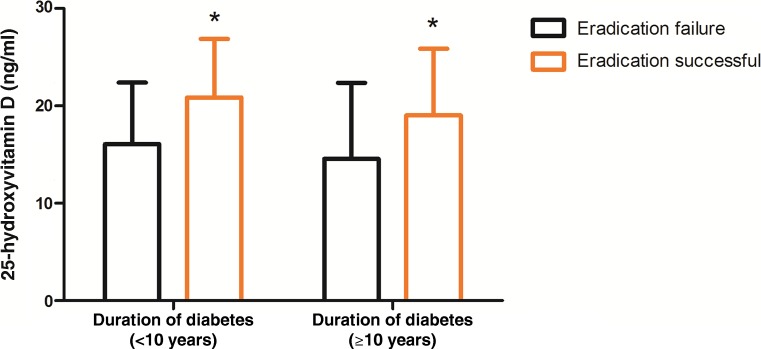
Results: The H. pylori was eradicated in 124 (77.5%) patients, while in 36 (22.5%) patients the treatment was unsuccessful. The eradication failure group had a lower mean vitamin D concentration than the group with successful eradication (15.09 ± 7.72 ng/ml vs. 19.87 ± 6.35 ng/ml, p = 0.004). The estimated odds ratio (OR) for eradication failure in individuals with serum vitamin D deficiency (<20 ng/ml) compared to those with sufficient vitamin D levels (>30 ng/ml) were 1.489 (95% confidence interval, CI: 1.046-2.121, P = 0.027), Individuals with long duration of diabetes (≥10 years) had odds of eradication failure of 1.467 (95% CI: 1.017-2.114, P = 0.040) compared to subjects with short duration of diabetes (<10 years).
Conclusions: Lower 25-OHD was not only associated with H. pylori eradication failure but was also related to dyslipidemia in T2DM patients. Increasing serum 25-OHD to appropriate levels by activated vitamin D use may improve the eradication rate.
Keywords: 25-hydroxyvitamin D; Helicobacter pylori eradication; Lipid profile; Type 2 diabetes; Vitamin D deficiency.
Conflict of interest statement
B. Huang, S. Yan, C. Chen, and S. Ye declare that they have no competing interests.
Figures
References
-
- Ikezaki H, Furusyo N, Jacques PF, Shimizu M, Murata M, Schaefer EJ, et al. Higher dietary cholesterol and omega-3 fatty acid intakes are associated with a lower success rate of Helicobacter pylori eradication therapy in Japan. Am J Clin Nutr. 2017;106(2):581–588. doi: 10.3945/ajcn.116.144873. - DOI - PubMed
MeSH terms
Substances
Grants and funding
LinkOut - more resources
Full Text Sources
Medical
Miscellaneous
