. 2019 Feb 1;199(3):302-312.
doi: 10.1164/rccm.201807-1345OC.

Club Cell Secretory Protein Deficiency Leads to Altered Lung Function

Affiliations

Club Cell Secretory Protein Deficiency Leads to Altered Lung Function

Jing Zhai et al. Am J Respir Crit Care Med. .

Abstract

Rationale: CC16 (club cell secretory protein-16), a member of the secretoglobin family, is one of the most abundant proteins in normal airway secretions and has been described as a serum biomarker for obstructive lung diseases.

Objectives: To determine whether low CC16 is a marker for airway pathology or is implicated in the pathophysiology of progressive airway damage in these conditions.

Methods: Using human data from the birth cohort of the Tucson Children's Respiratory Study, we examined the relation of circulating CC16 levels with pulmonary function and responses to bronchial methacholine challenge from childhood up to age 32 years. In wild-type and CC16-/- mice, we set out to comprehensively examine pulmonary physiology, inflammation, and remodeling in the naive airway.

Measurements and main results: We observed that Tucson Children's Respiratory Study participants in the lowest tertile of serum CC16 had significant deficits in their lung function and enhanced airway hyperresponsiveness to methacholine challenge from 11 years throughout young adult life. Similarly, CC16-/- mice had significant deficits in lung function and enhanced airway hyperresponsiveness to methacholine as compared with wild-type mice, which were independent of inflammation and mucin production. As compared with wild-type mice, CC16-/- mice had significantly elevated gene expression of procollagen type I, procollagen type III, and α-smooth muscle actin, areas of pronounced collagen deposition and significantly enhanced smooth muscle thickness.

Conclusions: Our findings support clinical observations by providing evidence that lack of CC16 in the lung results in dramatically altered pulmonary function and structural alterations consistent with enhanced remodeling.

Keywords: CC16; CCSP; COPD; asthma; uteroglobin.


Figures
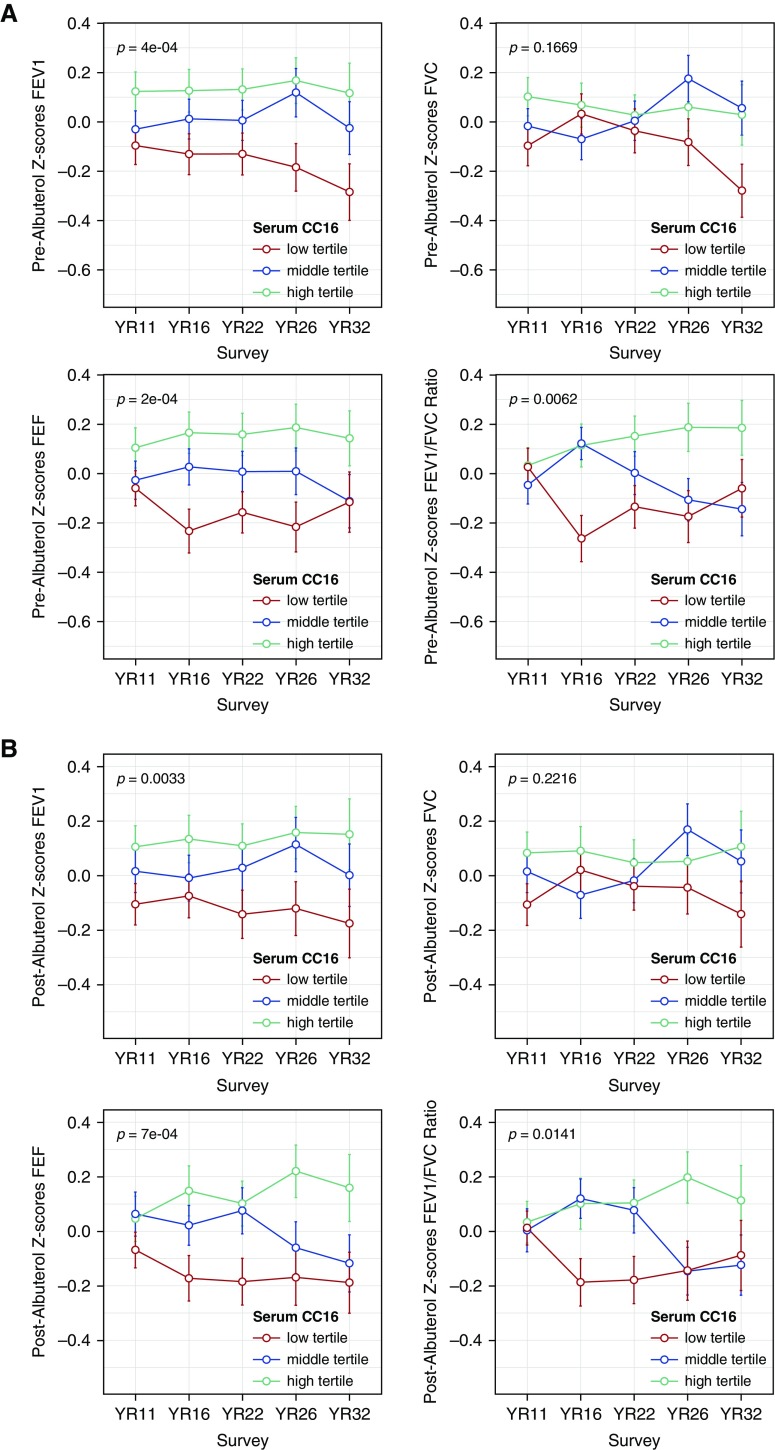
Figure 1.
Figure 1.
z-Scores of FEV1, FVC, forced expiratory flow between 25% and 75% of the FVC, and FEV1/FVC ratio. (A) Before bronchodilator (n subjects = 706) and (B) after bronchodilator (n subjects = 689) from age 11 to age 32 years by serum CC16 (club cell secretory protein 16) tertile categories. Lung function indices were standardized separately for males and females. Error bars indicate the standard error. P values refer to the overall comparison of lung function levels across the three CC16 tertiles. FEF25–75 = forced expiratory flow between 25% and 75% of the FVC.
Figure 2.
Figure 2.
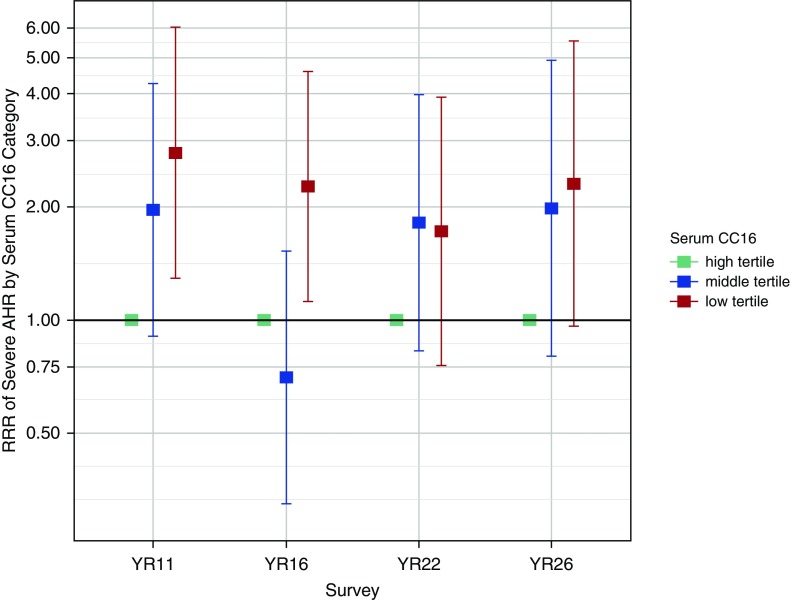
Adjusted relative risk ratios for severe airway hyperresponsiveness (AHR). From multinomial logistic regression models by serum CC16 (club cell secretory protein 16) tertile categories from age 11 to age 26 years (n subjects = 555; n observations = 1,228). High CC16 is the reference category. Error bars indicate 95% confidence intervals. Estimates for mild and moderate AHR are not presented in the figure, but they are reported in Table 3. No AHR is the reference group for both estimates presented in the figure and in Table 3. RRR = relative risk ratio.
Figure 3.
Figure 3.
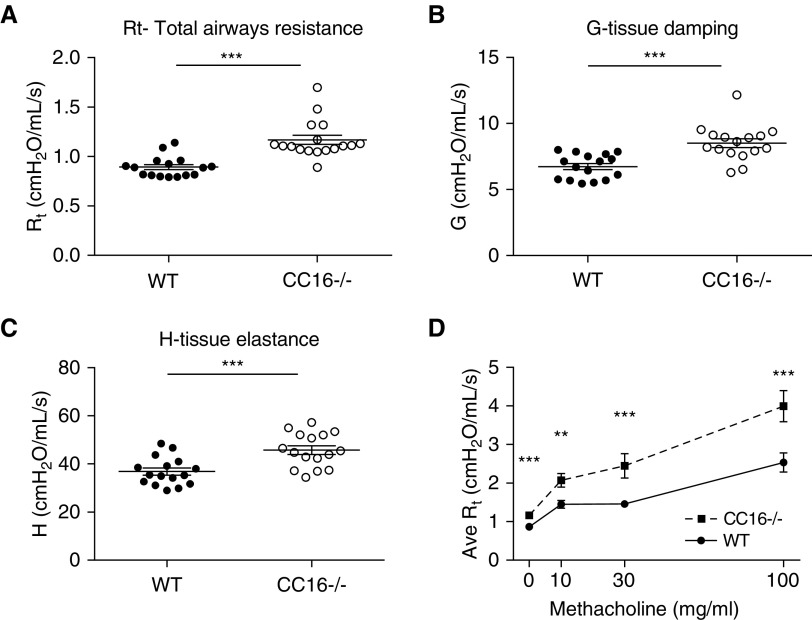
Pulmonary mechanics are altered in CC16 (club cell secretory protein 16)-deficient mice. Age-matched naive mice either sufficient (wild-type [WT], n = 16) or deficient in CC16 (CC16−/−; n = 16) were assessed using a Flexivent device for airway physiology measurements of (A) total airway resistance, (B) tissue damping, and (C) tissue elastance. ***P < 0.001 by Student’s t test. (D) An additional set of age-matched naive male mice either sufficient (WT, n = 17) or deficient in CC16 (CC16−/−, n = 19) were assessed using a Flexivent device for airway physiology measurements during increasing doses of aerosolized methacholine, **P < 0.01, ***P < 0.001 by Student’s t test. Data shown are the mean ± SEM. Ave = average; G = tissue damping; H = tissue elastance; Rt = total airway resistance.
Figure 4.
Figure 4.
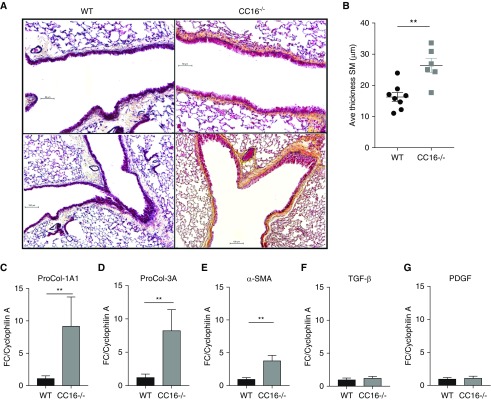
Remodeling factors are increased in the lungs of naive CC16 (club cell secretory protein 16) knockout mice. (A) Representative pentachrome-stained lung sections from wild-type (WT) and CC16−/− naive mice. Scale bars: upper panels, 50 μm; lower panels, 100 μm. (B) Quantitative analysis of smooth muscle thickness was measured on pictures taken at ×10 magnification using ImageJ software as described in the Methods section. n = 8 and 7 WT and CC16−/−, respectively. (C–G) Quantitative RT-PCR analysis for Pro-Col1A1 (C), Pro-Col3A (D), α-sma (E), Tgf-β (F), and Pdgf (G) gene expression in lung tissue from naive WT and CC16−/− mice. Graphed gene expression data are the mean ±  SD, **P < 0.01 by Student’s t test. n = 12 and 16 WT and CC16−/−, respectively. Ave = average; FC = fold over control; PDGF = platelet-derived growth factor; Pro-Col = procollagen; SM = smooth muscle; SMA = smooth muscle actin; TGF = transforming growth factor.

Comment in

  • Taking Precise Aim at Lung Disease.
    Piedimonte G. Piedimonte G. Am J Respir Crit Care Med. 2019 Feb 1;199(3):255-256. doi: 10.1164/rccm.201811-2117ED. Am J Respir Crit Care Med. 2019. PMID: 30557514 Free PMC article. No abstract available.

References

    1. Broeckaert F, Clippe A, Knoops B, Hermans C, Bernard A. Clara cell secretory protein (CC16): features as a peripheral lung biomarker. Ann N Y Acad Sci. 2000;923:68–77. - PubMed
    1. Lakind JS, Holgate ST, Ownby DR, Mansur AH, Helms PJ, Pyatt D, et al. A critical review of the use of Clara cell secretory protein (CC16) as a biomarker of acute or chronic pulmonary effects. Biomarkers. 2007;12:445–467. - PubMed
    1. Laucho-Contreras ME, Polverino F, Tesfaigzi Y, Pilon A, Celli BR, Owen CA. Club cell protein 16 (CC16) augmentation: a potential disease-modifying approach for chronic obstructive pulmonary disease (COPD) Expert Opin Ther Targets. 2016;20:869–883. - PMC - PubMed
    1. Shijubo N, Itoh Y, Yamaguchi T, Sugaya F, Hirasawa M, Yamada T, et al. Serum levels of Clara cell 10-kDa protein are decreased in patients with asthma. Hai. 1999;177:45–52. - PubMed
    1. Guerra S, Vasquez MM, Spangenberg A, Halonen M, Martin RJ. Club cell secretory protein in serum and bronchoalveolar lavage of patients with asthma. J Allergy Clin Immunol. 2016;138:932–934. - PMC - PubMed

Publication types