. 2018 Dec 7;6(4):112.
doi: 10.3390/medsci6040112.

Polyamine Homeostasis in Snyder-Robinson Syndrome

Affiliations

Polyamine Homeostasis in Snyder-Robinson Syndrome

Tracy Murray-Stewart et al. Med Sci (Basel). .

Abstract

Loss-of-function mutations of the spermine synthase gene (SMS) result in Snyder-Robinson Syndrome (SRS), a recessive X-linked syndrome characterized by intellectual disability, osteoporosis, hypotonia, speech abnormalities, kyphoscoliosis, and seizures. As SMS catalyzes the biosynthesis of the polyamine spermine from its precursor spermidine, SMS deficiency causes a lack of spermine with an accumulation of spermidine. As polyamines, spermine, and spermidine play essential cellular roles that require tight homeostatic control to ensure normal cell growth, differentiation, and survival. Using patient-derived lymphoblast cell lines, we sought to comprehensively investigate the effects of SMS deficiency on polyamine homeostatic mechanisms including polyamine biosynthetic and catabolic enzymes, derivatives of the natural polyamines, and polyamine transport activity. In addition to decreased spermine and increased spermidine in SRS cells, ornithine decarboxylase activity and its product putrescine were significantly decreased. Treatment of SRS cells with exogenous spermine revealed that polyamine transport was active, as the cells accumulated spermine, decreased their spermidine level, and established a spermidine-to-spermine ratio within the range of wildtype cells. SRS cells also demonstrated elevated levels of tissue transglutaminase, a change associated with certain neurodegenerative diseases. These studies form a basis for further investigations into the leading biochemical changes and properties of SMS-mutant cells that potentially represent therapeutic targets for the treatment of Snyder-Robinson Syndrome.

Keywords: Snyder-Robinson Syndrome; X-linked intellectual disability; polyamine transport; spermidine; spermine; spermine synthase; transglutaminase.


Conflict of interest statement

The authors declare no conflicts of interest. The funders had no role in the design of the study; in the collection, analyses, or interpretation of data; in the writing of the manuscript, or in the decision to publish the results.

Figures
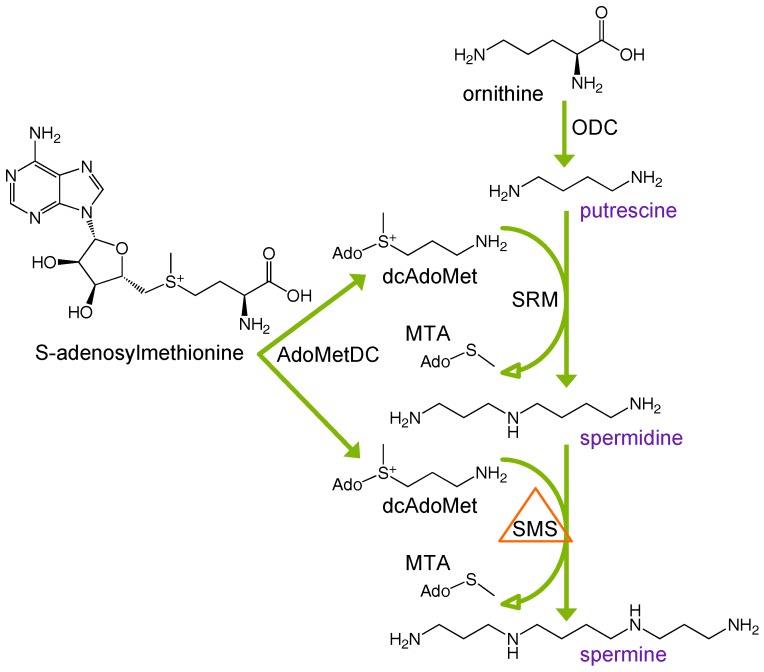
Figure 1
Figure 1
Mammalian polyamine biosynthesis. Polyamines are indicated in purple. Putrescine is created from ornithine via ornithine decarboxylase (ODC). Conversion of putrescine to spermidine and spermidine to spermine occurs through spermidine synthase (SRM) or spermine synthase (SMS), respectively. Both enzymes require the activity of S-adenosylmethionine decarboxylase (AdoMetDC) for the provision of the aminopropyl group donor (decarboxylated AdoMet, dcAdoMet). Snyder-Robinson Syndrome (SRS) patients are deficient in SMS activity, resulting in decreased spermine and accumulation of spermidine. MTA = methylthioadenosine.
Figure 2
Figure 2
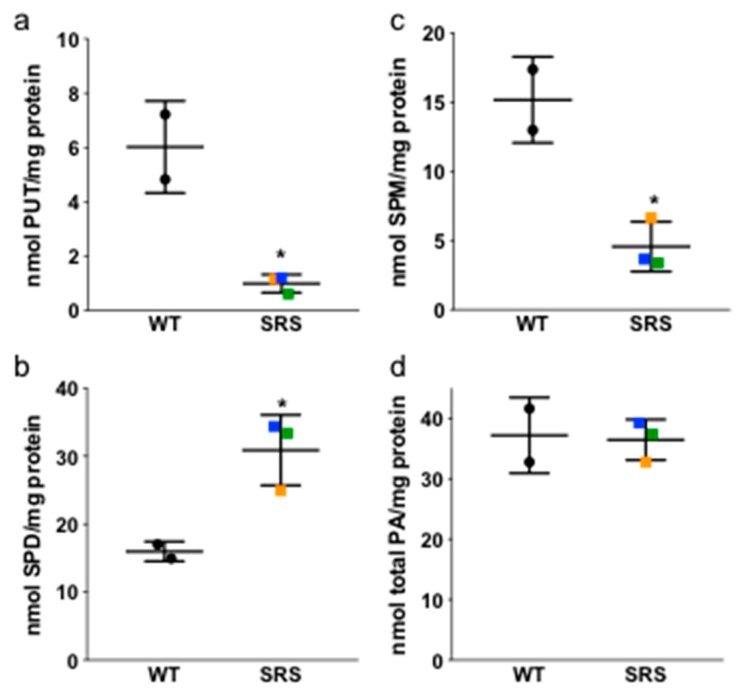
Alterations in basal intracellular concentrations of (a) putrescine (PUT), (b) spermidine (SPD), (c) spermine (SPM), and (d) total polyamines (PA) between SMS wildtype (WT) or mutant (SRS) lymphoblast cell lines (n = 5, each measured in duplicate). Concentrations are presented as nmol of polyamine per mg of cellular protein. The individual SRS cell line designations are orange for SRS1, blue for SRS2, and green for SRS3. Error bars indicate standard error of the mean (SEM). * p < 0.05.
Figure 3
Figure 3
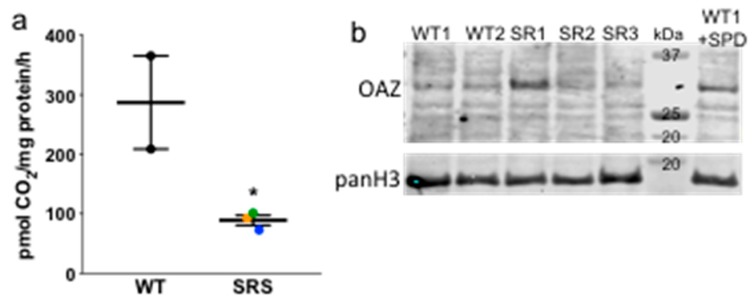
(a) ODC activity in donor or SRS lymphoblasts (n = 2, in triplicate; error bars = SEM), presented as pmol CO2 produced per hour per mg of total protein. Color designations are orange (SRS1), blue (SRS2), and green (SRS3). (b) Representative Western blot of ODC antizyme 1 (OAZ1) with pan histone H3 as loading control. The WT1 cell line treated with SPD for 24 h was used as a positive control for OAZ1. * p < 0.05.
Figure 4
Figure 4
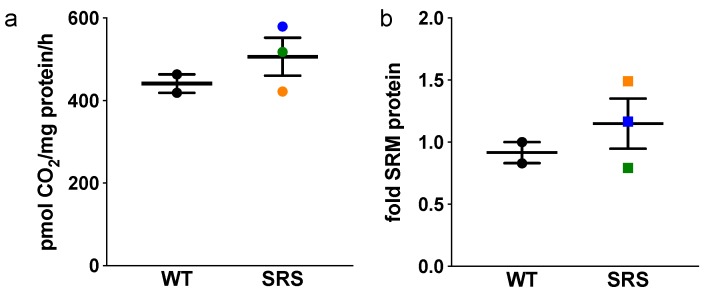
(a) Basal AdoMetDC activity (n = 2, in triplicate) of donor or SRS lymphoblast lines. Color designations are orange (SRS1), blue (SRS2), and green (SRS3). (b) Quantitative Western blots of SRM in lymphoblast cell lines (n = 2). All error bars indicate SEM.
Figure 5
Figure 5
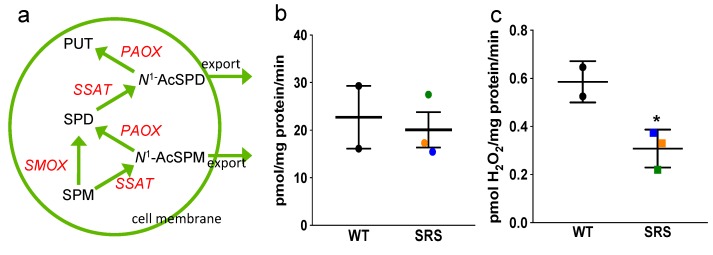
(a) The polyamine catabolic pathway. (b) Spermidine/spermine N1-acetyltransferase (SSAT) and (c) N1-acetylpolyamine oxidase (PAOX) activity assays. Color designations in (b,c) are orange for SRS1, blue for SRS2, and green for SRS3. Error bars indicate SEM (n ≥ 2, in triplicate; * p < 0.05).
Figure 6
Figure 6
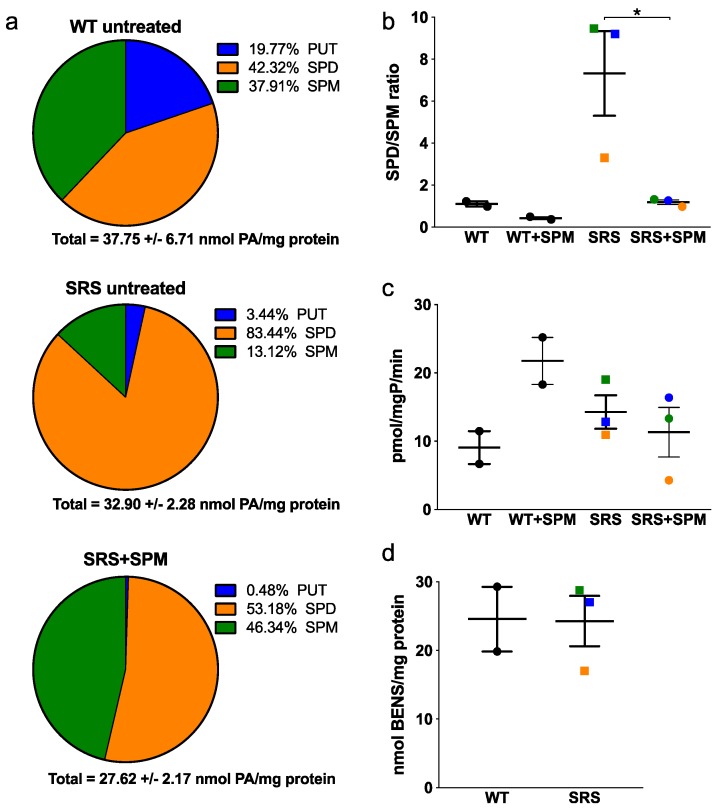
(a) Average polyamine levels of SRS lymphoblast lines before (middle) and after (bottom) 5 μM SPM treatment for 24 h, compared with untreated WT lymphoblast lines (top). (b) SPD/SPM ratios and (c) SSAT activity before and after SPM supplementation. (d) Intracellular accumulation of bis(ethyl)norspermine (BENSpm) following 10 μM treatment for 24 h. Color designations in (b–d) are orange for SRS1, blue for SRS2, and green for SRS3. All error bars indicate SEM (n ≥ 2, in triplicate; * p < 0.05).
Figure 7
Figure 7
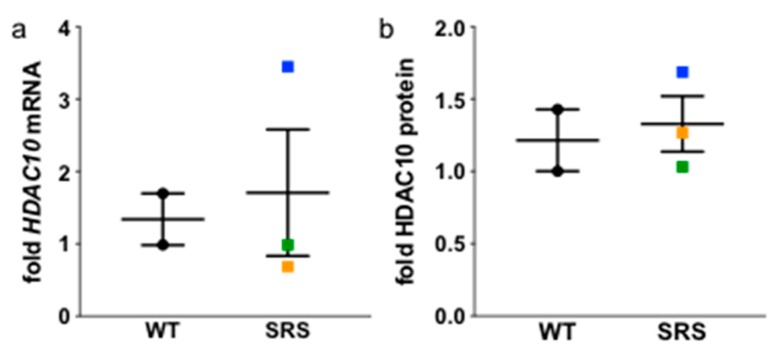
HDAC10 mRNA (a) and protein (b) levels in wildtype versus SRS lymphoblasts. Color designations are orange for SRS1, blue for SRS2, and green for SRS3. Error bars indicate SEM (n = 3).
Figure 8
Figure 8
Transglutaminase 2 mRNA (a) and protein (b) expression levels are increased in SRS cell lines. Colors designate SRS line 1 (orange), SRS line 2 (blue), and SRS line 3 (green). All error bars indicate SEM (n = 3; * p < 0.05).

References

    1. Snyder R.D., Robinson A. Recessive sex-linked mental retardation in the absence of other recognizable abnormalities. Report of a family. Clin. Pediatr. 1969;8:669–674. doi: 10.1177/000992286900801114. - DOI - PubMed
    1. Arena J.F., Schwartz C., Ouzts L., Stevenson R., Miller M., Garza J., Nance M., Lubs H. X-linked mental retardation with thin habitus, osteoporosis, and kyphoscoliosis: Linkage to Xp21.3-p22.12. Am. J. Med. Genet. 1996;64:50–58. doi: 10.1002/(SICI)1096-8628(19960712)64:1<50::AID-AJMG7>3.0.CO;2-V. - DOI - PubMed
    1. Wu H., Min J., Zeng H., McCloskey D.E., Ikeguchi Y., Loppnau P., Michael A.J., Pegg A.E., Plotnikov A.N. Crystal structure of human spermine synthase: Implications of substrate binding and catalytic mechanism. J. Biol. Chem. 2008;283:16135–16146. doi: 10.1074/jbc.M710323200. - DOI - PMC - PubMed
    1. Casero R.A., Jr., Murray Stewart T., Pegg A.E. Polyamine metabolism and cancer: Treatments, challenges and opportunities. Nat. Rev. Cancer. 2018 doi: 10.1038/s41568-018-0050-3. - DOI - PMC - PubMed
    1. Baronas V.A., Kurata H.T. Inward rectifiers and their regulation by endogenous polyamines. Front. Physiol. 2014;5:325. doi: 10.3389/fphys.2014.00325. - DOI - PMC - PubMed