Review
. 2018 Dec 12;10(12):708.
doi: 10.3390/v10120708.

Modulation of Innate Immune Responses by the Influenza A NS1 and PA-X Proteins

Affiliations
Review

Modulation of Innate Immune Responses by the Influenza A NS1 and PA-X Proteins

Aitor Nogales et al. Viruses. .

Abstract

Influenza A viruses (IAV) can infect a broad range of animal hosts, including humans. In humans, IAV causes seasonal annual epidemics and occasional pandemics, representing a serious public health and economic problem, which is most effectively prevented through vaccination. The defense mechanisms that the host innate immune system provides restrict IAV replication and infection. Consequently, to successfully replicate in interferon (IFN)-competent systems, IAV has to counteract host antiviral activities, mainly the production of IFN and the activities of IFN-induced host proteins that inhibit virus replication. The IAV multifunctional proteins PA-X and NS1 are virulence factors that modulate the innate immune response and virus pathogenicity. Notably, these two viral proteins have synergistic effects in the inhibition of host protein synthesis in infected cells, although using different mechanisms of action. Moreover, the control of innate immune responses by the IAV NS1 and PA-X proteins is subject to a balance that can determine virus pathogenesis and fitness, and recent evidence shows co-evolution of these proteins in seasonal viruses, indicating that they should be monitored for enhanced virulence. Importantly, inhibition of host gene expression by the influenza NS1 and/or PA-X proteins could be explored to develop improved live-attenuated influenza vaccines (LAIV) by modulating the ability of the virus to counteract antiviral host responses. Likewise, both viral proteins represent a reasonable target for the development of new antivirals for the control of IAV infections. In this review, we summarize the role of IAV NS1 and PA-X in controlling the antiviral response during viral infection.

Keywords: NS1; PA; PA-X; cytokines; host antiviral response; influenza a virus; innate immunity; interferon; pathogenesis; vaccine; virus evolution; virus–host interactions.


Conflict of interest statement

The authors declare no conflict of interest.

Figures
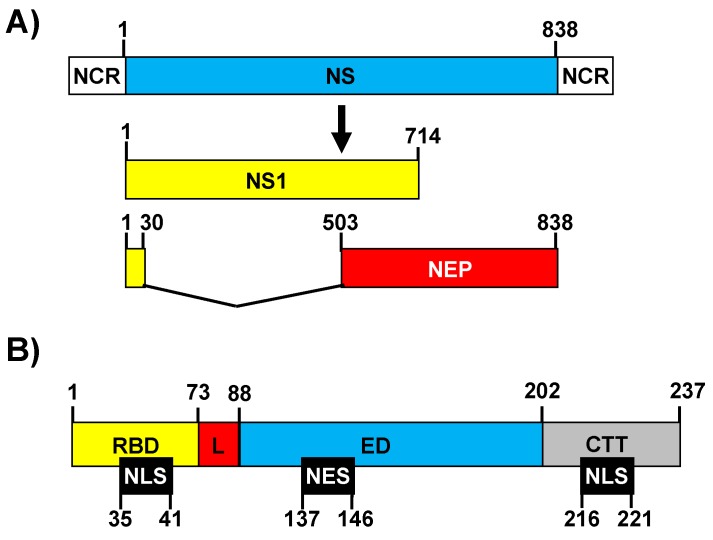
Figure 1
Figure 1
A schematic representation of an influenza A virus (IAV) non-structural (NS) segment, viral transcripts, and NS1 domains. (A) An IAV NS RNA segment is indicated by a blue box and non-coding regions (NCR) are indicated with white boxes. IAV NS1 and nuclear export protein (NEP) transcripts are indicated with yellow and red boxes, respectively. IAV NS1 and NEP open reading frames (ORFs) shared the first 30 nucleotides in the N-terminus. The numbers on the top of the bars represent the ORF length and nucleotide splice positions. (B) The NS1 protein is divided into four distinct regions: The N-terminal RNA-binding domain (RBD; amino acids 1–73, yellow), the linker sequence (L; amino acids 74–88, red), the effector domain (ED; amino acids 89–202, blue), and the C-terminal tail (CTT; amino acids 203 to the end, gray). Note that both the L and the CTT can vary in length among different IAV strains, and, although a 237 amino-acids-length NS1 has been represented, the NS1 can be 219, 230, and 237 amino acids in length. Nuclear localization and export signals (NLS and NES, respectively) are indicated with black boxes at the bottom.
Figure 2
Figure 2
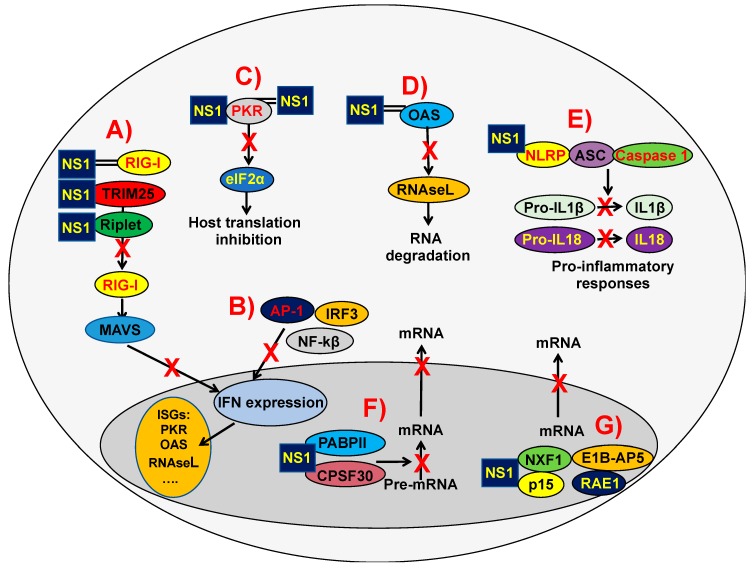
Direct and indirect effects of the IAV NS1 protein on innate immune responses. (A) IAV NS1 decreases RIG-I activation, and IFN responses, through the sequestration of dsRNA [88,89,90], or by interaction with TRIM25 or Riplet, which results in the suppressed ubiquitination and activation of RIG-I, which signals through the mitochondrial antiviral signaling protein (MAVS) to induce IFN responses [91,92]. (B) NS1 inhibits the IRF3 [99], NF-κβ [117], and AP-1 [100] transcription factors, impairing IFN production, and, therefore, the induction of IFN-stimulated gene (ISG) products. In addition, NS1 directly inhibits the antiviral activities of the ISGs PKR and OAS-RNaseL. (C) The IAV NS1 protein binds dsRNA and PKR, leading to decreased PKR activity to phosphorylate eIF2α, and host translation inhibition [101,102,103]. (D) The IAV NS1 protein, via the dsRNA-binding activity of its RBD, inhibits OAS activation, blocking RNA degradation [87]. (E) The IAV NS1 protein also inhibits NLRP3 inflammasome activation [105,106,107], impairing the cleavage of pro-interleukin (IL)-1β and pro-IL-18 into their mature forms IL-1β and IL-18, respectively, which are released from the cell to stimulate inflammatory processes. (F) NS1 proteins from some human and avian IAV strains bind to CPSF30, blocking the cleavage of immature mRNAs (pre-mRNAs) and the recruitment of the poly(A) polymerase to add the poly(A) tail [62,72,74,108,109,110,123]. The IAV NS1 protein also binds to the poly(A)-binding protein II (PABPII), inhibiting its ability to stimulate the synthesis of long poly(A) tails [111]. These last two processes lead to host shutoff of protein synthesis [111]. (G) Additionally, the NS1 of influenza A/WSN/33 H1N1 (WSN) binds NXF1, p15, RAE1, and E1B-AP5, which interact with both mRNAs and nucleoporins to direct mRNAs through the nuclear pore complex, blocking their function, and likely facilitating host cellular shutoff [116].
Figure 3
Figure 3
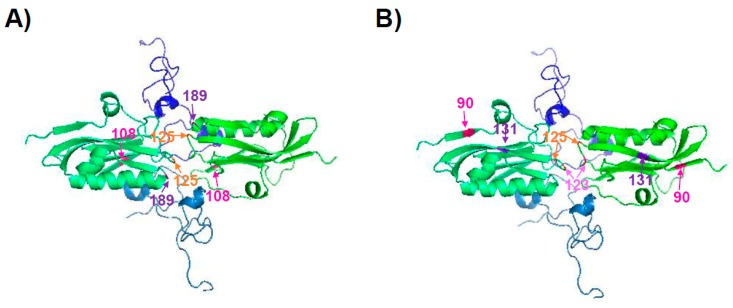
The tridimensional structure of the IAV NS1 ED coupled to the F2/F3 domain of CPSF30. A/Udorn/72 H3N2 strain NS1 ED bound to the F2/F3 fragment of the human CPSF30 was previously crystalized [108] (protein data bank (PDB) entry 2RHK). Colors were included using the MacPyMOL Molecular Graphics system (pymol.org). Each monomer of the NS1 ED is represented in green colors. Monomers of the F2/F3 fragment of the human CPSF30 are represented in blue colors. The artificially introduced NS1 amino acid residues 108, 125, and 189 restoring NS1–CPSF0 binding (A) [125], and the residues 90, 123, 125, and 131 found in naturally circulating pH1N1 viruses (B) [126], are indicated in reddish colors (orange, purple, and pink). Figure adapted from [126].
Figure 4
Figure 4
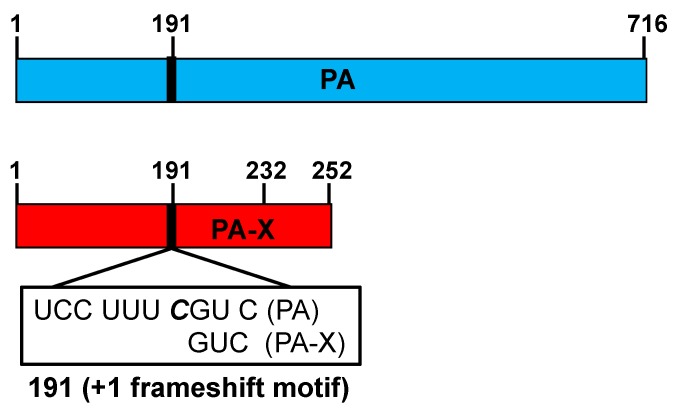
A schematic representation of the IAV PA viral segment and the PA and PA-X open reading frames (ORFs). Blue and red boxes indicate the ORF for PA and PA-X, respectively. The +1 frameshift motif (UCC UUU CGU C) at position 191 is indicated. Bold and italics in the frameshift motif (C nucleotide) indicate that the nucleotide C is not read during PA-X translation. PA-X proteins containing 232 or 252 amino acids if the C-terminal region has a 41 or 61 amino acid extension, respectively, are indicated.

References

    1. Palese P., Shaw M.L. Orthomyxoviridae: The viruses and their replication. In: Knipe D., Howley P., editors. Fields Virology. Lippincott Williams & Wilkins; Philadelphia, PA, USA: 2006. pp. 1648–1689.
    1. Parrish C.R., Kawaoka Y. The origins of new pandemic viruses: The acquisition of new host ranges by canine parvovirus and influenza A viruses. Annu. Rev. Microbiol. 2005;59:553–586. doi: 10.1146/annurev.micro.59.030804.121059. - DOI - PubMed
    1. Steel J., Lowen A.C., Mubareka S., Palese P. Transmission of influenza virus in a mammalian host is increased by PB2 amino acids 627K or 627E/701N. PLoS Pathog. 2009;5:e1000252. doi: 10.1371/journal.ppat.1000252. - DOI - PMC - PubMed
    1. Bailey E.S., Choi J.Y., Fieldhouse J.K., Borkenhagen L.K., Zemke J., Zhang D., Gray G.C. The continual threat of influenza virus infections at the human-animal interface: What is new from a one health perspective? Evol. Med. Public Health. 2018;2018:192–198. doi: 10.1093/emph/eoy013. - DOI - PMC - PubMed
    1. Gonzalez G., Marshall J.F., Morrell J., Robb D., McCauley J.W., Perez D.R., Parrish C.R., Murcia P.R. Infection and pathogenesis of canine, equine, and human influenza viruses in canine tracheas. J. Virol. 2014;88:9208–9219. doi: 10.1128/JVI.00887-14. - DOI - PMC - PubMed

Publication types

LinkOut - more resources