. 2018;318(3):1587-1596.
doi: 10.1007/s10967-018-6249-7. Epub 2018 Nov 10.

Estimate of Fukushima-derived radiocaesium in the North Pacific Ocean in summer 2012

Affiliations

Estimate of Fukushima-derived radiocaesium in the North Pacific Ocean in summer 2012

Y Inomata et al. J Radioanal Nucl Chem. 2018.

Abstract

Distributions of radiocaesium (134Cs and 137Cs) derived from the Tokyo Electric Power Company (TEPCO) Fukushima Dai-ichi Nuclear Power Plant (FNPP1) accident in the North Pacific Ocean in the summer of 2012 were investigated. We have estimated the radiocaesium inventory in the surface layer using the optimal interpolation analysis and the subducted amount into the central mode water (CMW) by using vertical profiles of FNPP1-134Cs and mass balance analysis as the first approach. The inventory of the 134Cs in the surface layer in the North Pacific Ocean in August-December 2012 was estimated at 5.1 ± 0.9 PBq on 1 October 2012, which corresponds to 8.6 ± 1.5 PBq when it was decay corrected to the date of the FNPP1 accident, 11 March 2011. It was revealed that 56 ± 10% of the released 134Cs into the North Pacific Ocean, which was estimated at 15.3 ± 2.6 PBq, transported eastward in the surface layer in 2012. The amount of 134Cs subducted in the CMW was estimated to be 2.5 ± 0.9 PBq based on the mass balance among the three domains of the surface layer, subtropical mode water, and CMW.

Keywords: Central mode water; FNPP1 accident; Inventory; Mass balance; North Pacific Ocean; Radiocaesium; Subtropical mode water.


Figures

Fig. 1
Fig. 1
The distributions of 134Cs activity concentrations in the North Pacific Ocean in August–December, 2012. The data measured during the period from August to December, 2012 were composited and decay corrected to a 1 October 2012, b 11 March 2011. The circles are the measurement data. The circles with small black dots are sites measuring the vertical distribution. The unit of measurement is Bq m−3
Fig. 2
Fig. 2
The deposition of 134Cs into the North Pacific Ocean on 15 March 2011. a The Masingar I model, b the Masingar MK-II model, c the MRI-PM/r model. The unit of measurement is PBq m−2 d−1. The data was decay corrected to 11 March 2011. Based on the σθ distributions in the North Pacific Ocean, the deposition region was divided into the STMW and CMW regions
Fig. 3
Fig. 3
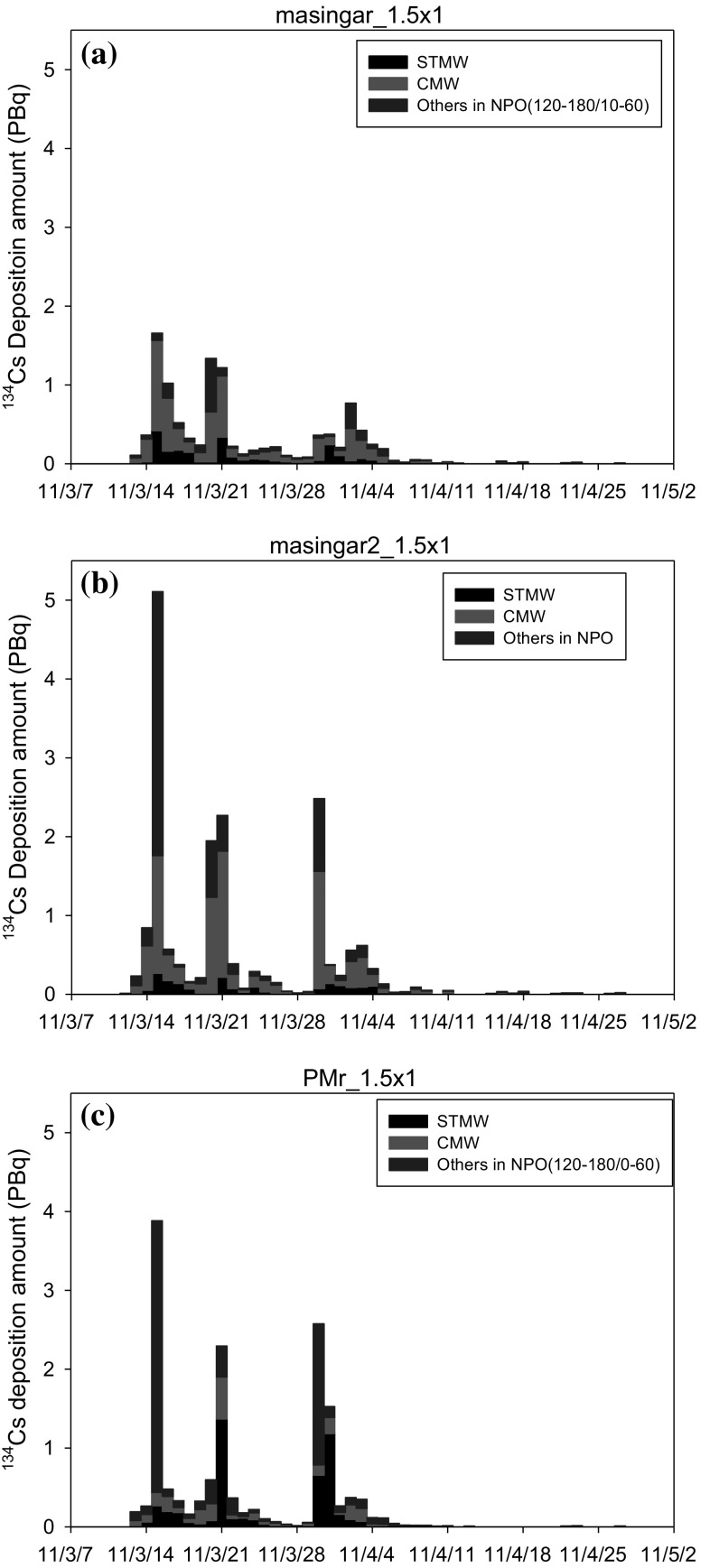
The temporal variation of daily 134Cs deposition into the North Pacific Ocean from 11 March to 30 April 2011. The North Pacific Ocean was divided into the STMW, CMW, and other regions. The analytical domain is longitude 120°E–180° between latitude 10°N and 60°N; a the Masingar I model, b the Masingar MK-II model, c the MRI-PM/r model. The data was decay corrected to 11 March 2011. (Color figure online)
Fig. 4
Fig. 4
The vertical distributions of (a)134Cs and ( b)137Cs activity concentrations in the North Pacific Ocean. Data of 134Cs and 137Cs activity concentrations were decay corrected to 11 March 2011. The sampling stations are BD05 (40.83°N, 149.99°E, 26 August 2012), BD07 (47.00°N, 160.08°E, 26 August 2012), BD09 (47.00°N, 170.58°E, 2 September 2012), BD11 (47.00°N, 180.00°E, 6 September 2012), BD14 (47.00°N, 190.00°E, 11 September 2012), and 00 (47.63°N, 161.83°E, 8 September 2012). Open circles mean that 134Cs and 137Cs activity concentrations were below the detection limit
Fig. 5
Fig. 5
The water column inventory of 134Cs decay corrected to 11 March 2011 against the 134Cs activity concentrations in surface seawater

References

    1. Aoyama M, Hamajima Y, Hult M, Uematsu M, Oka E, Tsumune D, Kumamoto Y. 134Cs and 137Cs in the North Pacific Ocean derived from the March 2011 TEPCO Fukushima Dai-ichi Nuclear Power Plant accident, Japan. Part one: surface pathway and vertical distributions. J Oceanogr. 2016;72:53–65. doi: 10.1007/s10872-015-0335-z. - DOI
    1. Hirose K. Fukushima Daiichi Nuclear Plant accident: atmospheric and oceanic impacts over the 5 years. J Environ Radioact. 2016;157:113–130. doi: 10.1016/j.jenvrad.2016.01.011. - DOI - PubMed
    1. Tsumune D, Tsubono T, Aoyama M, Hirose K. Distribution of oceanic 137Cs from the Fukushima Dai-ichi Nuclear Power Plant simulated numerically by a regional ocean model. J Environ Radioact. 2012;111:100–108. doi: 10.1016/j.jenvrad.2011.10.007. - DOI - PubMed
    1. Tsumune D, Tsubono T, Aoyama M, Uematsu M, Misumi K, Maeda Y, Yoshida Y, Hayami H. One-year, regional-scale simulation of 137Cs radioactivity in the ocean following the Fukushima Dai-ichi Nuclear Power Plant accident. Biogeosciences. 2013;10:5601–5617. doi: 10.5194/bg-10-5601-2013. - DOI
    1. Aoyama M, Uematsu M, Tsumune D. Surface pathway of radioactive plume of TEPCO Fukushima NPP1 released 134Cs and 137Cs. Biogeosciences. 2013;10:3067–3078. doi: 10.5194/bg-10-3067-2013. - DOI

LinkOut - more resources