. 2018 Dec 12;4(12):eaau6200.
doi: 10.1126/sciadv.aau6200. eCollection 2018 Dec.

Sleepmore in Seattle: Later school start times are associated with more sleep and better performance in high school students

Affiliations

Sleepmore in Seattle: Later school start times are associated with more sleep and better performance in high school students

Gideon P Dunster et al. Sci Adv. .

Abstract

Most teenagers are chronically sleep deprived. One strategy proposed to lengthen adolescent sleep is to delay secondary school start times. This would allow students to wake up later without shifting their bedtime, which is biologically determined by the circadian clock, resulting in a net increase in sleep. So far, there is no objective quantitative data showing that a single intervention such as delaying the school start time significantly increases daily sleep. The Seattle School District delayed the secondary school start time by nearly an hour. We carried out a pre-/post-research study and show that there was an increase in the daily median sleep duration of 34 min, associated with a 4.5% increase in the median grades of the students and an improvement in attendance.


Figures
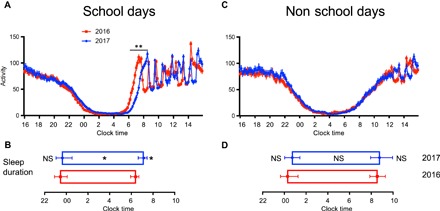
Fig. 1
Fig. 1. Delayed school start times result in later sleep offset and longer sleep.
Mean student activity waveforms and sleep summaries between years for school (A and B) and nonschool days (C and D). For both (A) and (C), there was a significant effect of time, year, and the interaction (see text). **P < 0.01, difference between years (Sidak’s comparisons). For (B), there is a significant delay in sleep offset (P = 0.0007), but not sleep onset (P = 0.0459), on weekdays in 2017 as compared to 2016, resulting in a significant increase of sleep duration on school days in 2017 (P = 0.0007); P < 0.017 threshold for significance for Wilcoxon signed-rank test corrected for multiple comparisons. The same analysis of sleep parameters on nonschool days shows no difference between years (D) [n = 84 (2017, school day) and n = 94 (2016, school day); n = 76 (2017, nonschool day) and n = 81 (2016, nonschool day)]. For (B) and (D), values represent median, and bars represent interquartile range. Sleep offset was also tested through generalized linear models (see text). Each student contributed at least five nights for the school-day data and three nights for the nonschool data. NS, not significant.
Fig. 2
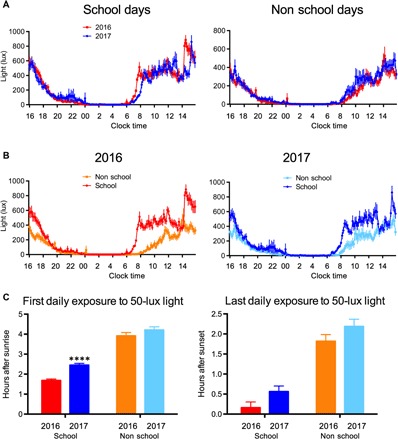
Fig. 2. Delayed school start times result in later exposure to light in the morning but not in the evening.
(A) Mean student light exposure waveforms between years for school and nonschool days. During school days, students appear to have a delay in morning light exposure but not in evening light exposure. This delay is not evident in the data from nonschool days. (B) For both years, exposure to light is delayed in weekends relative to weekdays. (C) Because of the non-normal nature of the light data, the times for first and last exposure to 50-lux light on school, and nonschool days were tested for each year using a two-way ANOVA. There was a significant effect of day of week (school or nonschool) and year but not of the interaction (see Table 1); ****P < 0.0001, significant difference between years (Sidak’s multiple comparisons). No difference was observed on nonschool days nor in the timing of the last daily exposure for school or nonschool days.
Fig. 3
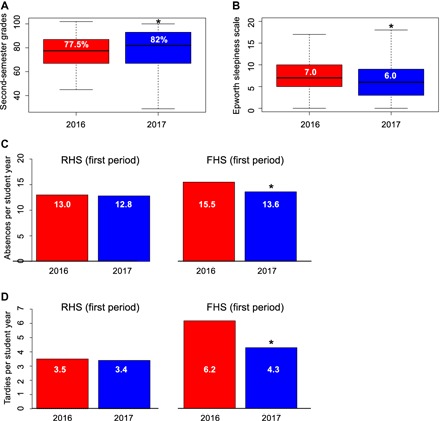
Fig. 3. Delayed school start times are associated with higher grades, reduced sleepiness, and improved attendance and punctuality.
(A and B) Box plots of student performance and daytime sleepiness. Generalized linear models indicated that student performance, as measured by second-semester grades, was significantly higher (*P = 0.0261), whereas daytime sleepiness was significantly lower (*P = 0.0370) in 2017 than 2016. First-period absence (C) and tardy (D) data were compared between years using a χ2 test. Students from FHS but not from RHS had a significant reduction in absences and tardies (*P < 0.0001) in 2017 as compared to 2016. Numbers within boxes in (A) and (B) represent medians, and numbers in bars in (C) and (D) represent absolute value.

References

    1. M. A. Carskadon, in Sleep in Children: Developmental Changes in Sleep Patterns, C. L. Marcus, Ed. (Informa Healthcare, 2008).
    1. Wright K. P. Jr., Gronfier C., Duffy J. F., Czeisler C. A., Intrinsic period and light intensity determine the phase relationship between melatonin and sleep in humans. J. Biol. Rhythms 20, 168–177 (2005). - PMC - PubMed
    1. Taylor D. J., Jenni O. G., Acebo C., Carskadon M. A., Sleep tendency during extended wakefulness: Insights into adolescent sleep regulation and behavior. J. Sleep Res. 14, 239–244 (2005). - PubMed
    1. Jenni O. G., Achermann P., Carskadon M. A., Homeostatic sleep regulation in adolescents. Sleep 28, 1446–1454 (2005). - PubMed
    1. Carskadon M. A., Sleep in adolescents: The perfect storm. Pediatr. Clin. North Am. 58, 637–647 (2011). - PMC - PubMed

Publication types

LinkOut - more resources