


Clinical features related to statin-associated muscle symptoms
- PMID: 30549046
- PMCID: PMC6465106
- DOI: 10.1002/mus.26397
Clinical features related to statin-associated muscle symptoms
Abstract
Introduction: Statins reduce cardiovascular disease risk and are generally well tolerated, yet up to 0.5% of statin-treated patients develop incapacitating muscle symptoms including rhabdomyolysis. Our objective was to identify clinical factors related to statin-associated muscle symptoms (SAMS).
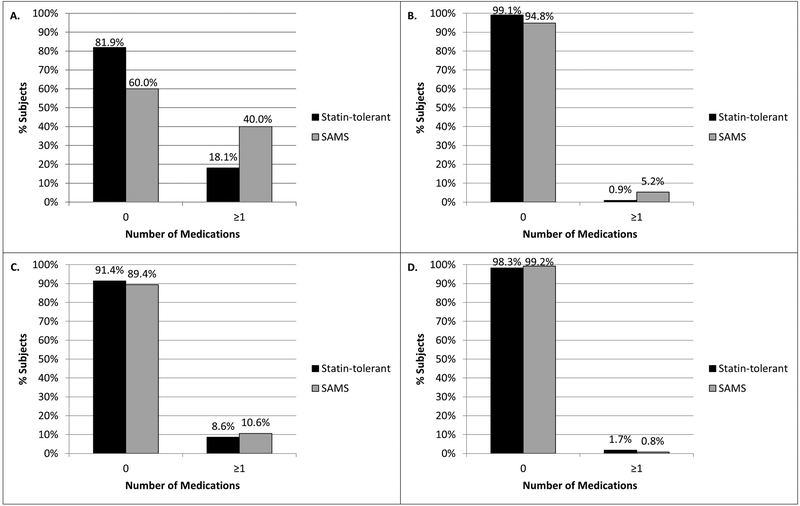
Methods: Clinical and laboratory characteristics were evaluated in 748 statin-treated Caucasians (634 with SAMS and 114 statin-tolerant controls). Information was collected on statin type, concomitant drug therapies, muscle symptom history, comorbidities, and family history. Logistic regression was used to identify associations.
Results: Individuals with SAMS were 3.6 times (odds ratio [OR] 3.60, 95% confidence interval [CI] 2.08-6.22) more likely than statin-tolerant controls to have a family history of heart disease. Additional associations included obesity (OR 3.08, 95% CI 1.18, 8.05), hypertension (OR 2.24, 95% CI 1.33, 3.77), smoking (OR 2.08, 95% CI 1.16, 3.74), and statin type.
Discussion: Careful medical monitoring of statin-treated patients with the associated coexisting conditions may ultimately reduce muscle symptoms and lead to improved compliance. Muscle Nerve 59:537-537, 2019.
Keywords: muscle disease; rhabdomyolysis; risk factors; statin-associated muscle symptoms; statins.
© 2018 Wiley Periodicals, Inc.
Conflict of interest statement
Figures
Comment in
-
Statin-associated muscle symptoms: Does the benefit outweigh the risk factor?Muscle Nerve. 2019 May;59(5):525-527. doi: 10.1002/mus.26470. Epub 2019 Mar 25. Muscle Nerve. 2019. PMID: 30882912 No abstract available.
References
-
- Stone NJ, Robinson JG, Lichtenstein AH, Bairey Merz CN, Blum CB, Eckel RH, et al. 2013 ACC/AHA guideline on the treatment of blood cholesterol to reduce atherosclerotic cardiovascular risk in adults: a report of the American College of Cardiology/American Heart Association Task Force on Practice Guidelines. J Am Coll Cardiol 2014;63: 2889–2934. - PubMed
-
- Vladutiu G Genetic predisposition to statin myopathy. Curr Opin Rheumatol 2008;20: 648–655. - PubMed
-
- Thompson PD, Clarkson P, Karas RH. Statin-associated myopathy. JAMA 2003;289: 1681–1690. - PubMed
-
- Bays H Statin safety: an overview and assessment of the data−−2005. Am J Cardiol 2006;97: 6C–26C. - PubMed
-
- Yeboah J, Sillau S, Delaney JC, Blaha MJ, Michos ED, Young R, et al. Implications of the new American College of Cardiology/American Heart Association cholesterol guidelines for primary atherosclerotic cardiovascular disease event prevention in a multi ethnic cohort: Multi-Ethnic Study of Atherosclerosis (MESA). Am Heart J 2015;169: 387–395 e383. - PMC - PubMed
Publication types
MeSH terms
Substances
Grants and funding
LinkOut - more resources
Full Text Sources
Medical
