


Intimate partner violence as a mechanism underlying the intergenerational transmission of maltreatment among economically disadvantaged mothers and their adolescent daughters
- PMID: 30554572
- PMCID: PMC7175628
- DOI: 10.1017/S0954579418001505
Intimate partner violence as a mechanism underlying the intergenerational transmission of maltreatment among economically disadvantaged mothers and their adolescent daughters
Abstract
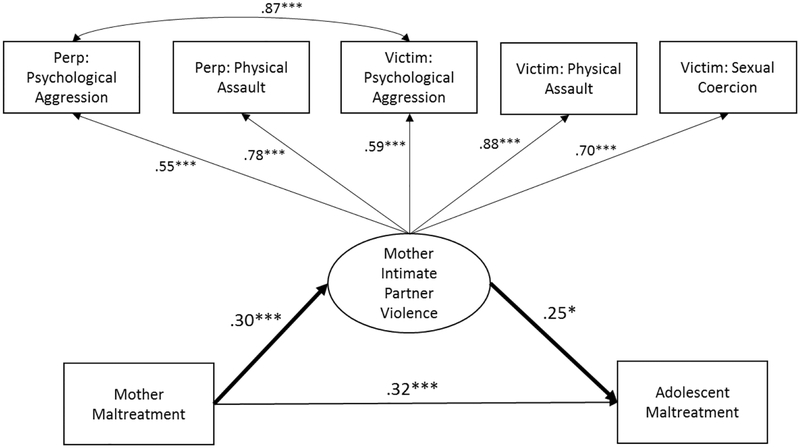
Child maltreatment represents a pervasive societal problem. Exposure to maltreatment is predictive of maladjustment across development with enduring negative effects found in adulthood. Compelling evidence suggests that some parents with a history of child abuse and neglect are at elevated risk for the maltreatment of their own children. However, a dearth of research currently exists on mediated mechanisms that may underlie this continuity. Ecological and transactional theories of child maltreatment propose that child maltreatment is multiply determined by various risk factors that exist across different ecological systems. Intimate partner violence (IPV) often co-occurs with child maltreatment and may represent a pathway through which risk for child abuse and neglect is transmitted across generations within a family. Informed by theories on the intergenerational transmission of child maltreatment and utilizing a community-based, cross-sectional sample of 245 racially and ethnically diverse, low-income mothers and daughters, the objective of this study was to investigate IPV as a propagating process through which risk of child abuse and neglect is conferred from parent to child. We found evidence suggesting that mothers' history of maltreatment is associated with both their IPV involvement and their adolescent daughters' maltreatment victimization (with exposure to IPV as a maltreatment subtype excluded for clarity). Maternal IPV also partially accounted for the continuity of maltreatment victimization from mother to adolescent. A secondary analysis that included the adolescent's own engagement in dating violence provided compelling but preliminary evidence of the emergence of a similar pattern of relational violence, whereby adolescent girls with maltreatment histories were likewise involved in abusive intimate relationships. Future directions and clinical implications of these findings are discussed.
Figures
References
-
- Appel AE, & Holden GW (1998). The co-occurrence of spouse and physical child abuse: A review and appraisal. Journal of Family Psychology, 12, 578–599. doi: 10.1037/0893-3200.12.4.578 - DOI
-
- Archer J (2000). Sex differences in aggression between heterosexual partners: a meta-analytic review. Psychological Bulletin, 126, 651–680. - PubMed
-
- Barnett D, Manly JT, & Cicchetti D (1993). Defining child maltreatment: The interface between policy and research. In Child Abuse, Child Development, and Social Policy (Vol. 8, pp. 7–73). Norwood, NJ: Ablex.
-
- Belsky J (1980). Child maltreatment: an ecological integration. American Psychologist, 35, 320–335. - PubMed
Grants and funding
LinkOut - more resources
Full Text Sources
