Review
. 2018 Nov 29:9:1388.
doi: 10.3389/fphar.2018.01388. eCollection 2018.

Advances in Achieving Opioid Analgesia Without Side Effects

Affiliations
Review

Advances in Achieving Opioid Analgesia Without Side Effects

Halina Machelska et al. Front Pharmacol. .

Abstract

Opioids are the most effective drugs for the treatment of severe pain, but they also cause addiction and overdose deaths, which have led to a worldwide opioid crisis. Therefore, the development of safer opioids is urgently needed. In this article, we provide a critical overview of emerging opioid-based strategies aimed at effective pain relief and improved side effect profiles. These approaches comprise biased agonism, the targeting of (i) opioid receptors in peripheral inflamed tissue (by reducing agonist access to the brain, the use of nanocarriers, or low pH-sensitive agonists); (ii) heteromers or multiple receptors (by monovalent, bivalent, and multifunctional ligands); (iii) receptor splice variants; and (iv) endogenous opioid peptides (by preventing their degradation or enhancing their production by gene transfer). Substantial advancements are underscored by pharmaceutical development of new opioids such as peripheral κ-receptor agonists, and by treatments augmenting the action of endogenous opioids, which have entered clinical trials. Additionally, there are several promising novel opioids comprehensively examined in preclinical studies, but also strategies such as biased agonism, which might require careful rethinking.

Keywords: addiction; biased agonists; endogenous opioid peptides; heteromers; opioid receptor signaling; opioid side effects; pain; peripheral opioid analgesia.


Figures
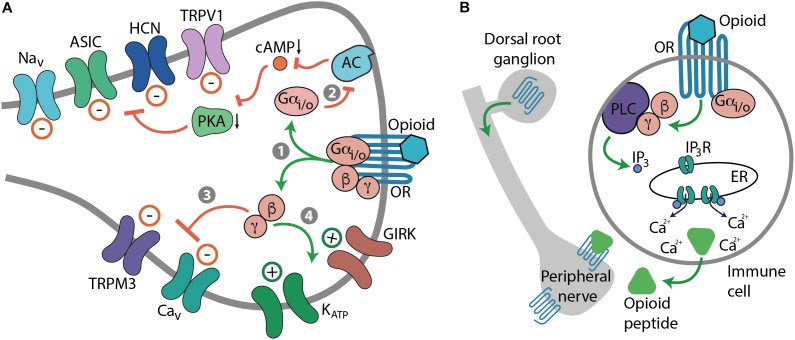
FIGURE 1
FIGURE 1
Mechanisms of opioid-induced analgesia. (A) Cellular effects mediated by neuronal opioid receptors (OR). Activation of OR by an opioid leads to the dissociation of Gi/o proteins into Gαi/o and Gβγ subunits (step 1). Gαi/o inhibits AC, cAMP formation, and PKA activity, which blocks various ion channels, including TRPV1, HCN, ASIC, and Nav channels (path 2). Gβγ blocks Cav and TRPM3 channels (path 3), and activates GIRK and KATP channels (path 4). Ultimately, these actions lead to the decrease in neuronal excitability, which culminates in analgesia. (B) Cellular effects mediated by OR in immune cells. Activation of leukocyte Gi/o-coupled OR leads to the Gβγ-mediated activation of PLC and production of IP3, which activates IP3R in endoplasmic reticulum (ER) to release intracellular Ca2+, which results in the secretion of opioid peptides from immune cells. The released opioid peptides activate neuronal OR and decrease pain.
FIGURE 2
FIGURE 2
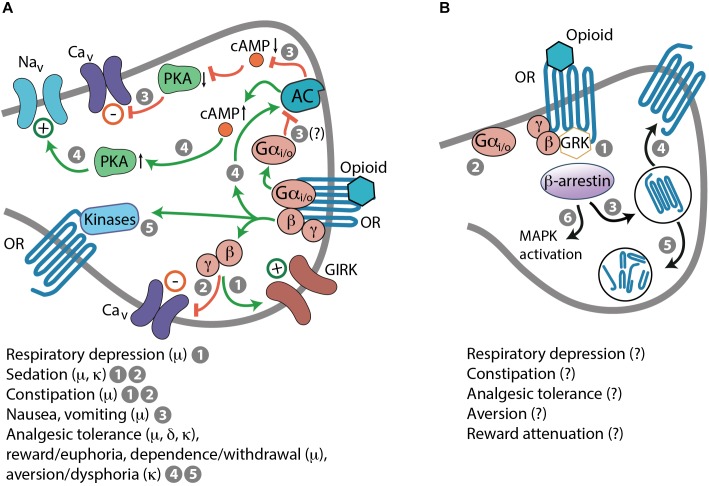
Mechanisms of opioid-induced side effects. (A) G protein-mediated side effects in response to activation of opioid receptors (OR). (1) Respiratory depression: Gβγ-dependent activation of GIRK channels. (1 and 2) Sedation and constipation: Gβγ-dependent activation of GIRK channels (1) and inhibition of Cav channels (2). (3) Nausea and vomiting: Gαi/o-mediated inhibition of AC, decreased cAMP levels and PKA activity, and inhibition of Cav channels; this is based on indirect evidence (indicated by a question mark). (4 and 5) Analgesic tolerance, reward/euphoria, dependence/withdrawal, or aversion/dysphoria: Gβγ-mediated AC activation, elevated cAMP levels, enhanced PKA activity, and activation of Nav channels (4). Phosphorylation of OR by various kinases (5), including PKA and activated by Gβγ PKC, CaMK II, and MAPK, which results in OR uncoupling form G protein-mediated effects. (B) β-arrestin-dependent actions. After even brief activation by an opioid, OR are phosphorylated by GRK recruited by Gβγ, followed by β-arrestin binding to phosphorylated OR (1), which terminates G protein coupling and signaling (2), and leads to OR internalization (3). Dephosphorylated OR can be recycled to the cell membrane (4) or directed to lysosomes and degraded (5). β-arrestin-2 might also promote morphine-induced respiratory depression, constipation, analgesic tolerance, and κ-receptor-mediated aversion, and dampen morphine-induced reward. Some of these effects may involve MAPK activation (6), but mechanisms are unknown (indicated by question marks).
FIGURE 3
FIGURE 3
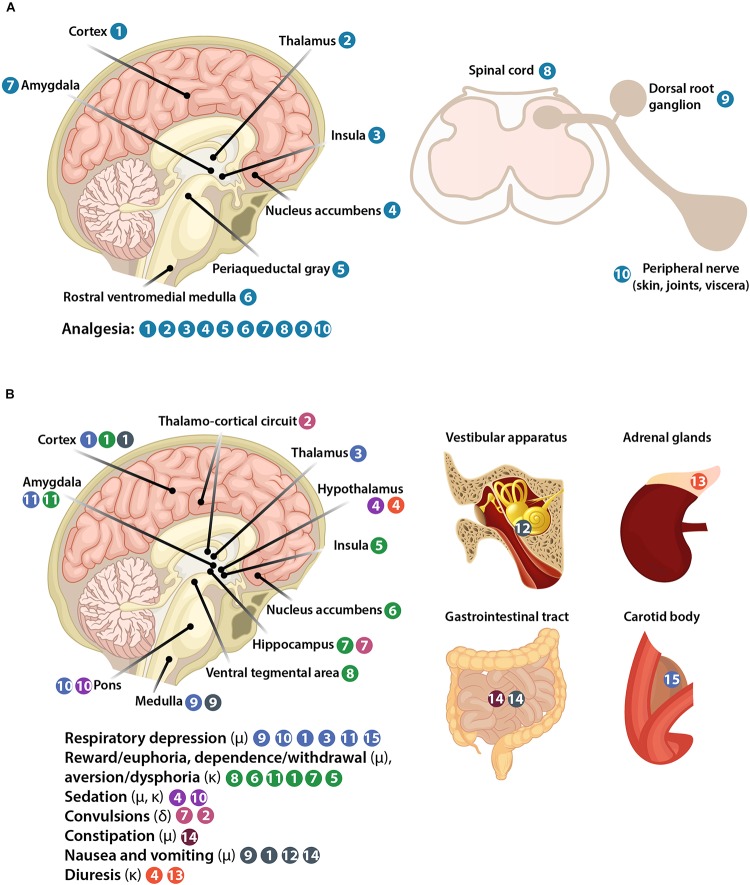
Representation of body structures involved in opioid-induced analgesia (A) and side effects (B).
FIGURE 4
FIGURE 4
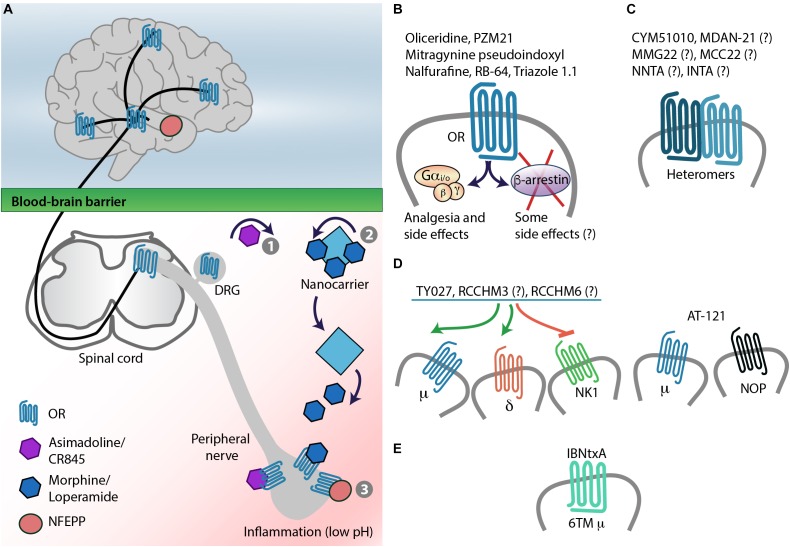
Strategies for safer pain control – targeting opioid receptors. (A) Targeting opioid receptors (OR) in peripheral painful tissue by chemical modification of agonists, which results in their decreased blood-brain barrier penetration (1), nanocarrier-based opioid delivery to inflamed tissue (2), or by low pH-dependent OR activation (3). (B) Biased agonism: This approach aims at targeting OR–G protein signaling without activation of β-arrestins, which were considered to mediate opioid-induced side effects, but not analgesia. This might need reconsideration, since G proteins not only mediate analgesia but also side effects (see also Figure 2A). (C) Targeting heteromers. (D) Development of multifunctional ligands, which act as μ- and δ-opioid receptor agonists and NK1 receptor antagonists, or μ- and NOP-receptor agonists. (E) Targeting truncated, 6TM domain μ-receptor variants. Question marks indicate that heteromer/multiple receptor selectivity of the ligand was not tested or not confirmed (see also Tables 2, 3).
FIGURE 5
FIGURE 5
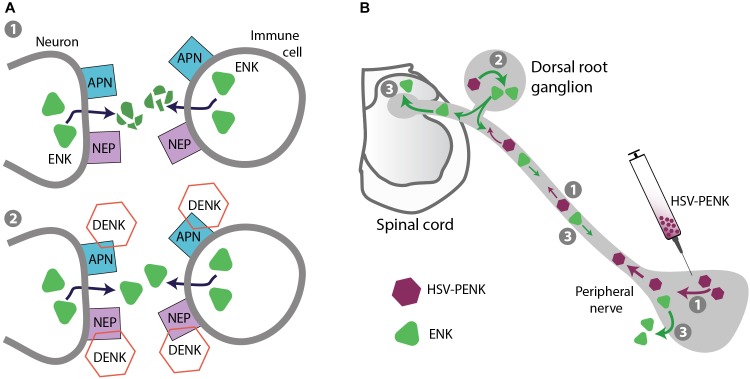
Strategies for safer pain control – targeting endogenous opioid peptides. (A) Prevention of opioid peptide degradation. (1) Opioid peptides, including enkephalins (ENK) are degraded by APN and NEP expressed on neurons (central and peripheral) and immune cells in inflamed tissue. (2) DENK inhibitors block APN and NEP, and prevent ENK degradation to locally alleviate pain. (B) Gene transfer to enhance opioid peptide production in native tissue. As an example, HSV vector encoding ENK precursor PENK injected into peripheral tissue is taken up by peripheral terminals of dorsal root ganglion (DRG) neurons and transported to their cell bodies in DRG (1), where PENK is processed to ENK (2). ENK is then transported to peripheral and central DRG neuron terminals (3), released, and respectively activates peripheral and spinal opioid receptors to produce analgesia.

References

    1. Abdel-Hamid I. A., Andersson K. E., Waldinger M. D., Anis T. H. (2016). Tramadol abuse and sexual function. Sex. Med. Rev. 4 235–246. 10.1016/j.sxmr.2015.10.014 - DOI - PubMed
    1. Akgün E., Javed M. I., Lunzer M. M., Smeester B. A., Beitz A. J., Portoghese P. S. (2013). Ligands that interact with putative MOR-mGluR5 heteromer in mice with inflammatory pain produce potent antinociception. Proc. Natl. Acad. Sci. U.S.A. 110 11595–11599. 10.1073/pnas.1305461110 - DOI - PMC - PubMed
    1. Albert-Vartanian A., Boyd M. R., Hall A. L., Morgado S. J., Nguyen E., Nguyen V. P., et al. (2016). Will peripherally restricted kappa-opioid receptor agonists (pKORAs) relieve pain with less opioid adverse effects and abuse potential? J. Clin. Pharm. Ther. 41 371–382. 10.1111/jcpt.12404 - DOI - PubMed
    1. Al-Hasani R., Bruchas M. R. (2011). Molecular mechanisms of opioid receptor-dependent signaling and behavior. Anesthesiology 155 1363–1381. 10.1097/ALN.0b013e318238bba6 - DOI - PMC - PubMed
    1. Altarifi A. A., David B., Muchhala K. H., Blough B. E., Akbarali H., Negus S. S. (2017). Effects of acute and repeated treatment with the biased mu opioid receptor agonist TRV130 (oliceridine) on measures of antinociception, gastrointestinal function, and abuse liability in rodents. J. Psychopharmacol. 31 730–739. 10.1177/0269881116689257 - DOI - PMC - PubMed

LinkOut - more resources