Efficacy of Mobile Phone-Delivered Smoking Cessation Interventions for Socioeconomically Disadvantaged Individuals: A Randomized Clinical Trial
- PMID: 30556832
- PMCID: PMC6439644
- DOI: 10.1001/jamainternmed.2018.5713
Efficacy of Mobile Phone-Delivered Smoking Cessation Interventions for Socioeconomically Disadvantaged Individuals: A Randomized Clinical Trial
Abstract
Importance: Limited evidence supports mobile phone-delivered cessation interventions for socioeconomically disadvantaged individuals.
Objective: To assess the efficacy of mobile phone-delivered cessation interventions targeted to smokers at neighborhood sites serving racial/ethnic minority and socioeconomically disadvantaged individuals.
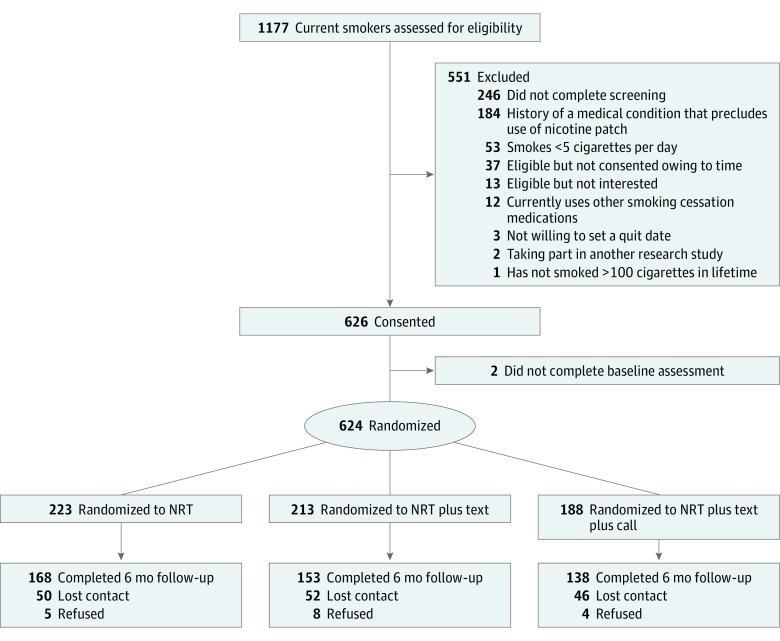
Design, setting, and participants: This group-randomized clinical trial with neighborhood site serving as the sampling unit compared smoking cessation interventions that included (1) nicotine replacement therapy (NRT), (2) NRT plus text messaging, and (3) NRT plus text messaging plus proactive counseling via mobile phone. Recruitment took place at churches, public housing complexes, and community centers located throughout the Houston, Texas, area. A total of 624 current cigarette smokers 18 years or older were enrolled at neighborhood sites from August 13, 2011, through December 12, 2014. Final follow-up was completed on June 12, 2015, and data were analyzed from August 17, 2017, through May 10, 2018, based on intention to treat.
Interventions: Nicotine replacement therapy consisted of transdermal nicotine patches; NRT plus text messages, transdermal nicotine patches and individually tailored mobile phone text messages; and NRT plus text plus call, transdermal patches, individually tailored mobile phone text messages, and proactive counseling via mobile phone.
Main outcomes and measures: The primary outcome was smoking abstinence at 6 months, defined as (1) biochemically verified smoking abstinence (calculated among a subgroup of 377 participants) as determined by saliva cotinine level; and (2) self-reported 30-day abstinence (calculated among all 624 participants).
Results: The study sample included 624 current cigarette smokers (50.6% female; mean [SD] age, 45.8 [12.8] years). Among the 377 participants eligible for biochemical verification, 127 self-reported 30-day abstinence and were asked to provide saliva samples. Of these, 98 samples were returned (participants who did not return samples were coded as smoking). Biochemically verified abstinence rates were 12.0% for NRT, 12.0% for NRT plus text, and 25.5% for NRT plus text plus call. Participants in the NRT plus text plus call group were 2.11 (95% CI, 1.00-4.48) times more likely to be biochemically verified as abstinent compared with the NRT group. No differences in biochemically verified abstinence between the NRT plus text group and the NRT group were observed. Similar associations were observed with the self-report cessation outcomes.
Conclusions and relevance: Findings indicate that assignment to an intervention consisting of text messaging alone may not increase cessation rates for socioeconomically disadvantaged smokers. However, text messaging plus proactive counseling may be an efficacious option.
Trial registration: ClinicalTrials.gov identifier: NCT00948129.
Conflict of interest statement
Figures
Comment in
-
Study evaluates mobile telephone interventions for socioeconomically disadvantaged smokers.CA Cancer J Clin. 2019 May;69(3):164-165. doi: 10.3322/caac.21473. Epub 2019 Mar 11. CA Cancer J Clin. 2019. PMID: 30856675 No abstract available.
References
-
- USDHHS The Health Consequences of Smoking: 50 Years of Progress: A Report of the Surgeon General. Atlanta, GA: US Department of Health and Human Services, Centers for Disease Control and Prevention, National Center for Chronic Disease Prevention and Health Promotion, Office on Smoking and Health; 2014.
-
- Marshall LL, Zhang L, Malarcher AM, Mann NH, King BA, Alexander RL. Race/ethnic variations in quitline use among US adult tobacco users in 45 states, 2011-2013. Nicotine Tob Res. 2017;19(12):1473-1481. - PubMed
Publication types
MeSH terms
Substances
Associated data
Grants and funding
LinkOut - more resources
Full Text Sources
Medical
Miscellaneous