


PR3-ANCA and panel diagnostics in pediatric inflammatory bowel disease to distinguish ulcerative colitis from Crohn's disease
- PMID: 30557305
- PMCID: PMC6296712
- DOI: 10.1371/journal.pone.0208974
PR3-ANCA and panel diagnostics in pediatric inflammatory bowel disease to distinguish ulcerative colitis from Crohn's disease
Abstract
Background: Accurate classification of patients with inflammatory bowel disease into the subtypes ulcerative colitis (UC) and Crohn's disease (CD) is still a challenge, but important for therapy and prognosis.
Objectives: To evaluate the diagnostic utility of anti-neutrophil cytoplasmic antibodies specific for proteinase-3 (PR3-ANCA) for ulcerative colitis (UC) and the value of an antibody panel incorporating PR3-ANCA to differentiate between Crohn's disease (CD) and UC.
Study design: In this cohort study, 122 pediatric and adolescent individuals were retrospectively included (61 IBD patients of two clinical centers, 61 non-IBD controls). All subjects had a comprehensive antibody profile done from stored sera taken close to time of diagnosis. By employing quasi-exhaustive logistic regression the best discriminative model for UC and CD,subjects was determined in a training cohort and confirmed in a validation cohort.
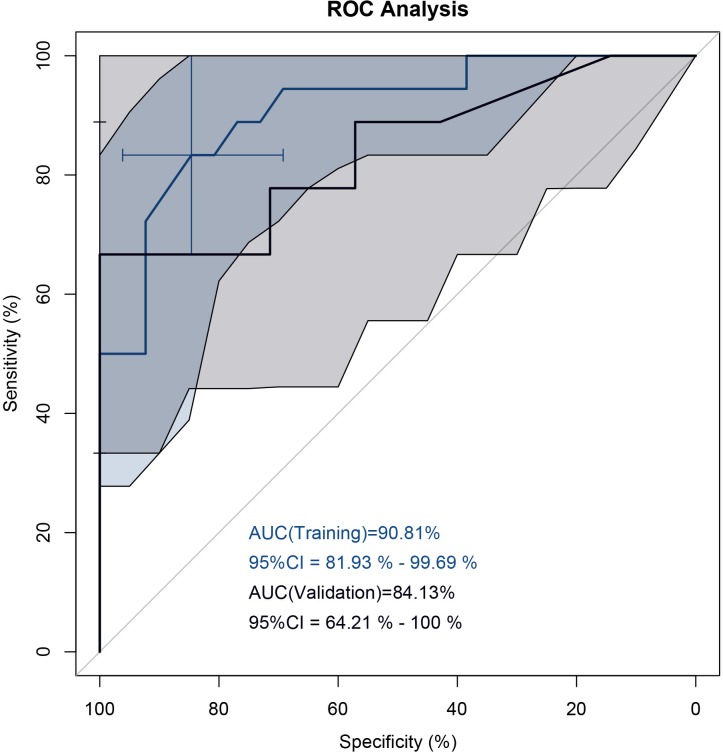
Results: PR3-ANCA was specifically associated with UC (odds ratio (OR), 17.6; 95% confidence interval (CI); 3.6, 87); P < .001). A four antibody-panel including PR3-ANCA had an AUC of 90.81% (95%CI; 81.93, 99.69) to distinguish between UC and CD in the training cohort. In a smaller external validation cohort, the AUC was 84.13% (95%CI; 64.21, 100) for accurate diagnosis of CD and UC.
Conclusion: PR3-ANCA is highly specific for UC. The differentiating capability of a panel, which contains PR3-ANCA and weighs broadly available antibodies, is superior and utilization of the panel can support accurate classification in the work-up of pediatric and adolescent patients with IBD patients.
Conflict of interest statement
The authors have declared that no competing interests exist.
Figures
References
-
- Levine A, de Bie CI, Turner D, Cucchiara S, Sladek M, Murphy MS, et al. (2013) Atypical disease phenotypes in pediatric ulcerative colitis: 5-year analyses of the EUROKIDS Registry. Inflamm Bowel Dis 19: 370–377. 10.1002/ibd.23013 - DOI - PubMed
-
- Carvalho RS, Abadom V, Dilworth HP, Thompson R, Oliva-Hemker M, Cuffari C (2006) Indeterminate colitis: a significant subgroup of pediatric IBD. Inflamm Bowel Dis 12: 258–262. 10.1097/01.MIB.0000215093.62245.b9 - DOI - PubMed
-
- Matsui T, Yao T, Sakurai T, Yao K, Hirai F, Matake H, et al. (2003) Clinical features and pattern of indeterminate colitis: Crohn's disease with ulcerative colitis-like clinical presentation. J Gastroenterol 38: 647–655. 10.1007/s00535-003-1117-8 - DOI - PubMed
-
- Alexander F, Sarigol S, DiFiore J, Stallion A, Cotman K, Clark H, et al. (2003) Fate of the pouch in 151 pediatric patients after ileal pouch anal anastomosis. J Pediatr Surg 38: 78–82. 10.1053/jpsu.2003.50015 - DOI - PubMed
-
- Levine A, Koletzko S, Turner D, Escher JC, Cucchiara S, de Ridder L, et al. (2014) ESPGHAN revised porto criteria for the diagnosis of inflammatory bowel disease in children and adolescents. J Pediatr Gastroenterol Nutr 58: 795–806. 10.1097/MPG.0000000000000239 - DOI - PubMed
