


Peer-assisted learning after onsite, low-dose, high-frequency training and practice on simulators to prevent and treat postpartum hemorrhage and neonatal asphyxia: A pragmatic trial in 12 districts in Uganda
- PMID: 30557350
- PMCID: PMC6296740
- DOI: 10.1371/journal.pone.0207909
Peer-assisted learning after onsite, low-dose, high-frequency training and practice on simulators to prevent and treat postpartum hemorrhage and neonatal asphyxia: A pragmatic trial in 12 districts in Uganda
Abstract
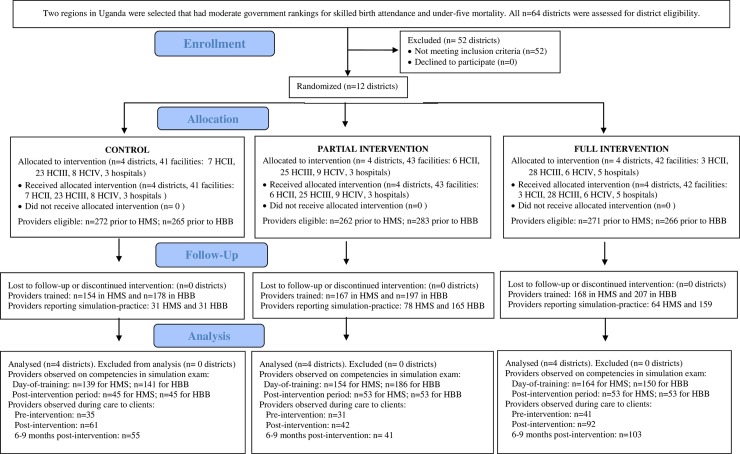
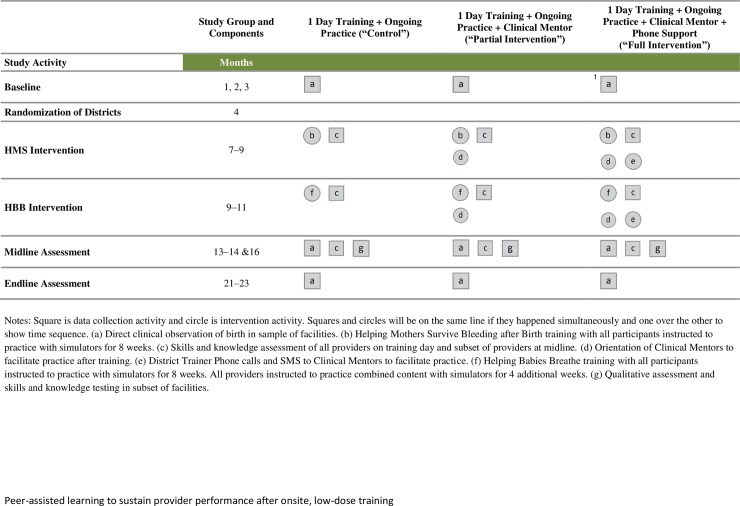
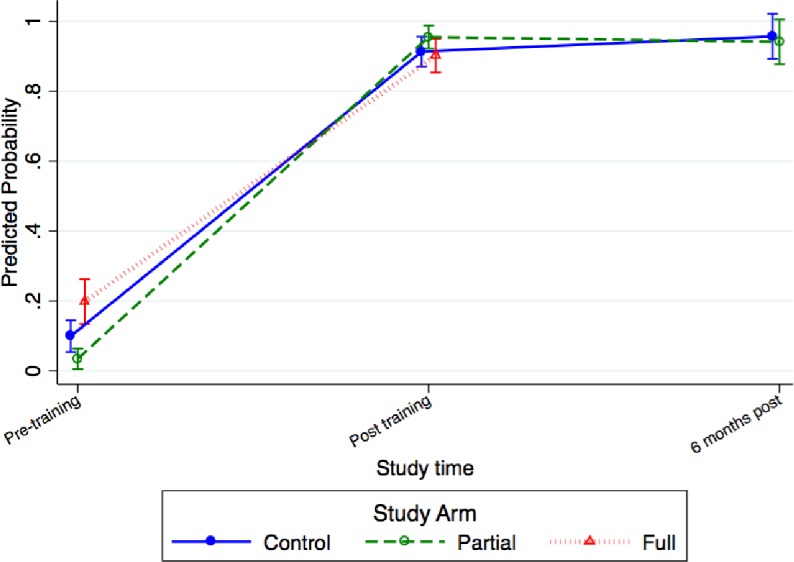
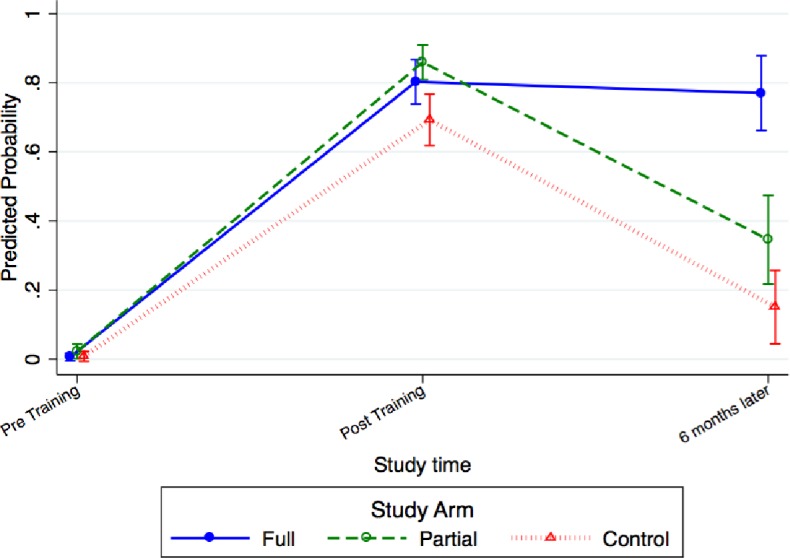
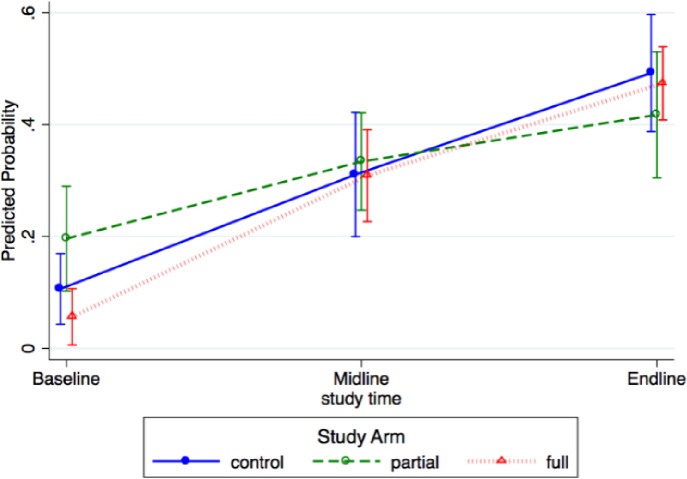
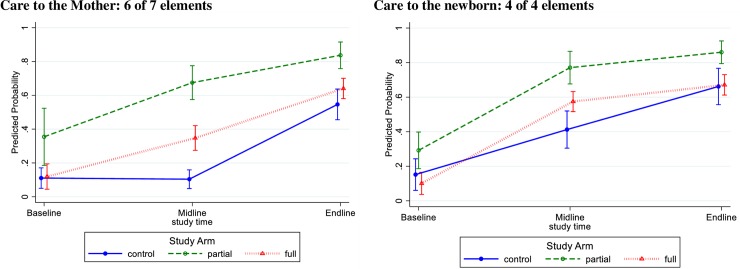
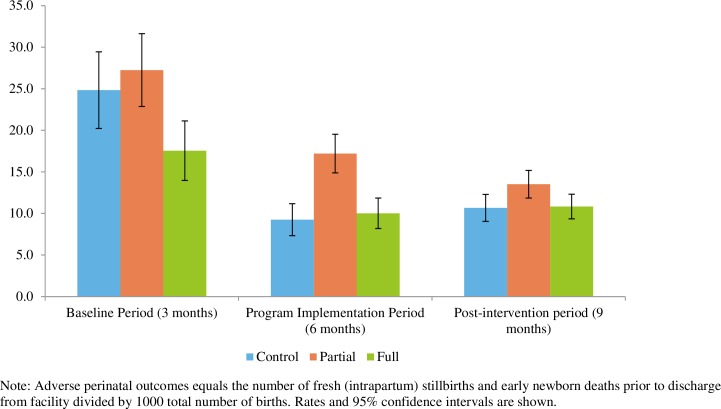
An urgent need exists to improve and maintain intrapartum skills of providers in sub-Saharan Africa. Peer-assisted learning may address this need, but few rigorous evaluations have been conducted in real-world settings. A pragmatic, cluster-randomized trial in 12 Ugandan districts provided facility-based, team training for prevention and management of postpartum hemorrhage and birth asphyxia at 125 facilities. Three approaches to facilitating simulation-based, peer assisted learning were compared. The primary outcome was the proportion of births with uterotonic given within one minute of birth. Outcomes were evaluated using observation of birth and supplemented by skills assessments and service delivery data. Individual and composite variables were compared across groups, using generalized linear models. Overall, 107, 195, and 199 providers were observed at three time points during 1,716 births across 44 facilities. Uterotonic coverage within one minute increased from: full group: 8% (CI 4%‒12%) to 50% (CI 42%‒59%); partial group: 19% (CI 9%‒30%) to 42% (CI 31%‒53%); and control group: 11% (5%‒7%) to 51% (40%‒61%). Observed care of mother and newborn improved in all groups. Simulated skills maintenance for postpartum hemorrhage prophylaxis remained high across groups 7 to 8 months after the intervention. Simulated skills for newborn bag-and-mask ventilation remained high only in the full group. For all groups combined, incidence of postpartum hemorrhage and retained placenta declined 17% and 47%, respectively, from during the intervention period compared to the 6‒9 month period after the intervention. Fresh stillbirths and newborn deaths before discharge decreased by 34% and 62%, respectively, from baseline to after completion, and remained reduced 6‒9 months post-implementation. Significant improvements in uterotonic coverage remained across groups 6 months after the intervention. Findings suggest that while short, simulation-based training at the facility improves care and is feasible, more complex clinical skills used infrequently such as newborn resuscitation may require more practice to maintain skills. Trial Registration: ClinicalTrials.gov NCT03254628.
Conflict of interest statement
CE reports grants from USAID for conduct of the study; grants from Laerdal Foundation for Acute Medicine, outside the submitted work; EB, IA, EW, CH RZ, RN, AM, DM report grants from USAID for conduct of the study. SN reports grants from USAID for conduct of the study and non-financial support from American Academy of Pediatrics, nonfinancial support from International Liaison Committee on Resuscitation, other from USAID outside the submitted work. We confirm that this statement does not alter our adherence to PLOS ONE policies on sharing data and materials.
Figures
References
-
- Kassebaum NJ, Bertozzi-Villa A, Coggeshall MS, Shackelford KA, Steiner C, Heuton KR, et al. Global, regional, and national levels and causes of maternal mortality during 1990–2013: a systematic analysis for the Global Burden of Disease Study 2013. Lancet. 2014;384(9947):980–1004. 10.1016/S0140-6736(14)60696-6 - DOI - PMC - PubMed
-
- Bartlett L, Cantor D, Lynam P, Kaur G, Rawlins B, Ricca J, et al. Facility-based active management of the third stage of labour: assessment of quality in six countries in sub-Saharan Africa. Bull World Health Organ. 2015;93(11):759–67. 10.2471/BLT.14.142604 - DOI - PMC - PubMed
-
- Lawn JE, Blencowe H, Oza S, You D, Lee AC, Waiswa P, et al. Every Newborn: progress, priorities, and potential beyond survival. Lancet. 2014;384(9938):189–205. 10.1016/S0140-6736(14)60496-7 . - DOI - PubMed
-
- Wall SN, Lee AC, Niermeyer S, English M, Keenan WJ, Carlo W, et al. Neonatal resuscitation in low-resource settings: what, who, and how to overcome challenges to scale up? Int J Gynaecol Obstet. 2009;107 Suppl 1:S47–62, S3-4. 10.1016/j.ijgo.2009.07.013 - DOI - PMC - PubMed
-
- Enweronu-Laryea C, Dickson KE, Moxon SG, Simen-Kapeu A, Nyange C, Niermeyer S, et al. Basic newborn care and neonatal resuscitation: a multi-country analysis of health system bottlenecks and potential solutions. BMC Pregnancy Childbirth. 2015;15 Suppl 2:S4 10.1186/1471-2393-15-S2-S4 - DOI - PMC - PubMed
Publication types
MeSH terms
Substances
Associated data
LinkOut - more resources
Full Text Sources
Medical
