


Vascular burden and APOE ε4 are associated with white matter microstructural decline in cognitively normal older adults
- PMID: 30557663
- PMCID: PMC6601608
- DOI: 10.1016/j.neuroimage.2018.12.009
Vascular burden and APOE ε4 are associated with white matter microstructural decline in cognitively normal older adults
Abstract
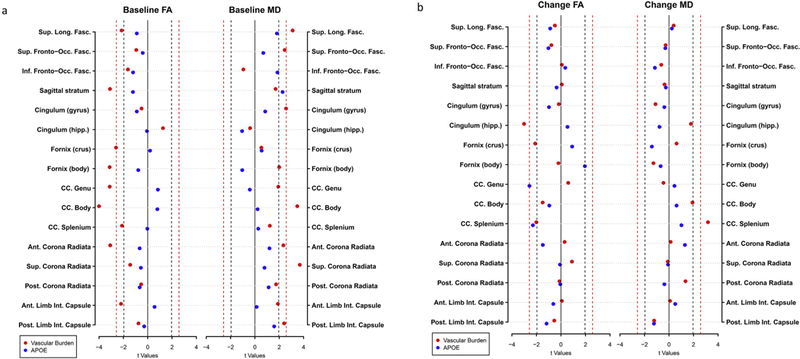
White matter microstructure can be measured with diffusion tensor imaging (DTI). While increasing age is a predictor of white matter (WM) microstructure changes, roles of other possible modifiers, such as cardiovascular risk factors, APOE ε4 allele status and biological sex have not been clarified. We investigated 665 cognitively normal participants from the Baltimore Longitudinal Study of Aging (age 50-95, 56.7% female) with a total of 1384 DTI scans. WM microstructure was assessed by fractional anisotropy (FA) and mean diffusivity (MD). A vascular burden score was defined as the sum of five risk factors (hypertension, obesity, elevated cholesterol, diabetes and smoking status). Linear mixed effects models assessed the association of baseline vascular burden on baseline and on rates of change of FA and MD over a mean follow-up of 3.6 years, while controlling for age, race, and scanner type. We also compared DTI trajectories in APOE ε4 carriers vs. non-carriers and men vs. women. At baseline, higher vascular burden was associated with lower FA and higher MD in many WM structures including association, commissural, and projection fibers. Higher baseline vascular burden was also associated with greater longitudinal decline in FA in the hippocampal part of the cingulum and the fornix (crus)/stria terminalis and splenium of the corpus callosum, and with greater increases in MD in the splenium of the corpus callosum. APOE ε4 carriers did not differ from non-carriers in baseline DTI metrics but had greater decline in FA in the genu and splenium of the corpus callosum. Men had higher FA and lower MD in multiple WM regions at baseline but showed greater increase in MD in the genu of the corpus callosum. Women showed greater decreases over time in FA in the gyrus part of the cingulum, compared to men. Our findings show that modifiable vascular risk factors (1) have a negative impact on white matter microstructure and (2) are associated with faster microstructural deterioration of temporal WM regions and the splenium of the corpus callosum in cognitively normal adults. Reducing vascular burden in aging could modify the rate of WM deterioration and could decrease age-related cognitive decline and impairment.
Keywords: Aging; Apolipoprotein ε4; Diffusion tensor imaging (DTI); Vascular risk factors; White matter microstructure.
Published by Elsevier Inc.
Figures
References
-
- Alexander DC, Pierpaoli C, Basser PJ, Gee JC, 2001. Spatial transformations of diffusion tensor magnetic resonance images. IEEE Trans. Med. Imag. 20 (11). 1131–1139. - PubMed
-
- >American Psychiatric Association, 1987. Diagnostic and Statistical Manual of Mental Health Disorders (DSM-III-R). American Psychiatric Association.
Publication types
MeSH terms
Substances
Grants and funding
LinkOut - more resources
Full Text Sources
Medical
Miscellaneous
