. 2019 Feb;22(2):302-312.
doi: 10.1111/ele.13191. Epub 2018 Dec 17.

C4 anatomy can evolve via a single developmental change

Affiliations

C4 anatomy can evolve via a single developmental change

Marjorie R Lundgren et al. Ecol Lett. 2019 Feb.

Abstract

C4 photosynthesis is a complex trait that boosts productivity in warm environments. Paradoxically, it evolved independently in numerous plant lineages, despite requiring specialised leaf anatomy. The anatomical modifications underlying C4 evolution have previously been evaluated through interspecific comparisons, which capture numerous changes besides those needed for C4 functionality. Here, we quantify the anatomical changes accompanying the transition between non-C4 and C4 phenotypes by sampling widely across the continuum of leaf anatomical traits in the grass Alloteropsis semialata. Within this species, the only trait that is shared among and specific to C4 individuals is an increase in vein density, driven specifically by minor vein development that yields multiple secondary effects facilitating C4 function. For species with the necessary anatomical preconditions, developmental proliferation of veins can therefore be sufficient to produce a functional C4 leaf anatomy, creating an evolutionary entry point to complex C4 syndromes that can become more specialised.

Keywords: Alloteropsis; C3-C4 intermediate; C4 photosynthesis; bundle sheath; evolution; grass; leaf anatomy; mesophyll; vein density.


Figures

Figure 1
Figure 1
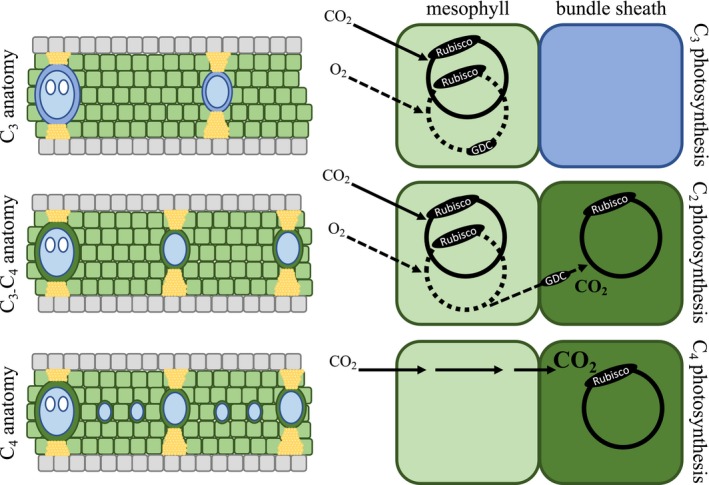
Schematic of leaf anatomy and photosynthetic pathway in C3, C3‐C4 and C4 grasses. In C3 plants, CO 2 assimilation via the Calvin–Benson cycle (solid black circle) and CO 2 release via photorespiration (dashed black circle) both occur in mesophyll cells (light green). C3 leaves consequently have larger areas of mesophyll tissue than bundle sheath tissue, where no photosynthetic activity occurs. C3‐C4 plants use an intermediate physiology called C2 photosynthesis, where the Calvin‐Benson cycle occurs in mesophyll cells, like in C3 plants. However, because glycine decarboxylase (GDC) is specifically localised to bundle sheath cells in these plants, the photorespiratory cycle is split across these two cell types, creating a weak CO 2‐concentrating mechanism, where CO 2 is released in the bundle sheath and can be reassimilated via the Calvin cycle. C2 photosynthesis, therefore, requires large areas of mesophyll for photosynthesis via an initial Calvin‐Benson cycle, but also close contact between mesophyll and bundle sheath cells for the photorespiratory CO 2 pump. C4 plants have a strong CO 2 concentrating mechanism whereby CO 2 is biochemically shuttled from the mesophyll into the bundle sheath. The high CO 2 concentration in the bundle sheath largely avoids oxygenation and thus, photorespiration. Photosynthesis via the C4 cycle therefore requires large areas of bundle sheath tissue, but less mesophyll, which can be achieved via the insertion of minor veins. Dark blue, bundle sheath lacking chloroplasts; dark green, bundle sheaths with chloroplasts; light green, mesophyll cells; yellow, extraxylary fibres/bundle sheath extensions; grey, epidermal cells; light blue, veins; white, metaxylem.
Figure 2
Figure 2
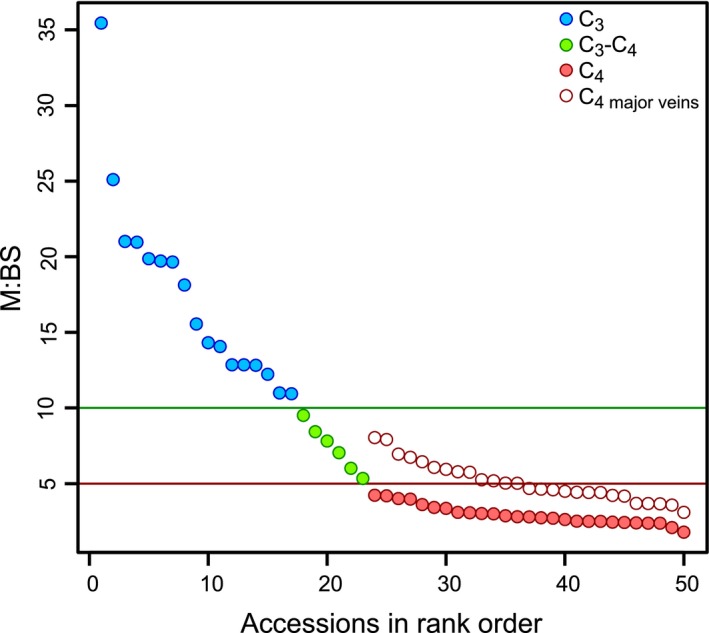
Continuous variation in Alloteropsis semialata leaf anatomy, but distinct division among C3, C3‐C4 and C4 types. Ratios of mesophyll (M) to bundle sheath (BS) area of individual accessions of C3 (blue circles), C3‐C4 (green circles) and C4 (solid red circles) plants, ranked by M:BS value. n = 50. Lines delineating M:BS ratios that distinguish C3 from C3‐C4 (green) and C3‐C4 from C4 (red) are shown. For C4 individuals, M:BS ratios are also calculated in the absence of minor veins (open red circles).
Figure 3
Figure 3
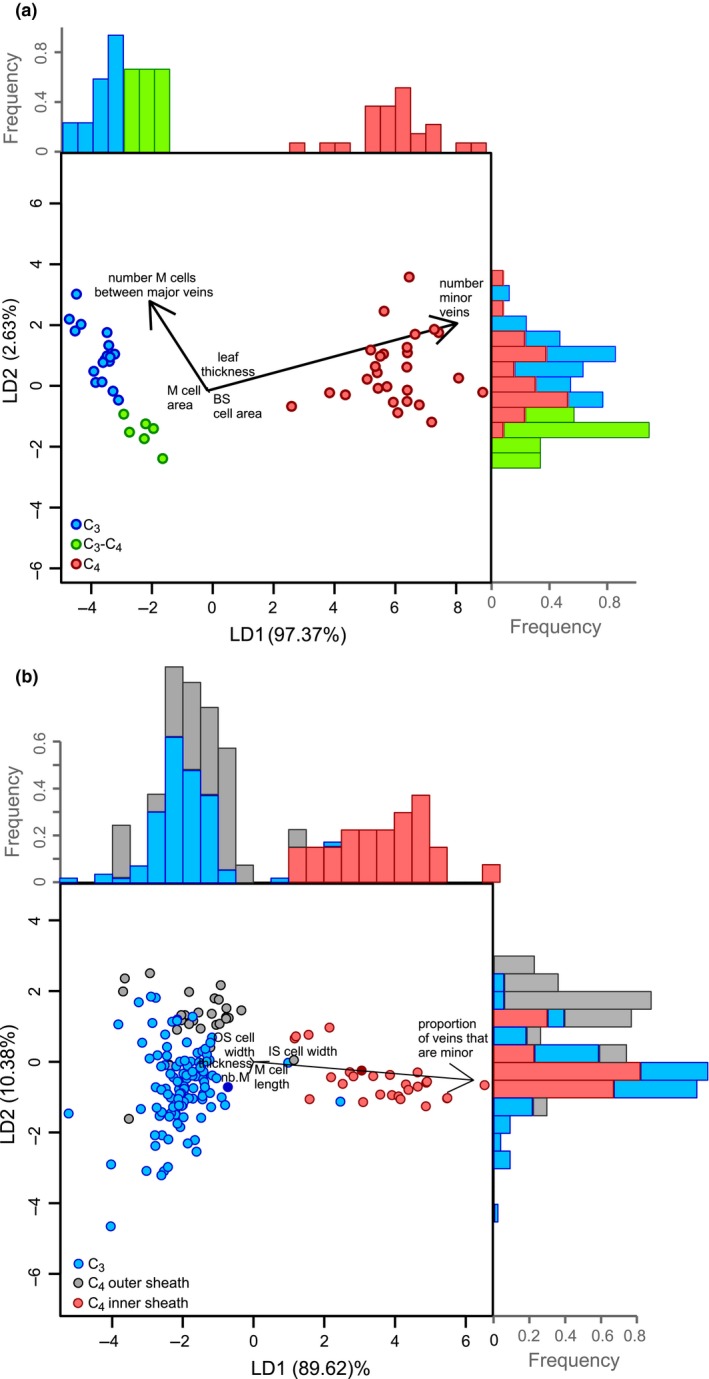
Linear discriminant analysis of leaf anatomical traits. The first (LD1) and second (LD2) dimensions of the LDA are plotted against each other with histograms of each dimension shown on the opposing axis for (a) the LDA on C3, C3‐C4 and C4 Alloteropsis semialata accessions and (b) the LDA on 157 C3, C4 inner sheath and C4 outer sheath grass species. In addition, one C3 and one C4 A. semialata accession were included in this larger LDA and are denoted by solid blue and red circles respectively. Loading plots are overlaid via black arrows. M, mesophyll; IS, inner sheath; OS, outer sheath; nb.M, number of mesophyll cells between veins.
Figure 4
Figure 4
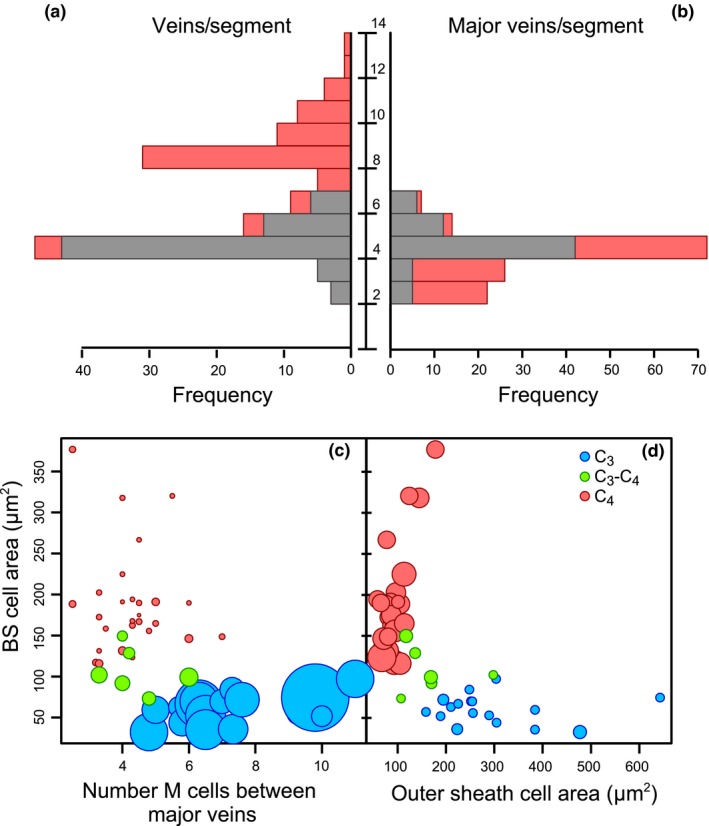
Diversity of intraspecific anatomical components. Histograms of (a) vein density (i.e., the total number of veins per segment) and (b) the number of major veins per segment in C4 (red; n = 72) and non‐C4 (grey, n = 69) accessions. Scatter plots show (c) the average number of mesophyll (M) cells between major veins vs. the average area of individual bundle sheath (BS) cells, with dot size proportional to the M:BS ratio, and (d) BS cell area vs. outer sheath cell area, with dot size proportional to the number of veins per segment. Colours indicate photosynthetic type with C3 (blue; n = 17), C3‐C4 (green; n = 6) and C4 (red; n = 27).

References

    1. Bellasio, C. & Lundgren, M.R. (2016). Anatomical constraints to C4 evolution: light harvesting capacity in the bundle sheath. New Phytol., 212, 485–496. - PubMed
    1. Bellasio, C. , Beerling, D.J. & Griffiths, H. (2016a). An Excel tool for deriving key photosynthetic parameters from combined gas exchange and chlorophyll fluorescence: theory and practice. Plant, Cell Environ., 39, 1180–1197. - PubMed
    1. Bellasio, C. , Beerling, D.J. & Griffiths, H. (2016b). Deriving C4 photosynthetic parameters from combined gas exchange and chlorophyll fluorescence using an Excel tool: theory and practice. Plant, Cell Environ., 39, 1164–1179. - PubMed
    1. Bräutigam, A. & Gowik, U. (2016). Photorespiration connects C3 and C4 photosynthesis. J. Exp. Bot., 67, 2953–2962. - PubMed
    1. Bräutigam, A. , Schluter, U. , Lundgren, M.R. , Flachbart, S. , Ebenhoh, O. , Schonknecht, G. et al (2018). Biochemical mechanisms driving rapid fluxes in C4 photosynthesis. bioRxiv, 387431.