


Do Androgens Modulate the Pathophysiological Pathways of Inflammation? Appraising the Contemporary Evidence
- PMID: 30558178
- PMCID: PMC6306858
- DOI: 10.3390/jcm7120549
Do Androgens Modulate the Pathophysiological Pathways of Inflammation? Appraising the Contemporary Evidence
Abstract
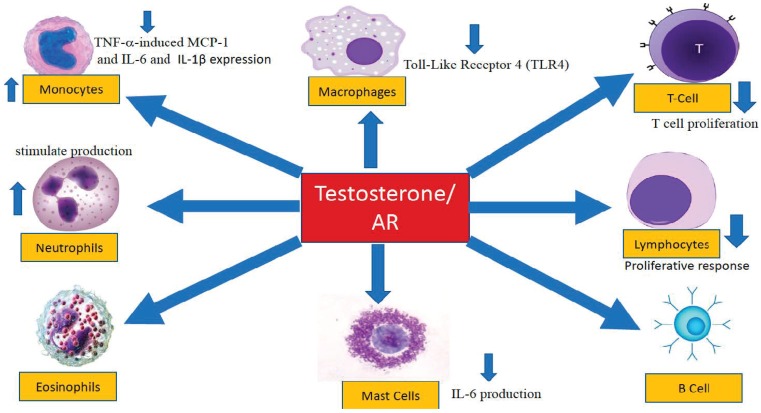
The role of testosterone in the pathophysiology of inflammation is of critical clinical importance; however, no universal mechanism(s) has been advanced to explain the complex and interwoven pathways of androgens in the attenuation of the inflammatory processes. PubMed and EMBASE searches were performed, including the following key words: "testosterone", "androgens", "inflammatory cytokines", "inflammatory biomarkers" with focus on clinical studies as well as basic scientific studies in human and animal models. Significant benefits of testosterone therapy in ameliorating or attenuating the symptoms of several chronic inflammatory diseases were reported. Because anti⁻tumor necrosis factor therapy is the mainstay for the treatment of moderate-to-severe inflammatory bowel disease; including Crohn's disease and ulcerative colitis, and because testosterone therapy in hypogonadal men with chronic inflammatory conditions reduce tumor necrosis factor-alpha (TNF-α), IL-1β, and IL-6, we suggest that testosterone therapy attenuates the inflammatory process and reduces the burden of disease by mechanisms inhibiting inflammatory cytokine expression and function. Mechanistically, androgens regulate the expression and function of inflammatory cytokines, including TNF-α, IL-1β, IL-6, and CRP (C-reactive protein). Here, we suggest that testosterone regulates multiple and overlapping cellular and molecular pathways involving a host of immune cells and biochemical factors that converge to contribute to attenuation of the inflammatory process.
Keywords: C-reactive protein; chronic inflammatory diseases; interleukin-1 beta; interleukin-6; testosterone; tumor necrosis factor-alpha.
Conflict of interest statement
The authors declare no conflict of interest.
Figures

References
-
- Ashley N.T., Weil Z.M., Nelson R.J. Inflammation: Mechanisms, Costs, and Natural Variation. Annu. Rev. Ecol. Evol. Syst. 2012;43:385–406. doi: 10.1146/annurev-ecolsys-040212-092530. - DOI
-
- Miligkos M., Papamichael K., Vande Casteele N., Mantzaris G.J., Giles A., Levesque B.G., Zintzaras E. Efficacy and safety profile of anti-tumor necrosis factor-α versus anti-integrin agents for the treatment of Crohn’s disease: A network meta-analysis of indirect comparisons. Clin. Ther. 2016;38:1342–1358. doi: 10.1016/j.clinthera.2016.03.018. - DOI - PubMed
-
- Choy E.H., Bernasconi C., Aassi M., Molina J.F., Epis O.M. Treatment of Rheumatoid Arthritis With Anti–Tumor Necrosis Factor or Tocilizumab Therapy as First Biologic Agent in a Global Comparative Observational Study. Arthritis Care Res. 2017;69:1484–1494. doi: 10.1002/acr.23303. - DOI - PMC - PubMed
Publication types
LinkOut - more resources
Full Text Sources
Other Literature Sources
Research Materials
Miscellaneous
