


Strategies for improving physician documentation in the emergency department: a systematic review
- PMID: 30558573
- PMCID: PMC6297955
- DOI: 10.1186/s12873-018-0188-z
Strategies for improving physician documentation in the emergency department: a systematic review
Abstract
Background: Physician chart documentation can facilitate patient care decisions, reduce treatment errors, and inform health system planning and resource allocation activities. Although accurate and complete patient chart data supports quality and continuity of patient care, physician documentation often varies in terms of timeliness, legibility, clarity and completeness. While many educational and other approaches have been implemented in hospital settings, the extent to which these interventions can improve the quality of documentation in emergency departments (EDs) is unknown.
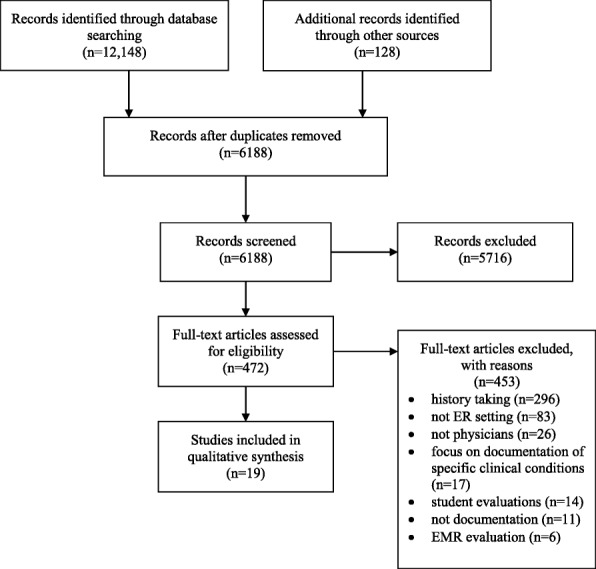
Methods: We conducted a systematic review to assess the effectiveness of approaches to improve ED physician documentation. Peer reviewed electronic databases, grey literature sources, and reference lists of included studies were searched to March 2015. Studies were included if they reported on outcomes associated with interventions designed to enhance the quality of physician documentation.
Results: Nineteen studies were identified that report on the effectiveness of interventions to improve physician documentation in EDs. Interventions included audit/feedback, dictation, education, facilitation, reminders, templates, and multi-interventions. While ten studies found that audit/feedback, dictation, pharmacist facilitation, reminders, templates, and multi-pronged approaches did improve the quality of physician documentation across multiple outcome measures, the remaining nine studies reported mixed results.
Conclusions: Promising approaches to improving physician documentation in emergency department settings include audit/feedback, reminders, templates, and multi-pronged education interventions. Future research should focus on exploring the impact of implementing these interventions in EDs with and without emergency medical record systems (EMRs), and investigating the potential of emerging technologies, including EMR-based machine-learning, to promote improvements in the quality of ED documentation.
Keywords: Documentation; Emergency departments; Medical records; Physicians; Systematic reviews.
Conflict of interest statement
Ethics approval and consent to participate
Not Applicable.
Competing interests
The authors declare that they have no competing interests.
Publisher’s Note
Springer Nature remains neutral with regard to jurisdictional claims in published maps and institutional affiliations.
References
-
- Physician Documentation Expert Panel . A guide to better physician documentation. Toronto: Ontario Ministry of Health and Long-Term Care; 2006.
-
- Kripalani S, LeFevre F, Phillips CO, Williams MV, Basaviah P, Baker DW. Deficits in communication and information transfer between hospital-based and primary care physicians: implications for patient safety and continuity of care. JAMA. 2007;297(8):831–841. doi: 10.1001/jama.297.8.831. - DOI - PubMed
Publication types
MeSH terms
Grants and funding
LinkOut - more resources
Full Text Sources
Other Literature Sources
