


Dietary behaviors throughout childhood are associated with adiposity and estimated insulin resistance in early adolescence: a longitudinal study
- PMID: 30558613
- PMCID: PMC6296122
- DOI: 10.1186/s12966-018-0759-0
Dietary behaviors throughout childhood are associated with adiposity and estimated insulin resistance in early adolescence: a longitudinal study
Abstract
Background: Despite the growing prevalence of excess weight and prediabetes in children, the contributing role of dietary behaviors throughout childhood remains poorly understood. We examined longitudinal associations of dietary behaviors throughout childhood with adiposity and estimated insulin resistance (HOMA-IR) in adolescence.
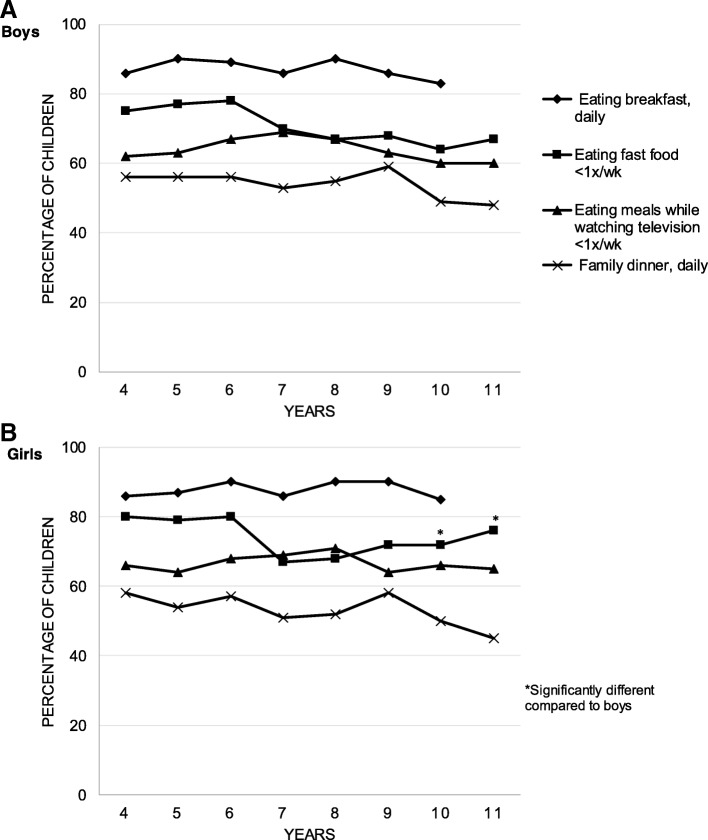
Methods: Among 995 children from Project Viva, a pre-birth cohort, we examined associations of child dietary behaviors (frequency of eating breakfast, fast food, family dinner, and eating meals while watching television) reported annually throughout childhood (from ages 4 to 11 years) with body mass index z-score (BMI-z; n = 991), waist circumference (WC; n = 995), DXA overall and central adiposity measurements (n = 721), and HOMA-IR (n = 579) in early adolescence (13.2 ± 0.9 years old). We used mixed effects models adjusted for potential confounders.
Results: Eating breakfast daily throughout childhood was associated with lower BMI-z and DXA-measured overall and central adiposity in boys and girls (e.g. for whole-body fat %: β - 1.43% [95% CI: -2.42, - 0.45] and - 1.47% [- 2.25, - 0.68]), and with lower HOMA-IR in boys (% difference - 15.6% [- 22.7, - 7.9]). Daily family dinner and eating fast food less than once per week throughout childhood were both associated with lower BMI-z and adiposity in girls (for BMI-z: β - 0.17 units [- 0.24, - 0.11] and β - 0.09 units [- 0.17, - 0.02]) and lower insulin resistance in boys (% difference - 7.3% [- 12.4,- 1.8] and - 7.6% [- 13.2, - 1.7]). Finally, eating meals while watching television < 1/week throughout childhood was associated with lower adolescent adiposity (e.g. WC: - 1.55 cm [- 2.39, - 0.71]) and HOMA-IR (% difference: - 10.7% [- 15.8, - 5.2]) in boys.
Conclusion: Healthful dietary behaviors throughout childhood are associated with less adiposity and lower estimated insulin resistance in early adolescence.
Trial registration: NCT02820402.
Keywords: Adiposity; Adolescence; Breakfast; Childhood; Dietary behaviors; Family dinner; Fast-food; Insulin resistance; Television.
Conflict of interest statement
Ethics approval and consent to participate
The institutional review board of Harvard Pilgrim Health Care approved this study and all procedures were in accordance with the ethical standards for human experimentation established by the Declaration of Helsinki. All women provided written informed consent at enrollment and each postnatal follow-up visit and children provided assent at the early adolescent visit.
Consent for publication
Not applicable.
Competing interests
The authors declare that they have no competing interests.
Publisher’s Note
Springer Nature remains neutral with regard to jurisdictional claims in published maps and institutional affiliations.
Figures
References
Publication types
MeSH terms
Associated data
Grants and funding
LinkOut - more resources
Full Text Sources
Medical
