


Estimating the proportion of bystander selection for antibiotic resistance among potentially pathogenic bacterial flora
- PMID: 30559213
- PMCID: PMC6304942
- DOI: 10.1073/pnas.1810840115
Estimating the proportion of bystander selection for antibiotic resistance among potentially pathogenic bacterial flora
Abstract
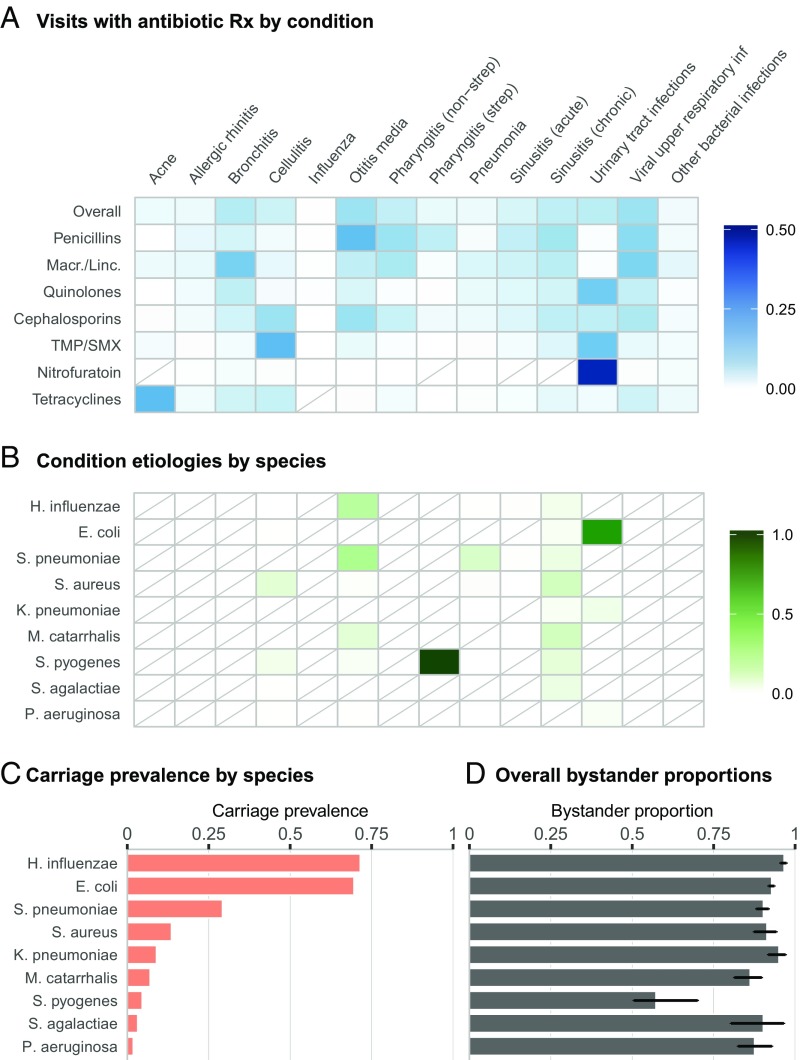
Bystander selection-the selective pressure for resistance exerted by antibiotics on microbes that are not the target pathogen of treatment-is critical to understanding the total impact of broad-spectrum antibiotic use on pathogenic bacterial species that are often carried asymptomatically. However, to our knowledge, this effect has never been quantified. We quantify bystander selection for resistance for a range of clinically relevant antibiotic-species pairs as the proportion of all antibiotic exposures received by a species for conditions in which that species was not the causative pathogen ("proportion of bystander exposures"). Data sources include the 2010-2011 National Ambulatory Medical Care Survey and National Hospital Ambulatory Medical Care Survey, the Human Microbiome Project, and additional carriage and etiological data from existing literature. For outpatient prescribing in the United States, we find that this proportion over all included antibiotic classes is over 80% for eight of nine organisms of interest. Low proportions of bystander exposure are often associated with infrequent bacterial carriage or concentrated prescribing of a particular antibiotic for conditions caused by the species of interest. Applying our results, we roughly estimate that pneumococcal conjugate vaccination programs result in nearly the same proportional reduction in total antibiotic exposures of Streptococcus pneumoniae, Staphylococcus aureus, and Escherichia coli, despite the latter two organisms not being targeted by the vaccine. These results underscore the importance of considering antibiotic exposures of bystanders, in addition to the target pathogen, in measuring the impact of antibiotic resistance interventions.
Keywords: antibiotic resistance; microbiome; vaccines.
Conflict of interest statement
Conflict of interest statement: M.L. has received consulting income from Affinivax, Antigen Discovery, Merck, and Pfizer and research grants through Harvard School of Public Health from Pfizer and PATH.
Figures
References
-
- Sullivan A, Edlund C, Nord CE. Effect of antimicrobial agents on the ecological balance of human microflora. Lancet Infect Dis. 2001;1:101–114. - PubMed
-
- Gustafsson I, et al. Bacteria with increased mutation frequency and antibiotic resistance are enriched in the commensal flora of patients with high antibiotic usage. J Antimicrob Chemother. 2003;52:645–650. - PubMed
-
- Lindgren M, Löfmark S, Edlund C, Huovinen P, Jalava J. Prolonged impact of a one-week course of clindamycin on Enterococcus spp. in human normal microbiota. Scand J Infect Dis. 2009;41:215–219. - PubMed
-
- Nyberg SD, et al. Long-term antimicrobial resistance in Escherichia coli from human intestinal microbiota after administration of clindamycin. Scand J Infect Dis. 2007;39:514–520. - PubMed
-
- Fireman B, et al. Impact of the pneumococcal conjugate vaccine on otitis media. Pediatr Infect Dis J. 2003;22:10–16. - PubMed
Publication types
MeSH terms
Substances
Grants and funding
LinkOut - more resources
Full Text Sources
Medical
