


Utility of threshold tracking transcranial magnetic stimulation in ALS
- PMID: 30560220
- PMCID: PMC6275211
- DOI: 10.1016/j.cnp.2018.10.002
Utility of threshold tracking transcranial magnetic stimulation in ALS
Abstract
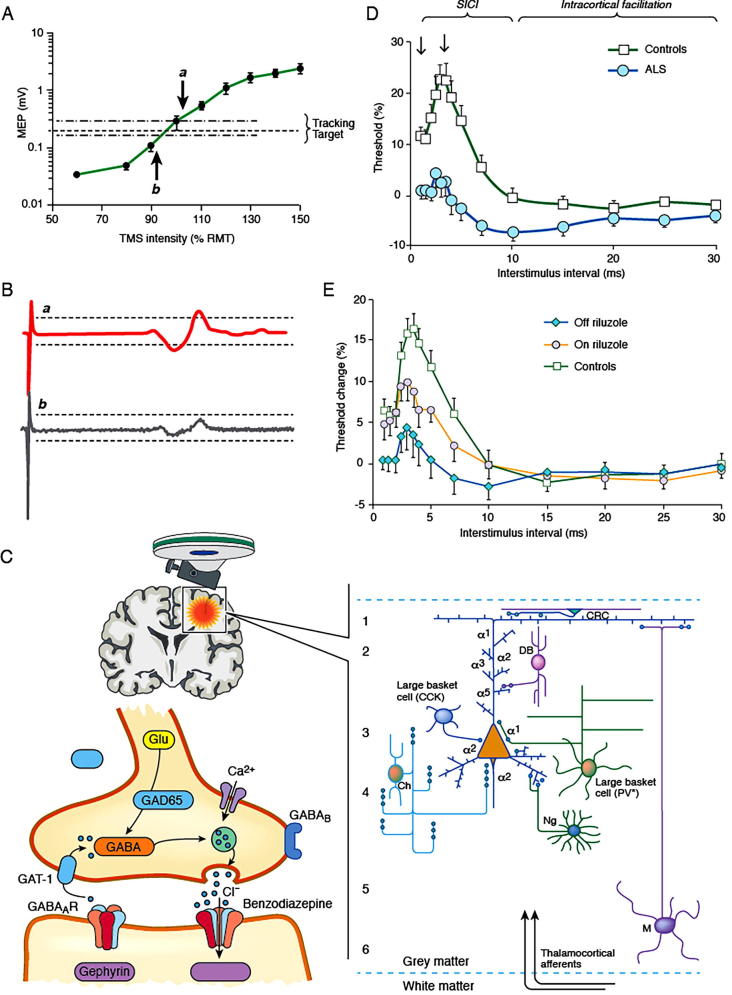
Upper motor neuron [UMN] and lower motor neuron [LMN] dysfunction, in the absence of sensory features, is a pathognomonic feature of amyotrophic lateral sclerosis [ALS]. Although the precise mechanisms have yet to be elucidated, one leading hypothesis is that UMN precede LMN dysfunction, which is induced by anterograde glutamatergic excitotoxicity. Transcranial magnetic stimulation (TMS) is a neurophysiological tool that provides a non-invasive and painless assessment of cortical function. Threshold tracking methodologies have been recently adopted for TMS, whereby changes in threshold rather than motor evoked potential (MEP) amplitude serve as outcome measures. This technique is reliable and provides a rapid assessment of cortical function in ALS. Utilisng the threshold tracking TMS technique, cortical hyperexcitability was demonstrated as an early feature in sporadic ALS preceding the onset of LMN dysfunction and possibly contributing to disease spread. Separately, cortical hyperexcitability was reported to precede the clinical onset of familial ALS. Of further relevance, the threshold tracking TMS technique was proven to reliably distinguish ALS from mimicking disorders, even in the presence of a comparable degree of LMN dysfunction, suggesting a diagnostic utility of TMS. Taken in total, threshold tracking TMS has provided support for a cortical involvement at the earliest detectable stages of ALS, underscoring the utility of the technique for probing the underlying pathophysiology. The present review will discuss the physiological processes underlying TMS parameters, while further evaluating the pathophysiological and diagnostic utility of threshold tracking TMS in ALS.
Keywords: Amyotrophic lateral sclerosis; Cortical hyperexcitability; Threshold tracking TMS.
Figures
References
-
- Agarwal S., Highton-Williamson E., Caga J., Matamala J.M., Dharmadasa T., Howells J. Primary lateral sclerosis and the amyotrophic lateral sclerosis-frontotemporal dementia spectrum. J. Neurol. 2018;265:1819–1828. - PubMed
-
- Amassian V.E., Stewart M., Quirk G.J., Rosenthal J.L. Physiological basis of motor effects of a transient stimulus to cerebral cortex. Neurosurgery. 1987;20:74–93. - PubMed
-
- Attarian S., Azulay J.P., Lardillier D., Verschueren A., Pouget J. Transcranial magnetic stimulation in lower motor neuron diseases. Clin. Neurophysiol. 2005;116:35–42. - PubMed
-
- Awiszus F., Feistner H., Urbach D., Bostock H. Characterisation of paired-pulse transcranial magnetic stimulation conditions yielding intracortical inhibition or I-wave facilitation using a threshold-hunting paradigm. Exp. Brain Res. 1999;129:317–324. - PubMed
Publication types
LinkOut - more resources
Full Text Sources
Research Materials
Miscellaneous
