


Lung Function in Young Adults and Risk of Cardiovascular Events Over 29 Years: The CARDIA Study
- PMID: 30561252
- PMCID: PMC6405620
- DOI: 10.1161/JAHA.118.010672
Lung Function in Young Adults and Risk of Cardiovascular Events Over 29 Years: The CARDIA Study
Abstract
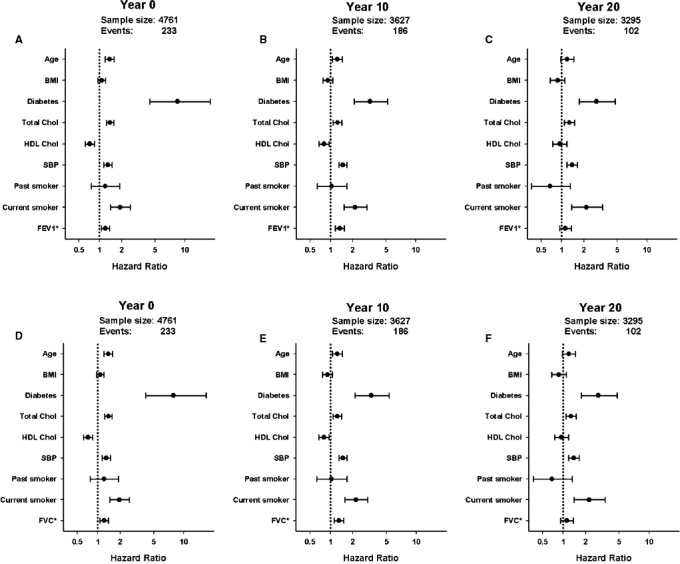
Background Diminished peak lung function in young adulthood is a risk factor for future chronic obstructive pulmonary disease. The association between lung disease and cardiovascular disease later in life is well documented. Whether peak lung function measured in young adulthood is associated with risk of future cardiovascular events is unknown. Methods and Results CARDIA (The Coronary Artery Risk Development in Young Adults) study is a prospective, multicenter, community-based, longitudinal cohort study including 4761 participants aged 18 to 30 years with lung function testing we investigated the association between lung health in young adulthood and risk of subsequent cardiovascular events. We performed Cox proportional hazards regression to test the association between baseline and years 10 and 20 pulmonary function with incident cardiovascular events. Linear and logistic regression was performed to explore the associations of lung function with development of risk factors for cardiovascular disease as well as carotid intima-media thickness and coronary artery calcified plaque. At baseline, mean age (± SD ) was 24.9±3.6 years. Baseline forced expiratory volume in 1 second (hazard ratio) per -10-unit decrement in percent predicted forced expiratory volume in 1 second (hazard ratio, 1.18; 95% CI, 1.06-1.31 [ P=0.002]) and FVC per -10-unit decrement in percent predicted FVC (hazard ratio, 1.19; 95% CI, 1.06-1.33 [ P=0.003]) were associated with future cardiovascular events independent of traditional cardiovascular risk factors. Baseline lung function was associated with heart failure and cerebrovascular events but not coronary artery disease events. Conclusions Lung function in young adulthood is independently associated with cardiovascular events into middle age. This association appears to be driven by heart failure and cerebrovascular events rather than coronary heart disease. Clinical Trial Registration URL : https://www.clinicaltrials.gov . Unique identifier: NCT 00005130.
Keywords: cardiac disease; heart failure; lung; pulmonary; pulmonary heart disease.
Figures
References
-
- Mannino DM, Holguin F, Pavlin BI, Ferdinands JM. Risk factors for prevalence of and mortality related to restriction on spirometry: findings from the first national health and nutrition examination survey and follow‐up. Int J Tuberc Lung Dis. 2005;9:613–621. - PubMed
-
- Duprez DA, Hearst MO, Lutsey PL, Herrington DM, Ouyang P, Barr RG, Bluemke DA, McAllister D, Carr JJ, Jacobs DR Jr. Associations among lung function, arterial elasticity, and circulating endothelial and inflammation markers: the multiethnic study of atherosclerosis. Hypertension. 2013;61:542–548. - PMC - PubMed
-
- Ford ES, Wheaton AG, Mannino DM, Presley‐Cantrell L, Li C, Croft JB. Elevated cardiovascular risk among adults with obstructive and restrictive airway functioning in the United States: a cross‐sectional study of the National Health and Nutrition Examination Survey from 2007–2010. Respir Res. 2012;13:115. - PMC - PubMed
-
- Curkendall SM, DeLuise C, Jones JK, Lanes S, Stang MR, Goehring E Jr, She D. Cardiovascular disease in patients with chronic obstructive pulmonary disease, Saskatchewan Canada cardiovascular disease in COPD patients. Ann Epidemiol. 2006;16:63–70. - PubMed
-
- Sin DD, Wu L, Man SF. The relationship between reduced lung function and cardiovascular mortality: a population‐based study and a systematic review of the literature. Chest. 2005;127:1952–1959. - PubMed
Publication types
MeSH terms
Grants and funding
LinkOut - more resources
Full Text Sources
Medical
